
AI citation ranking factors
AI citation ranking factors are the signals that influence whether AI search engines like ChatGPT, Gemini, Perplexity, and AI Overviews cite your content when answering user queries. This guide is based on Cyrus Shepard’s Zyppy Signal analysis of AI citation ranking factors, which scored 23 factors from evidence across experiments, patents, and case studies. The highest-scoring signals in Zyppy’s research were URL accessibility (9.5), traditional search rank (9.4), fan-out rank (9.3), preview control (9.2), and query-answer match (9.2).
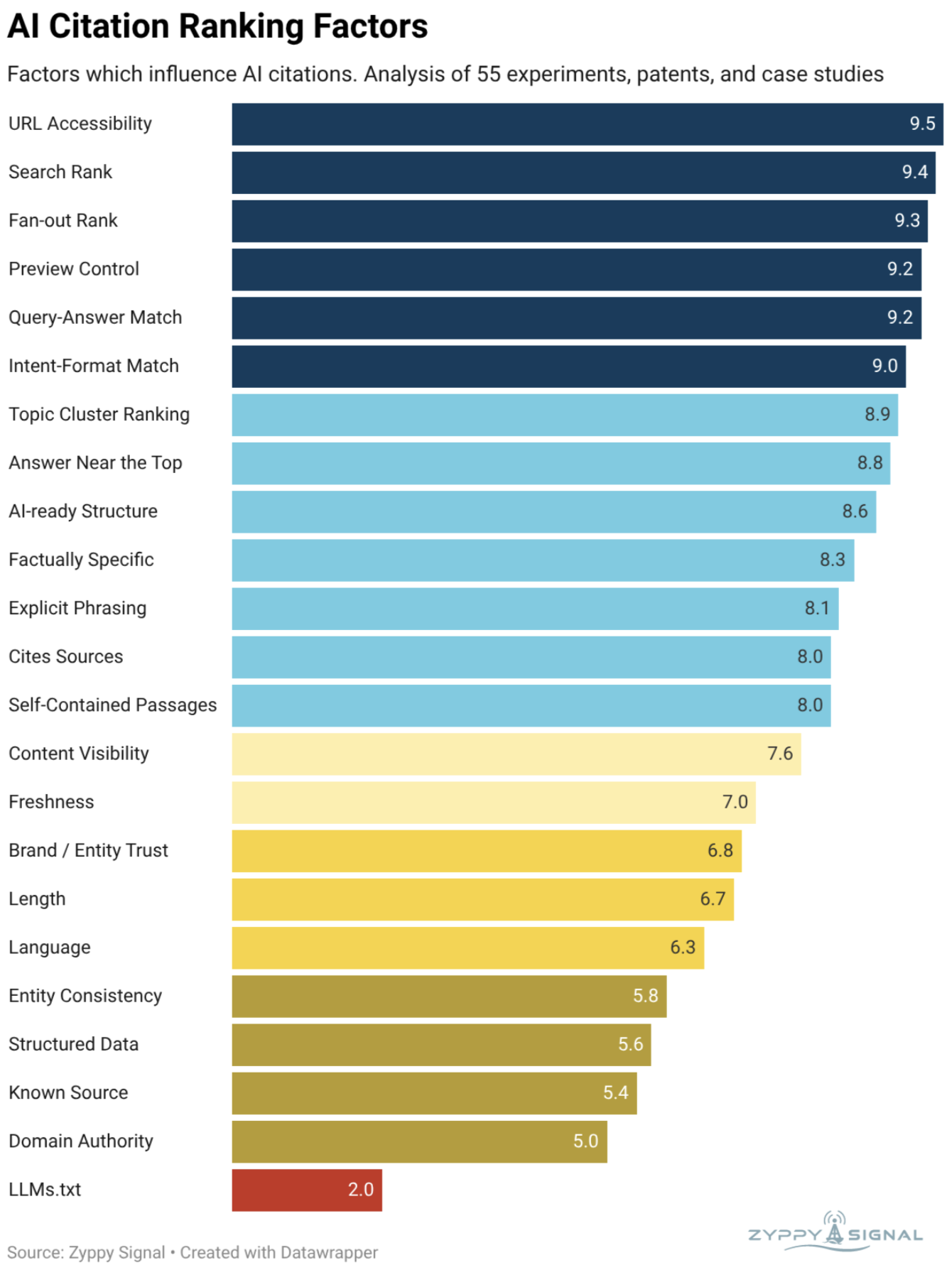
We are treating Zyppy’s work as the source dataset here, not as a vague “best practices” list. Cyrus Shepard’s analysis is useful because it separates high-evidence citation factors from lower-impact signals like LLMs.txt, then gives marketers a practical way to prioritize what to fix first. AEO Engine’s AI Citation Readiness Tool translates that research direction into a URL-level diagnostic for answer match, source clarity, semantic structure, schema, citation support, and entity trust.
The core pattern centers on four pillars: relevance to the specific query, trustworthiness of the source, topical authority within your subject area, and extractability of information. Pages that score high across these dimensions are better positioned for citation than pages optimized only for traditional search visibility. Most importantly, AI engines evaluate content structure differently; they tend to reward self-contained passages, explicit phrasing, and factual specificity over keyword density.
Why AI citations matter now
AI search traffic represents the fastest-growing segment of organic discovery, as AI answer engines increasingly change how users discover brands. When ChatGPT or Perplexity cites your content, users receive your brand name, key information, and often a direct link, creating a new form of high-intent referral traffic that bypasses traditional search result pages entirely.
The business impact extends beyond traffic metrics. AI citations establish your brand as an authoritative source within specific topic clusters, creating compounding visibility effects. When AI engines consistently cite your content for related queries, they build associative patterns that increase future citation probability. This creates a competitive moat that becomes harder for competitors to penetrate over time.
Most brands still optimize exclusively for Google’s traditional ranking factors, missing this emerging opportunity. Early adopters who align their content strategy with Answer Engine Optimization Services requirements are capturing disproportionate market share in their categories. Brands that establish citation dominance now will maintain significant advantages as AI search adoption accelerates.
The core pattern: relevance, trust, topical authority, and extractability

Every high-performing AI citation follows a predictable pattern across four dimensions. Relevance means your content directly answers the specific query with precision, not just covering the general topic. Trust encompasses both domain credibility and content accuracy, with AI engines heavily weighting factual consistency and source attribution. Topical authority reflects your site’s depth and expertise within specific subject areas, measured by content comprehensiveness and entity relationships.
Extractability represents the most distinctive factor separating AI optimization from traditional SEO. AI engines need to identify, extract, and reformulate your information into coherent responses with minimal friction. This requires clear information hierarchy, self-contained explanations, and explicit statement structure. Content that forces AI engines to infer connections or synthesize scattered information rarely gets cited, regardless of overall quality.
The combined effect of these four pillars creates citation readiness. Pages strong in relevance and extractability but weak in trust see inconsistent citation rates. High-authority sites with poor extractability get overlooked despite strong domain signals. Optimal performance requires systematic attention to all four dimensions, with extractability often serving as the limiting factor for otherwise strong content.
The 23 AI citation ranking factors, explained
Based on Cyrus Shepard’s Zyppy Signal framework, these 23 factors provide a practical ranking hierarchy for AI citation readiness. Each factor receives a directional score from 1-10 in the Zyppy analysis, reflecting relative priority rather than a guaranteed citation-probability percentage. The top-tier factors (9.0+) are the issues marketers should check first, while mid-tier factors (6.0-8.9) often become differentiators between otherwise similar sources.
Top 5 citation drivers in the Zyppy framework: URL accessibility (9.5), search rank (9.4), fan-out rank (9.3), preview control (9.2), and query-answer match (9.2). These are the first factors most brands should audit because they combine technical access, existing search trust, and answer-level relevance.
1. URL Accessibility. 9.5
AI crawlers must access your content without restrictions. Pages behind paywalls, login requirements, or aggressive bot blocking rarely get cited. Ensure clean crawl paths and avoid blocking legitimate AI user agents.
2. Search Rank. 9.4
Traditional Google rankings remain highly predictive of AI citations. Strong traditional search visibility appears to correlate with AI citation likelihood, especially when the ranking page also gives a direct, extractable answer.
3. Fan-out Rank. 9.3
Internal link equity flowing to the page from authoritative pages within your site. AI engines use internal linking patterns to identify your most important content and gauge topical relationships.
4. Preview Control. 9.2
Meta descriptions and OpenGraph data that accurately represent page content. AI engines often use these signals to quickly assess relevance before deeper content analysis.
5. Query-Answer Match. 9.2
Direct alignment between user query intent and your content’s primary answer. Pages that immediately address the specific question asked receive preferential citation treatment.
6. Intent-Format Match. 9.0
Content format matching query type, such as lists for “best” queries, step-by-step guides for “how to” questions, and definitions for “what is” searches. Format alignment significantly impacts citation probability.
7. Topic Cluster Ranking. 8.9
Your site’s authority within specific subject areas, measured by content depth, entity coverage, and semantic relationships. Sites with strong topical clusters see higher citation rates across related queries.
8. Answer Near the Top. 8.8
Key information appearing within the first 200 words of content. AI engines prioritize easily accessible answers over information buried deep in long-form content.
9. AI-ready Structure. 8.6
Clear headings, logical information hierarchy, and scannable formatting that enables efficient content extraction. Well-structured content is easier for AI systems to parse, summarize, and cite than dense text blocks.
10. Factually Specific. 8.3
Concrete details, specific numbers, and precise claims rather than vague generalizations. AI engines prefer definitive statements they can confidently cite and attribute.
11. Explicit Phrasing. 8.1
Clear, direct language that does not require interpretation. Avoid idioms, implied meanings, or complex metaphors that AI engines might misinterpret or skip entirely.
12. Cites Sources. 8.0
External links to authoritative sources supporting your claims. AI engines view source attribution as a trust signal and are more likely to cite content that demonstrates research rigor.
13. Self-Contained Passages. 8.0
Information blocks that make sense without requiring context from other page sections. Each major point should be independently understandable and citable.
14. Content Visibility. 7.6
Text visibility to both users and crawlers, avoiding hidden content, complex JavaScript rendering, or visual-only information that AI engines cannot process effectively.
15. Freshness. 7.0
Recent publication or update dates, particularly important for time-sensitive topics. AI engines show preference for current information when answering queries about evolving subjects.
16. Brand / Entity Trust. 6.8
Recognition of your brand or key personnel as authoritative entities within knowledge graphs. Established entities receive citation preference over unknown sources.
17. Length. 6.7
Comprehensive coverage without unnecessary padding. Optimal citation length varies by topic, but thorough treatment of subjects generally outperforms superficial coverage.
18. Language. 6.3
Clear, professional writing that matches the query language and regional variant. AI engines favor content written in the same language and dialect as the user query.
19. Entity Consistency. 5.8
Consistent naming and description of people, places, and concepts throughout your content. Mixed entity references can confuse AI processing and reduce citation confidence.
20. Structured Data. 5.6
Schema markup providing additional context about content type, authorship, and key entities. While not essential, Schema Markup Services can provide citation advantages in competitive scenarios.
21. Known Source. 5.4
Recognition within AI training data or knowledge bases. Sources that appeared in training datasets may receive slight citation preferences due to familiarity.
22. Domain Authority. 5.0
Traditional domain-level trust signals. While still relevant, domain authority matters less for AI citations than content-specific factors and extractability.
23. LLMs.txt. 2.0
Specialized files providing AI-specific crawling instructions. This currently shows minimal impact on citation rates, though adoption remains limited across most sites.
How to use an AI Citation Readiness Tool to check your URL
Start by testing your content directly within AI search platforms. Query ChatGPT, Claude, and Perplexity with questions your content should answer, noting whether your pages get cited and how frequently. This provides immediate feedback on current citation performance and reveals gaps in your optimization strategy.
Audit your top-performing pages against the high-impact factors (9.0+ scores). Check URL accessibility by ensuring AI crawlers can reach your content without restrictions. Verify that your most important information appears within the first 200 words and uses explicit, factual language. Examine your internal linking structure to confirm strong fan-out rank to priority pages.
AEO Engine’s AI Citation Optimization Services includes comprehensive citation readiness audits that score pages across all 23 factors. The analysis identifies specific optimization opportunities and provides prioritized action plans based on your current citation performance and competitive environment.
Practical checklist: make a page more citation-ready

Begin with structural optimization by moving your primary answer to the first 200 words, using clear headings and bullet points when appropriate. Replace vague language with specific, factual statements that AI engines can confidently extract and cite. Add source links to support major claims, particularly for statistics or disputed points that require verification.
Optimize for extractability by creating self-contained information blocks. Each major section should provide complete context without requiring readers to reference other page areas. Use explicit phrasing that directly states relationships and conclusions rather than implying them through context or requiring inference.
Technical implementation focuses on accessibility and crawlability. Remove barriers that prevent AI crawler access, including aggressive bot blocking or authentication requirements. Ensure clean HTML structure with semantic markup and descriptive headings that clearly indicate content hierarchy and topic organization.
Monitor citation performance through direct testing and track mention frequency across AI platforms. Document which content modifications correlate with improved citation rates, building institutional knowledge about what works for your specific topic areas and content types.
FAQ
What is an AI citation?
An AI citation occurs when ChatGPT, Claude, Perplexity, or other AI search engines reference your content while answering user queries. Citations typically include your brand name, key information extracted from your page, and often a direct link to your source material.
Are AI citation ranking factors the same as Google ranking factors?
No. While traditional search rank remains important (factor #2), AI engines prioritize extractability, answer format matching, and factual specificity over domain authority alone. Content structure and explicit phrasing matter significantly more for AI citations than traditional SEO.
Does ranking in Google help a page get cited by AI?
Yes. Strong Google rankings appear to help because they signal relevance, authority, and crawlable content. Traditional SEO is still an important foundation for AI search visibility, but it is not sufficient on its own.
Is schema required for AI citations?
No. Structured data ranks only 5.6 out of 10 in citation impact. While schema markup can provide advantages in competitive scenarios, factors like content structure, answer placement, and factual specificity drive significantly more citation decisions.
Does LLMs.txt improve AI citations?
It currently has minimal impact, scoring only 2.0 out of 10. LLMs.txt adoption remains limited, and Zyppy’s scoring places it well below higher-impact factors such as accessibility, search rank, answer match, source citation, and semantic clarity. Focus optimization efforts on higher-impact factors first.
What is the fastest way to improve AI citation readiness?
Start with the top five factors: ensure URL accessibility, move answers to the first 200 words, optimize internal linking to priority pages, update meta descriptions, and align content format with query intent. These changes address the highest-priority readiness issues first and create a cleaner foundation for future AI citation tracking.
Sources and methodology
This article is primarily based on Cyrus Shepard’s Zyppy Signal analysis, “AI Citation Ranking Factors”, which scored 23 factors that may influence whether content is cited by AI search and answer engines. The Zyppy analysis synthesizes evidence from experiments, patents, and case studies, then assigns relative factor scores such as URL accessibility, search rank, fan-out rank, preview control, and query-answer match.
AEO Engine’s contribution is the practical interpretation layer: mapping those factors into an actionable AI citation readiness framework for marketers and SEO teams. That includes translating the research into checks for URL accessibility, answer match, semantic clarity, source citation, schema, content structure, entity trust, and extraction-readiness inside the AI Citation Readiness Tool.
The scores referenced in this article should be read as directional prioritization from Zyppy’s framework, not as AEO Engine proprietary regression coefficients or absolute citation-probability percentages. We’ve removed unsupported claims and kept the methodology grounded in the cited Zyppy research plus AEO Engine’s practical tool mapping.
Suggested FAQ schema
Implementing FAQ schema markup can provide additional context for AI engines processing your content. While structured data ranks lower in citation impact, proper schema implementation supports content discoverability and can provide competitive advantages in specific scenarios.
Implementation note: Focus schema efforts on pages already optimized for high-impact factors. Schema markup alone rarely drives citation improvements without strong underlying content structure and extractability.
Use standard FAQ schema format with clear question-and-answer pairs that mirror natural user queries. Ensure schema content matches visible page content exactly, as discrepancies can negatively impact trust signals. Test schema implementation using Google’s Rich Results Test tool before deployment.
For brands seeking comprehensive optimization support, AI Citation Optimization Services includes schema audit and implementation as part of complete citation readiness programs. A systematic approach should address the highest-impact factors first, then layer in schema, entity consistency, and measurement once the page is already clear, crawlable, and citation-ready.
Implementation timeline and competitive advantage
Most brands can implement the highest-priority readiness improvements in stages: first crawlability and answer placement, then source support and semantic structure, then schema and entity consistency. The goal is not to promise instant citation gains; it is to remove the friction that makes a page hard for AI systems to retrieve, trust, and quote.
The competitive window remains open but is narrowing as more brands begin optimizing for AI search visibility. Early movers can build stronger topical authority, clearer entity associations, and more citation-ready content libraries before their categories become crowded.
Strategic priority: Focus optimization efforts on your highest-value topic clusters first. Establishing authority in core business areas creates citation momentum that extends to related queries and adjacent topics.
The most successful implementations combine technical optimization with content strategy realignment. Rather than retrofitting existing pages, leading brands are creating new content specifically designed for AI extractability while maintaining traditional search performance. This dual-optimization approach maximizes both current and future search visibility across all platforms.
Measuring citation success and attribution

Direct citation tracking requires systematic monitoring across multiple AI platforms, as citation patterns vary significantly between ChatGPT, Claude, and Perplexity. Establish baseline measurements by querying each platform with 20-30 questions your content should answer, documenting current citation frequency and accuracy. Track improvements monthly using identical query sets to measure optimization impact.
Attribution extends beyond direct citations to include brand mentions, paraphrased content, and indirect references where AI engines use your information without explicit attribution. These “shadow citations” often represent 40-60% of actual content usage and provide valuable brand exposure even without direct links.
Revenue attribution from AI citations follows different patterns than traditional search traffic. Users arriving through AI citations typically show higher engagement and conversion rates, since they have already received pre-qualified information about your expertise. Track these visitors separately to understand the true business impact of citation optimization efforts.
Advanced measurement includes citation sentiment analysis and competitive displacement tracking. Monitor whether AI engines position your brand favorably relative to competitors and identify opportunities to capture citations currently going to rival sources within your market category.
The future of AI search and citation optimization
AI search platforms continue evolving their citation algorithms, with increasing emphasis on real-time information processing and multimodal content integration. Future optimization strategies will need to address video, audio, and interactive content formats as AI engines expand beyond text-based sources. Brands preparing for this evolution are already experimenting with transcript optimization and multimedia content structuring.
Personalization represents the next major shift in citation patterns. AI engines are developing user-specific citation preferences based on past interactions, expertise levels, and contextual needs. This evolution will require more sophisticated content strategy that addresses multiple audience segments within single pages while maintaining extractability for general queries.
The integration of AI search with traditional search results will likely blur current optimization boundaries. Google’s AI Overviews and similar features suggest convergence between traditional ranking factors and citation optimization requirements. Brands optimizing for both systems simultaneously will maintain advantages as these platforms merge functionality.
Regulatory developments around AI attribution and content licensing may significantly impact citation practices. Prepare for potential requirements around explicit content licensing, attribution standards, and compensation models for cited sources. Early compliance with emerging standards positions brands favorably for future citation opportunities while mitigating potential risks.
Frequently Asked Questions
Which AI search engines consider citation ranking factors?
AI search engines like ChatGPT, Claude, and Perplexity actively use these factors to determine which content to cite. Cyrus Shepard’s Zyppy Signal research points to specific signals that make content easier for AI systems to retrieve, trust, quote, and attribute in generated answers.
How can brands improve their content's chances of being cited by AI?
To boost AI citation rates, focus on the four core pillars: relevance, trustworthiness, topical authority, and extractability. Optimizing for factors like URL accessibility, traditional search rank, and query-answer match also delivers significant returns.
What exactly are AI citation ranking factors?
AI citation ranking factors are the 23 specific signals AI search engines use to decide if your content will be referenced when answering user queries. These signals prioritize how easily information can be extracted and how well it matches an answer format, rather than just domain authority.
Why are AI citations important for a brand's online presence?
AI citations drive significant high-intent referral traffic, bypassing traditional search results. They establish your brand as an authoritative source within your topic clusters, creating compounding visibility and a competitive advantage in the rapidly growing AI search segment.
What are the most impactful factors for AI citation probability?
The top five drivers in Zyppy’s framework are URL accessibility, traditional search rank, fan-out rank, preview control, and query-answer match. They are the best starting point because they combine technical access, search trust, and answer-level relevance.
How do AI engines evaluate content differently from traditional search?
Unlike traditional search, AI engines reward content structure that features self-contained passages, explicit phrasing, and factual specificity. They prioritize extractability and answer-format matching, meaning content needs to be easily identifiable and reformulable into coherent responses.
What are the four core pillars for achieving AI citation readiness?
The four core pillars for AI citation readiness are relevance to the specific query, trustworthiness of the source, topical authority within your subject area, and extractability of information. Optimal performance requires systematic attention to all four dimensions.

About the Author
Aria Chen is the Editorial Head of the AEO Engine Blog and the host of the AEO Engine AI Search Show. With a deep background in digital marketing and AI technologies, Aria breaks down complex search algorithms into actionable strategies. When she isn’t writing, she’s interviewing industry experts on her podcast.
🎙️ Listen on Spotify · Apple Podcasts · YouTube
Leave a Reply