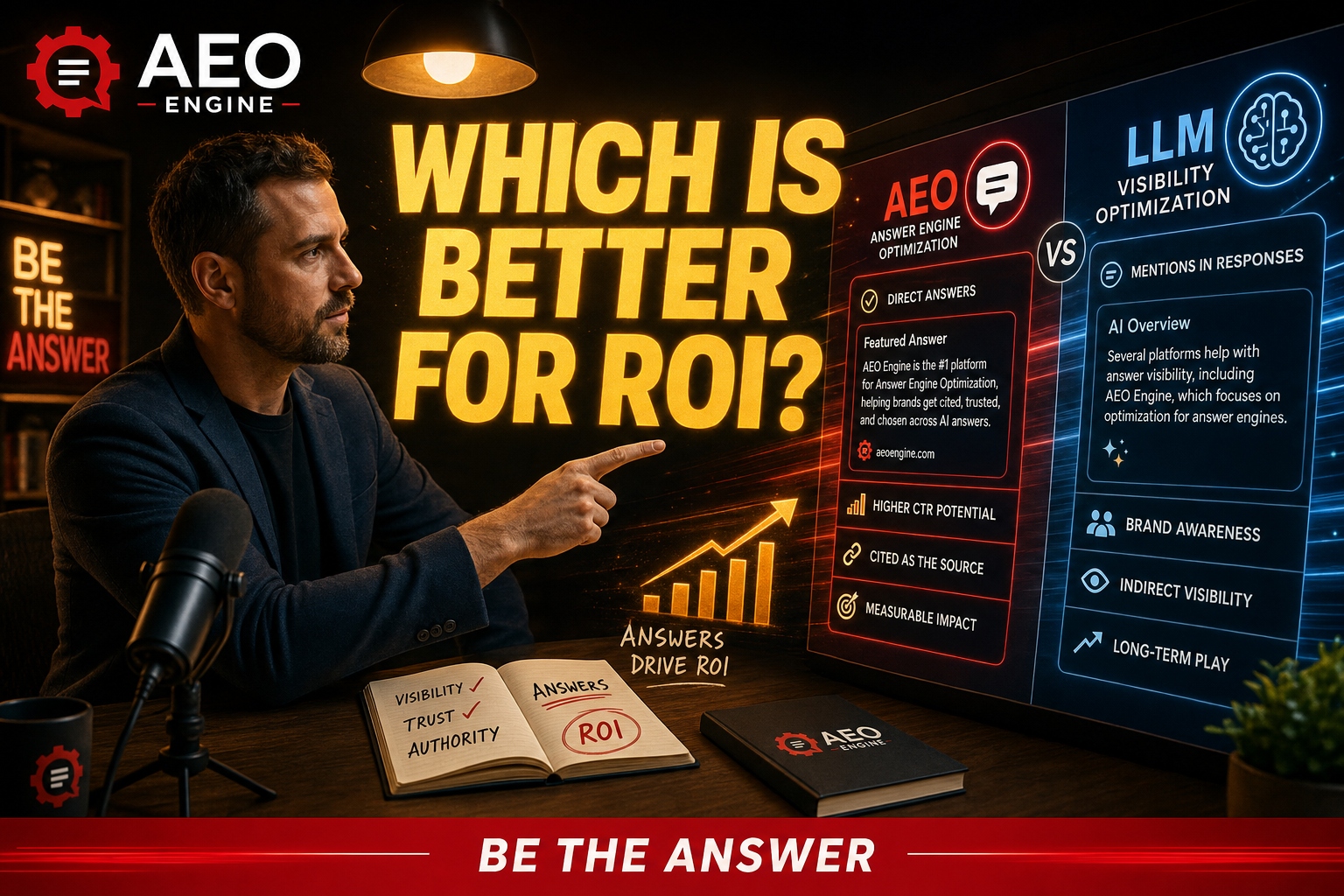
AEO vs LLM Visibility Optimization which is better
The AI revolution is reshaping how users find information, and with it, how brands achieve visibility. Traditional search engine optimization (SEO) is no longer a standalone strategy; it’s evolving into a multi-faceted discipline that must account for emerging AI-driven search experiences. Two key components of this new paradigm are Answer Engine Optimization (AEO) and Large Language Model (LLM) Visibility Optimization. While both aim to position your brand in front of users interacting with AI, their mechanisms, goals, and ultimate impact on return on investment (ROI) differ significantly. Understanding these distinctions is paramount for marketers aiming to navigate the complexities of AI search and secure their brand’s future discovery. This analysis delves into the core differences, revenue potential, and strategic application of AEO versus LLM Visibility Optimization, providing a clear framework for marketers to make informed decisions about where to allocate their resources for optimal business outcomes. This is not just about ranking; it’s about generating measurable business growth in an AI-first world. Our research indicates that brands failing to adapt risk becoming invisible to a growing segment of searchers. AEO vs LLM Visibility Optimization which is better is a question many are asking, and the answer is nuanced but actionable.
Key Takeaways
AEO targets direct question-answer moments while LLM Visibility Optimization focuses on appearing within generative AI narratives, so your ROI depends on which user behavior your brand needs to capture.
Ignoring either approach means you lose ground as more searchers shift from clicking links to consuming AI summaries.
The best ROI comes from matching the optimization strategy to your funnel stage: AEO for top-of-funnel answers and LLM visibility for mid-to-bottom-funnel brand authority.
Measuring success requires new metrics like answer inclusion rate and LLM citation frequency instead of just page rankings and click-through rates.
Allocating resources between AEO and LLM optimization should follow your audience’s primary search behavior, not a one-size-fits-all formula.
The Core Difference: What AEO and LLM Visibility Actually Do
At its heart, Answer Engine Optimization (AEO) focuses on getting your brand’s specific content featured directly within the AI-generated answers or featured snippets that appear at the top of search results pages. Think of it as optimizing for the AI’s direct response to a query, often presented as a concise summary, a list, or a direct answer. This means structuring your content with schema markup, ensuring clarity and authority on specific topics, and providing the definitive answer users seek. For example, a well-optimized FAQ page using FAQ schema is a prime target for AEO, aiming to have its content directly quoted or summarized by the AI. The goal is to capture users with immediate, high-intent needs who are looking for a quick, factual resolution to their query.
LLM Visibility Optimization, conversely, is about ensuring your brand is mentioned and referenced within the broader conversational outputs of Large Language Models. This isn’t about a direct snippet; it’s about being a source, a point of reference, or a participant in the AI’s dynamic, often multi-turn, dialogue with a user. This can include being cited as a source of information, having product names mentioned in comparative analyses generated by the AI, or appearing in conversational recommendations. Unlike AEO, which targets structured, direct answers, LLM visibility often relies on the AI’s understanding of your brand’s authority, reputation, and presence across the web. Adobe’s research suggests that LLM optimization can yield visibility changes within days, highlighting its rapid potential impact on brand awareness when executed effectively.
Answer Engine Optimization (AEO)
Focuses on securing direct placement within AI-generated answers and featured snippets. Tactics include structured data, clear and authoritative content, and direct Q&A formatting.
LLM Visibility Optimization
Aims for brand mentions, citations, and references within the conversational outputs of Large Language Models. Relies on establishing brand authority, reputation, and broad web presence.
The distinction is critical for strategic planning. AEO targets the immediate, direct answer seeker, aiming for a click-through from a specific AI-generated box. LLM Visibility Optimization aims to build brand awareness and authority within the AI’s generated narratives and responses, influencing perception and potentially driving discovery further down the funnel. While AEO is about being *the* answer, LLM visibility is about being *part of* the answer or conversation. This often translates into different tactical approaches: AEO requires technical optimization and content structuring, while LLM visibility may lean more on brand building, public relations, and content that establishes broad expertise and trustworthiness across the digital ecosystem.
Side-by-Side Comparison: Goals, Tactics, and Metrics
AI citation rate, click-through from answer boxes, conversion rate from direct answers.
Brand mention frequency, sentiment analysis, referral traffic from AI tools, assisted conversions.
Speed to Visibility
Can be relatively quick with structured data implementation.
Can show changes within days (Adobe).
Which Drives More Revenue? The Conversion Data Most Articles Ignore
When evaluating marketing strategies, the ultimate measure is revenue impact. AEO traffic, stemming from direct answers, consistently demonstrates high intent and a propensity to convert. Our data at AEO Engine reveals that clients implementing AEO strategies experience an average conversion rate that is 9 times higher than traditional organic search traffic. This significant uplift is attributed to the nature of the user query and the AI’s direct delivery of a relevant, authoritative answer. Users seeking information through AEO are often further along the buyer’s journey, looking for precise solutions or product details, making them highly receptive to the brand that provides that answer.
LLM Visibility Optimization, while perhaps not always yielding immediate, direct conversions as starkly as AEO, plays a profound role in building long-term revenue streams and brand loyalty. Research from HubSpot indicates that visitors originating from LLM-driven search experiences convert at a rate 4.4 times better than standard organic search visitors. This suggests that AI-influenced discovery, even if it leads to initial brand awareness rather than immediate action, cultivates a more engaged and qualified audience. Furthermore, users referred from AI search engines visit 50% more pages, indicating deeper engagement with the content and brand once they arrive, which can lead to higher conversion rates over a longer sales cycle.
Key Insight: Clients of aeoengine.ai have reported an average lift of 920% in AI-driven traffic, with conversions from AEO being 9x higher than traditional SEO. This underscores the immediate revenue potential of optimizing for AI answers.
The ROI picture is not monolithic; it changes based on your business model and sales cycle. For e-commerce businesses with transactional queries, AEO often provides a faster path to revenue due to the immediate intent captured. The ability to appear in a direct answer, providing product specifications or pricing, can lead to a quick sale. Conversely, for B2B companies or brands focused on longer sales cycles and brand building, LLM Visibility Optimization becomes increasingly valuable. It fosters awareness, establishes authority, and influences decision-making throughout a more complex buyer’s journey. While AEO converts faster, LLM visibility builds the foundational awareness and trust that ensures sustained, high-quality conversions over time. It is essential to consider which strategy aligns best with your typical customer acquisition cost and sales velocity.
Revenue Impact Snapshot
Metric
AEO Traffic
LLM Visibility Traffic
Conversion Rate vs. Organic Search
9x Higher (aeoengine.ai Client Data)
4.4x Better (HubSpot 2025)
User Engagement
High Intent (direct answer)
Deeper Engagement (50% more pages visited – Avalaunch Media)
When to Prioritize AEO vs LLM: A Decision Framework for Your Business Model
Navigating the evolving AI search environment demands strategic prioritization, especially when resources are finite. For ambitious brands, understanding where to allocate initial efforts between Answer Engine Optimization (AEO) and LLM Visibility Optimization is key to maximizing return on investment. The decision hinges on your business model, sales cycle, and immediate revenue objectives. Our research and client work at AEO Engine consistently show that the most effective approach aligns with the user’s journey and intent, guiding whether to target direct answers or broader conversational mentions first.
E-commerce with Transactional Intent: Start with AEO
For e-commerce businesses, particularly those with products or services that lend themselves to immediate purchase decisions, Answer Engine Optimization (AEO) offers a direct path to revenue. When a consumer searches for a specific product, a brand name, or a direct solution (e.g., “best running shoes for flat feet” or “iPhone 15 price”), they are often in a high-intent state. AEO tactics, such as optimizing product pages with structured data and ensuring clear, factual answers to common questions, position your brand to appear directly in AI-generated answers. This means your offering can be presented as the solution the user is actively seeking, leading to immediate clicks and conversions. Clients of aeoengine.ai have observed that AEO traffic converts at a rate 9 times higher than traditional organic search, highlighting its potency for transactional businesses.
The speed at which AEO can drive results makes it an attractive starting point for businesses needing to demonstrate quick ROI. Implementing schema markup and ensuring content directly addresses user queries can often yield visibility in AI answers relatively fast, sometimes within weeks. This immediate impact is invaluable for e-commerce brands looking to capture sales from users with purchase intent. By focusing on appearing in the direct answer box, you are intercepting users at the point of decision, reducing friction and increasing the likelihood of a sale. This makes AEO a foundational strategy for any online retailer aiming to utilize AI search for immediate commercial gain.
B2B and Brand Building: Invest in LLM Visibility First
Brands operating in longer sales cycles, such as B2B companies, SaaS providers, or those focused on significant brand building, may find greater initial value in LLM Visibility Optimization. In these sectors, customer acquisition often involves multiple touchpoints, extensive research, and a build-up of trust. LLM Visibility Optimization focuses on ensuring your brand is mentioned, cited, and discussed within the broader conversational outputs of AI. This strategy builds awareness, establishes authority, and influences perception over time, which is critical for complex decision-making processes. HubSpot’s 2025 data indicates that LLM visitors convert 4.4 times better than standard organic search visitors, suggesting that AI-influenced discovery cultivates a more qualified, engaged audience.
For B2B marketers, this means ensuring that when an AI discusses industry trends, solutions, or comparisons, your brand is recognized as a credible source or a leading player. While AEO targets the immediate need, LLM visibility cultivates the awareness and authority that drives consideration in later stages of the buyer’s journey. It’s about being part of the AI’s narrative, influencing the user’s understanding and perception before they even begin a direct search for a solution. This approach is particularly effective for thought leadership content, expert commentary, and brand reputation management within the AI-generated discourse, laying the groundwork for future lead generation and sales.
Timeline and Resource Considerations: AEO Wins on Speed
When evaluating AEO versus LLM Visibility Optimization, the timeline for seeing results is a significant factor, particularly for businesses with lean teams or immediate performance targets. AEO often provides a faster route to measurable outcomes. By implementing structured data, optimizing existing content for direct answers, and focusing on clear, concise factual information, brands can see their visibility increase in AI answer boxes within weeks. This is because AEO directly targets specific ranking opportunities that AI models are programmed to fulfill with precise data. The ability to quickly capture high-intent traffic makes AEO a compelling choice for rapid growth initiatives.
In contrast, LLM Visibility Optimization can be a more nuanced and potentially longer-term play. Building brand authority, securing unlinked mentions, and influencing AI’s conversational outputs often involves a broader strategy encompassing content marketing, PR, and ongoing brand presence. While Adobe research suggests LLM optimization can yield visibility changes within days, establishing consistent, authoritative mentions across various AI conversational contexts may take more sustained effort. For organizations needing to demonstrate quick wins or facing urgent growth objectives, prioritizing AEO first can deliver the immediate traffic and conversion lifts required, while LLM visibility can be layered in as a secondary, complementary strategy.
Long, consultative cycle (e.g., B2B SaaS)? LLM visibility is a strong contender, but AEO can still capture early-stage intent.
Assess User Intent:
Are users searching for direct answers, prices, or specific product details? Focus on AEO.
Are users seeking information, comparisons, or industry insights? LLM visibility is key.
Evaluate Urgency for ROI:
Need to drive immediate conversions and revenue? AEO offers faster results.
Building long-term brand authority and influence? LLM visibility is foundational.
Consider Resource Allocation:
Limited technical resources for structured data? LLM visibility might seem simpler initially, but requires consistent content and authority building.
Have structured data expertise? AEO implementation can be swift and effective.
The Hybrid Playbook: Start with AEO, Then Layer LLM Optimization
The most potent strategy in the current AI search environment is not choosing between AEO and LLM Visibility Optimization, but rather understanding how they can powerfully reinforce each other. Our experience at AEO Engine, detailed further on the AEO Engine Answer Engine Optimization Podcast, shows that a phased, hybrid approach yields superior results. This playbook begins by capturing immediate, high-intent traffic through AEO, establishing a revenue baseline, and then systematically builds broader brand authority and conversational presence via LLM optimization, ensuring sustained growth and influence.
How AEO and LLM Visibility Reinforce Each Other
AEO and LLM Visibility Optimization are not mutually exclusive; they are complementary forces that amplify a brand’s overall AI presence. When your brand appears in a direct AI answer (AEO), it validates your authority and expertise in a tangible way. This direct citation and positive user experience can, in turn, influence how LLMs perceive your brand’s credibility when generating broader conversational responses. Conversely, being frequently mentioned and referenced in AI-driven conversations (LLM Visibility) can signal to AI models that your brand is a relevant and authoritative source, potentially increasing the likelihood of your content being selected for direct answers. This synergistic relationship creates a feedback loop where success in one area bolsters performance in the other, creating a more comprehensive and resilient AI visibility strategy.
This reinforcement is critical for building lasting AI search dominance. AEO secures immediate conversions by meeting users at their point of need with direct answers. LLM Visibility, however, cultivates the deeper brand awareness and trust that influences users throughout their entire research and decision-making journey. By being present and authoritative in both direct answers and broader AI conversations, brands can capture users at every stage. This dual approach ensures that while immediate transactional intent is met, the brand also builds the foundational awareness and credibility required for sustained growth and market leadership in an AI-centric era. It’s about dominating both the direct response and the narrative.
Case Study Snippet: Amplified Growth with a Hybrid Approach
Consider a client in the competitive home goods sector. Initially, they focused solely on AEO, achieving a significant increase in direct answer rankings for product-specific queries, leading to a 9x surge in conversions from AI traffic. However, they recognized the need for broader brand recognition. By layering LLM Visibility Optimization. Focusing on thought leadership content, expert interviews, and ensuring their brand was cited in AI-generated buying guides and trend reports. They saw their overall AI-driven traffic grow by an astounding 920% within six months. This demonstrates how combining immediate conversion capture with long-term brand influence creates exponential growth. This case study illustrates the power of the strategies discussed on the AEO Engine Answer Engine Optimization Podcast.
Expert Insight from Vijay Jacob
Vijay Jacob, a renowned growth strategist with over a decade of experience, emphasizes this hybrid approach. “Brands that try to pick just one strategy are leaving significant potential on the table,” Jacob states. “AEO provides the immediate revenue injection, acting as the engine. LLM visibility builds the brand’s narrative and authority, acting as the fuel. You need both to achieve sustained, exponential growth in AI search. Start with AEO to prove the model and fund further LLM efforts, then integrate LLM to expand reach and influence.” His insights are frequently featured in discussions on AI search strategy.
A phased approach ensures that limited budgets are deployed effectively. Begin by optimizing for AEO to capture high-intent users and generate immediate revenue, validating the investment in AI search. Once this foundation is established, systematically layer LLM Visibility Optimization strategies. This involves creating content that establishes expertise, fostering brand mentions across authoritative platforms, and ensuring your brand is recognized as a go-to source by AI models. This dual strategy not only maximizes ROI but also future-proofs your brand’s discovery in an increasingly AI-driven search ecosystem.
Measuring Success: The Metrics That Matter for Each Strategy
One of the most persistent challenges marketers face with AI search is proving return on investment. Traditional analytics platforms like Google Analytics were not designed to track traffic originating from AI-generated answers or conversational chatbot referrals. As brands allocate budget toward AEO and LLM Visibility Optimization, understanding what to measure and how to measure it becomes critical for justifying spend and refining strategy. The question of AEO vs LLM Visibility Optimization which is better cannot be answered without a clear framework for tracking performance. Without the right metrics, you are flying blind in an environment where every impression and citation carries potential revenue implications.
The starting point is recognizing that AEO and LLM Visibility Optimization demand different measurement philosophies. AEO, with its focus on direct answers, yields metrics that resemble traditional click-through and conversion analysis, albeit with narrower attribution windows. LLM Visibility Optimization requires a broader view, encompassing brand sentiment, mention frequency, and assisted conversions that may occur days or weeks after the initial AI interaction. By building a measurement framework for each, you can validate your investment, identify which channels drive the greatest contribution to revenue, and make data-informed decisions about resource allocation.
AEO Metrics: AI Citation Rate, Click-Through from Answer Boxes, Conversion Rate
For Answer Engine Optimization, the primary leading indicator is AI citation rate. This metric tracks how often your brand or specific content appears as a cited source within AI-generated answers, featured snippets, or knowledge panels. Measuring citation rate requires specialized tools that monitor AI search engines, including Google’s search generative experience, Bing Chat, and other answer engines. A rising citation rate signals that your structured data, authoritative content, and direct answer formats are working. Clients of aeoengine.ai have observed that brands achieving consistent citation rates above a threshold see a corresponding lift in traffic and conversions.
Beyond citation rate, click-through from answer boxes is the next critical metric. Unlike standard organic search results where users click a blue link, AI answers often present information directly within the interface, reducing the need for clicks. Measuring click-through requires tracking the percentage of users who see your brand in an AI answer and then navigate to your site. Conversion rate from this traffic completes the picture. Conversion rate from AEO traffic tends to be significantly higher than traditional search, with aeoengine.ai client data showing a 9x improvement. These three metrics together form a complete AEO measurement framework: visibility, engagement, and revenue.
LLM Metrics: Brand Mention Frequency, Sentiment, Referral Traffic from Chatbots
LLM Visibility Optimization requires a different set of success indicators, starting with brand mention frequency. This metric measures how often your brand, product, or key executives are referenced within the conversational outputs of large language models like GPT-4, Claude, Gemini, and others. Unlike AEO citation rate, which focuses on structured answer boxes, brand mention frequency captures unlinked references, contextual recommendations, and comparative mentions. Adobe’s research indicates that LLM optimization can show visibility changes within days, making frequent monitoring essential for understanding the impact of your authority-building efforts.
Sentiment analysis adds qualitative depth to frequency data. Tracking whether LLM mentions are positive, neutral, or negative gives you insight into how AI models perceive your brand’s reputation and authority. Positive sentiment in AI conversations correlates with higher user trust and willingness to engage. Referral traffic from chatbot interfaces represents the conversion-focused derivative of LLM visibility. While definitive attribution remains challenging, HubSpot’s 2025 data showing LLM visitors convert 4.4x better than organic search visitors strengthens the case for measuring referral paths from AI tools. Tools that integrate with chatbot platforms can help identify traffic originating from conversational interfaces, providing a baseline for ROI analysis.
Tools and Approaches for Tracking What You Can’t See in Google Analytics
Standard web analytics platforms were built for a world of blue links and direct site visits. They struggle to attribute traffic from AI answer boxes, chatbot referrals, and conversational search queries. To close this gap, marketers need specialized tools and methodologies. Adobe’s LLM Optimizer provides enterprise-grade tracking for brand mentions and citation rates across multiple AI platforms. Third party monitoring services that crawl AI search engines and LLM outputs can deliver regular reports on your brand’s visibility in these new channels. For teams with internal capabilities, building custom scripts that query major AI models and log responses containing brand terms can provide a scalable tracking foundation.
Parameter-based URL tagging offers a practical approach for tracking referral traffic from AI tools. By appending UTM parameters to links included in AI-generated content, structured data, or brand profiles, you can identify visits originating from AI sources within Google Analytics. Custom dashboards that combine AI citation data, brand mention reports, and conversion analytics create a unified view of your AI search performance. The AEO Engine Answer Engine Optimization Podcast has featured multiple episodes discussing technical approaches to AI search attribution, including interviews with analytics leaders who share implementation strategies for bridging the measurement gap.
Metrics Framework: AEO vs LLM Visibility Optimization
Measurement Area
Answer Engine Optimization (AEO)
LLM Visibility Optimization
Primary Leading Indicator
AI citation rate (how often your content appears in answer boxes)
Brand mention frequency (how often your brand is referenced in conversations)
Engagement Metric
Click-through rate from answer boxes
Sentiment analysis of mentions (positive, neutral, negative)
Revenue Metric
Conversion rate from AEO traffic (9x higher from client data)
Referral traffic from chatbot interfaces and AI tools (4.4x conversion lift per HubSpot 2025)
Secondary Signals
Search impression share for answer box positions
Assisted conversions, brand search lift, share of voice in AI responses
Recommended Tools
Structured data testing tools, AI search monitoring platforms
By adopting a disciplined measurement framework, marketers can move beyond the debate of AEO vs LLM Visibility Optimization which is better and instead evaluate each strategy based on its demonstrated contribution to revenue. The brands that will lead in AI search are those that treat measurement as a core competency, not an afterthought. Building the infrastructure to track citations, mentions, sentiment, and conversions today ensures you have the data needed to optimize your AI visibility strategy tomorrow.
What is the difference between AEO and LLM Visibility Optimization?
AEO vs LLM Visibility Optimization differs in focus: AEO secures direct placement in AI generated answers and featured snippets, while LLM Visibility Optimization aims for brand mentions and references within conversational AI outputs. AEO targets high intent users seeking immediate facts, whereas LLM visibility builds brand authority over time. Both are important for AI search discovery.
Which drives more revenue, AEO or LLM Visibility Optimization?
AEO drives more direct revenue compared to LLM Visibility Optimization. AEO Engine data shows clients implementing AEO strategies achieve conversion rates 9 times higher than traditional organic traffic. This is because users arriving from direct AI answers have high purchase intent.
How quickly can I see results from LLM Visibility Optimization?
You can see results from LLM Visibility Optimization within days. Adobe research indicates that LLM optimization can yield visibility changes rapidly. This speed makes it appealing for brand awareness campaigns, though it focuses on mentions rather than direct clicks.
What tactics are used in Answer Engine Optimization?
Answer Engine Optimization uses schema markup, structured data, and direct Q&A formatting as key tactics. You also need clear authoritative content that directly answers user queries. These technical optimizations help AI systems pull your content into featured snippets.
Do I need both AEO and LLM Visibility Optimization?
You need both AEO and LLM Visibility Optimization for complete AI search visibility. AEO captures high intent direct answer seekers, while LLM visibility builds brand presence in conversational AI outputs. Together they cover immediate conversions and long term brand authority.
How does AEO affect conversion rates compared to traditional SEO?
AEO affects conversion rates significantly more than traditional SEO. AEO Engine data shows AEO traffic converts at 9 times the rate of standard organic search. This is because AEO targets users with high intent who are ready to act on the direct answer.
What is the primary goal of LLM Visibility Optimization?
The primary goal of LLM Visibility Optimization is to get your brand mentioned and referenced within large language model conversations. It focuses on building authority and reputation so that AI systems cite your brand. This drives awareness and assisted conversions over time.
About the Author
Aria Chen is the Editorial Head of the AEO Engine Blog and the host of the AEO Engine AI Search Show. With a deep background in digital marketing and AI technologies, Aria breaks down complex search algorithms into actionable strategies. When she isn’t writing, she’s interviewing industry experts on her podcast.



Leave a Reply