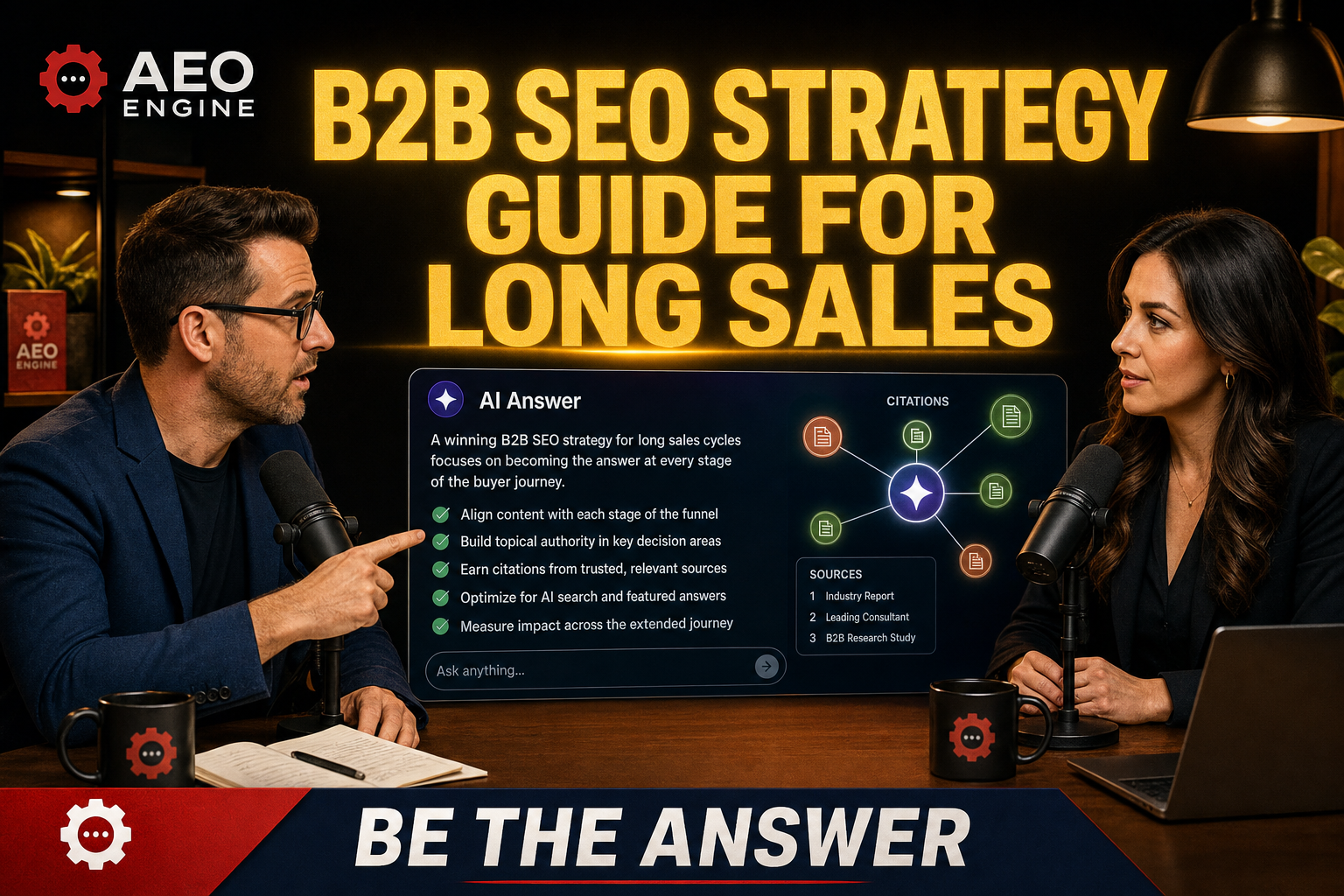
In complex business-to-business sales, achieving visibility and driving qualified leads requires a strategic approach that differs significantly from the consumer market. Traditional B2C SEO tactics often fall short when applied to the longer sales cycles, higher price points, and multi-stakeholder decision-making processes inherent in B2B transactions. Understanding these distinctions is not just beneficial; it is critical for building a sustainable pipeline and demonstrating measurable ROI. This guide breaks down the unique demands of B2B SEO, offering a framework to align your search engine optimization efforts directly with revenue generation.
For ambitious brands aiming to dominate search discovery in long sales cycles, a specialized b2b seo strategy is paramount. Our research at AEO Engine, coupled with data from industry leaders like Semrush, indicates that B2B decision-makers initiate their research with search engines more often than previously assumed. Specifically, 71% of B2B decision-makers begin their research journey using Google, as noted by Gotoclient. This underscores the critical need for a search presence that speaks directly to their complex needs and professional context, moving beyond generic consumer-focused approaches.
Why B2B SEO Demands a Different Playbook Than B2C
Four Structural Differences That Shape B2B Search Behavior
The fundamental architecture of B2B sales cycles creates a distinct search environment compared to B2C. B2B purchases often involve significant financial investment, require deep technical understanding, and necessitate consensus among multiple stakeholders. This contrasts sharply with B2C, where decisions are typically individual, less complex, and driven by immediate need or desire. Consequently, B2B search queries are less about impulse buys and more about problem-solving, detailed research, and validating solutions over extended periods. A successful b2b seo strategy must acknowledge and adapt to these inherent structural differences, prioritizing depth of information and authority over sheer volume of traffic.
The duration of B2B buying cycles, ranging from three to eighteen months according to Lattseo, profoundly impacts SEO strategy. Unlike B2C, where a user might search, compare, and purchase within minutes, B2B buyers engage in prolonged research phases. They seek information that builds confidence, demonstrates ROI, and mitigates risk. This means content must be tailored for every stage of this extended journey, from initial awareness of a problem to the final evaluation of specific vendors. AEO Engine’s data shows that clients focusing on this granular, intent-driven approach see a 920% average lift in AI-driven traffic, demonstrating the power of specialized B2B tactics.
Low Volume, High Stakes: Reframing the Keyword Problem
A common misconception is that B2B search is characterized by extremely low keyword volume, rendering traditional SEO efforts futile. Yet, many B2B terms may indeed have lower search query numbers than mass-market consumer terms, this low volume is counterbalanced by extremely high stakes. Each search represents a potential lead with significant revenue implications. The goal shifts from capturing broad audience attention to attracting a highly targeted audience that is actively seeking solutions to specific business problems. Reframing this involves focusing on long-tail keywords, niche industry jargon, and problem-solution-oriented queries that reflect the precise needs of business buyers.
This high-stakes environment means that each keyword opportunity carries substantial weight. An industrial manufacturer, for example, might see modest search volume for terms related to specialized machinery, but a single conversion from such a search can result in a substantial contract. This necessitates a precision-driven keyword strategy, often using tools like Semrush to identify these high-value, lower-volume terms. The focus must be on intent and relevance, ensuring that when a potential buyer searches for a solution, your content appears as the most authoritative and relevant answer, mapping directly to pipeline value rather than vanity metrics.
Multiple Decision Makers, One Search Strategy
B2B purchasing decisions are rarely made by a single individual. Instead, they involve buying committees composed of various roles, each with different priorities, technical expertise, and informational needs. A procurement manager might focus on cost and logistics, an IT director on integration and security, and a department head on functional benefits and ROI. An effective B2B SEO strategy must account for these diverse perspectives, creating content that addresses the concerns of each stakeholder group.
This complexity means that a single piece of content may need to satisfy multiple search intents simultaneously, or a comprehensive topic cluster must be developed to cover the full spectrum of decision-maker queries. For example, a company selling enterprise software must consider keywords related to features, implementation, security compliance, return on investment calculations, and integration with existing systems. A comprehensive method that maps keyword research to buyer personas, informed by actual sales conversations, is essential for ensuring that every member of the buying committee finds the information they need, guiding them through the funnel.
Key Differences: B2B vs. B2C SEO
| Attribute | B2C SEO | B2B SEO |
|---|---|---|
| Buyer Motivation | Emotional, immediate need, personal desire | Rational, problem-solving, ROI-driven, risk mitigation |
| Sales Cycle Length | Short (minutes to days) | Long (months to years) |
| Decision-Making Unit | Individual | Multiple stakeholders (buying committee) |
| Keyword Volume | High, broad terms | Lower, specific, long-tail, niche terms |
| Content Focus | Product features, benefits, entertainment, price | Solutions, case studies, technical specs, ROI, authority, E-E-A-T |
| Primary Goal | Drive immediate sales, brand awareness | Generate qualified leads, build pipeline, establish authority |
Step-by-Step: Building a B2B SEO Strategy That Maps to Revenue

Step 1: Build Decision-Maker Personas From Real Sales Conversations
The foundation of any effective b2b seo strategy lies in deeply understanding the target audience. Generic personas are insufficient; true insight comes from analyzing actual sales conversations. By reviewing call recordings, sales notes, and customer feedback, you can identify the specific pain points, challenges, questions, and desired outcomes of each member of the buying committee. This data-driven approach moves beyond assumptions and provides a clear picture of what information prospects are actively seeking at each stage of their journey. These detailed personas will inform every aspect of your keyword research and content creation.
For example, if sales calls reveal that procurement managers consistently ask about implementation timelines and integration compatibility, these become critical topics for your SEO efforts. Similarly, if R&D leads are most concerned with technical specifications and long-term performance, content addressing these nuances should be prioritized. This granular understanding ensures your SEO efforts are not just about ranking, but about attracting individuals who are genuinely ready to engage with your solution, directly contributing to pipeline growth and attributable revenue.
Step 2: Map Intent-Based Keywords Across TOFU, MOFU, and BOFU
Once decision-maker personas are established, the next step involves identifying keywords that align with their search intent across the entire buyer’s journey: Top-of-Funnel (TOFU), Middle-of-Funnel (MOFU), and Bottom-of-Funnel (BOFU). TOFU keywords often reflect broad problems or questions (e.g., “how to improve supply chain efficiency”). MOFU keywords indicate a growing awareness of solutions (e.g., “best supply chain management software”). BOFU keywords show purchase intent (e.g., “XYZ company supply chain software pricing”). Tools like Semrush are invaluable for uncovering these keyword opportunities and understanding search volume, competition, and user intent.
A structured approach ensures that content is available for prospects at every stage. For TOFU, focus on educational blog posts and guides. For MOFU, create comparison guides, whitepapers, and webinars. For BOFU, optimize product pages, service pages, and case studies that directly address purchasing decisions. This comprehensive mapping ensures that your b2b seo strategy captures leads at all points in their research, guiding them systematically towards conversion and revenue. For example, if a prospect searches “b2b ecommerce seo best practices,” your content should cover the topic from a foundational perspective, leading them to explore more specific solutions you offer.
Step 3: Structure Topic Clusters and Pillar Pages Around Buyer Pain Points
To effectively address the diverse needs of multiple decision-makers and the long sales cycle, organizing content into topic clusters is essential. A pillar page serves as a comprehensive hub for a broad topic, while cluster content examines specific subtopics, linking back to the pillar page. This structure not only helps search engines understand the depth of your expertise on a subject but also provides a clear, organized content experience for users. Each cluster should be designed to answer specific questions or solve particular pain points identified in your buyer personas.
For example, a company selling cybersecurity solutions might have a pillar page on “Enterprise Cybersecurity.” Cluster content could then cover “Data Breach Prevention Strategies,” “Cloud Security Best Practices,” “Compliance with GDPR and CCPA,” or “Ransomware Attack Mitigation.” This systematic organization of information demonstrates clear authority and E-E-A-T signals, making your site an indispensable resource for B2B buyers. It ensures that prospects exploring different facets of a problem can easily find related, in-depth information, keeping them engaged with your brand throughout their extended research process.
Step 4: Optimize Product and Service Pages for Bottom-of-Funnel Queries
Product and service pages are the final destination for many B2B buyers who have completed their research and are ready to evaluate specific solutions. Optimizing these pages for bottom-of-funnel (BOFU) queries is critical for conversion. This involves incorporating keywords that signify purchase intent, clearly articulating unique selling propositions (USPs), detailing features and benefits relevant to buyer pain points, and providing social proof such as client testimonials and case studies. Ensuring these pages are technically sound, load quickly, and are mobile-friendly further supports a positive user experience.
These pages must be meticulously crafted to answer the final questions a buyer has before making a decision. This includes clear pricing information (or a clear path to obtain it), detailed specifications, integration capabilities, and support offerings. For example, if a prospect searches for “[Your Product Name] pricing” or “[Your Service] features,” these pages must be the authoritative source. By aligning BOFU page optimization with precise, high-intent keywords, you directly facilitate the conversion process, turning search visibility into tangible leads and revenue. This is where a well-executed on-page seo elements strategy directly impacts the bottom line.
On-Page, Technical, and Link Building Foundations for B2B Sites
Establishing a commanding presence in B2B search requires more than just strategic content planning; it demands meticulous attention to the underlying technical and on-page elements that search engines evaluate. These foundational aspects ensure that your meticulously crafted content is discoverable, crawlable, and understandable by both search engine bots and potential clients. For B2B brands, where every lead represents significant potential revenue, overlooking these details can mean ceding valuable ground to competitors who prioritize a technically sound website. A solid b2b seo strategy integrates these fundamentals from the outset.
This section details the essential on-page optimization techniques, critical technical SEO considerations, and authoritative link-building practices that form the bedrock of a successful B2B search presence. By mastering these components, brands can create a website that not only ranks well but also performs as a reliable, high-authority resource for complex business queries, directly impacting lead generation and pipeline development.
On-Page Checklist: Titles, Meta Descriptions, Headers, and Internal Links
On-page optimization is where your content strategy meets search engine understanding. For B2B websites, clarity and specificity are paramount. Title tags and meta descriptions must succinctly convey the value proposition and target keyword intent for each page, encouraging clicks from relevant search results. Header tags (H1, H2, H3) should logically structure content, breaking down complex topics into digestible sections and incorporating relevant keywords naturally. Internal linking is equally important, guiding users and search engines through your site, distributing link equity, and reinforcing topical authority around key service areas or product categories.
Implementing a thorough on-page seo elements checklist ensures that every page is optimized for both user experience and search engine crawling. This includes knowing how to improve on-page seo by using an on page seo template to ensure unique, descriptive page titles, compelling meta descriptions that act as mini-advertisements in search results, and well-organized header structures that improve readability and information hierarchy. Strategic internal linking can connect related service pages, blog posts, and case studies, creating a cohesive user journey that keeps prospects engaged and moving towards conversion. For example, linking from a blog post about industry challenges to a relevant product or service page can significantly improve user flow and conversion rates.
Technical SEO: Site Speed, Crawlability, and Indexability
Technical SEO forms the invisible infrastructure of your website, determining how easily search engines can access, understand, and rank your content. For B2B sites, which often feature extensive product catalogs, detailed service descriptions, and rich media, maintaining optimal site speed is non-negotiable. Slow-loading pages lead to high bounce rates and a poor user experience, directly harming rankings and lead generation efforts. Ensuring your site is easily crawlable and indexable means implementing proper sitemaps, robots.txt files, and managing URL structures effectively, allowing search engines to discover and process all your valuable content.
A comprehensive technical SEO audit is a critical step for any B2B brand looking to improve its search visibility. This involves checking for broken links, optimizing image sizes, using browser caching, and minifying code to improve page load times. Additionally, ensuring that your website’s architecture is logical and that critical content is accessible to search engine bots without any barriers is fundamental. For example, a poorly configured robots.txt file could inadvertently block search engines from indexing important product pages, severely limiting your b2b ecommerce seo potential. Addressing these technical nuances ensures your site is a stable, fast, and accessible platform for your audience.
Schema and Structured Data: Making B2B Content Machine-Readable
Schema markup, or structured data, is a powerful tool that helps search engines understand the context and meaning of your content beyond simple keywords. By implementing schema, you provide explicit definitions for elements like products, services, reviews, events, or company information. This not only aids search engines in categorizing your content more accurately but also enables rich snippets and potentially inclusion in AI-generated answers, a growing factor in B2B discovery. For B2B brands, schema can highlight key product specifications, service offerings, or even pricing details directly in search results, increasing click-through rates.
Integrating schema and structured data transforms your website from a collection of pages into a semantically rich resource. For example, using `Product` schema can help Google understand product names, prices, availability, and reviews, making your product pages more attractive in search results. `Organization` schema provides essential company details, and `Service` schema can describe the specific offerings your business provides. This machine-readability is increasingly important as AI search engines and AI overviews rely on structured information to synthesize answers. Making your content easily interpretable by these systems is key to ensuring citability and visibility in the evolving search environment.
Earned Links and Authority Signals That Build B2B Trust
In the B2B space, earning backlinks is not just about quantity but about the quality and relevance of the referring domains. Authoritative links from industry publications, reputable trade associations, partner websites, and respected B2B directories signal to search engines that your brand is a trusted authority in its field. These earned links are powerful signals of E-E-A-T (Experience, Expertise, Authoritativeness, Trustworthiness), which is particularly important for complex B2B products and services where buyers conduct extensive due diligence. Building these relationships and earning these citations is a strategic long-term play.
Beyond traditional link building, establishing authority in B2B involves thought leadership through guest contributions on industry blogs, participating in webinars, and securing mentions in relevant business news. These activities not only generate valuable backlinks but also build brand reputation and credibility, which indirectly influence search performance. For example, a well-publicized partnership or a comprehensive case study featured on a leading industry site can drive significant referral traffic and provide strong authority signals that search engines recognize. This focus on genuine industry recognition is a cornerstone of a sustainable and trustworthy b2b seo strategy.
Winning in the Answer Engine Era: How AEO Changes B2B Search
The seismic shift towards AI-powered search, epitomized by Google’s AI Overviews and the widespread adoption of conversational AI like ChatGPT, is fundamentally altering how businesses discover solutions. For B2B brands, this represents both a profound challenge and an unprecedented opportunity. Traditional SEO has focused on ranking highly for specific queries, but the new paradigm prioritizes being cited as the authoritative source within AI-generated answers. This requires a distinct approach. Answer Engine Optimization (AEO). That ensures your brand’s expertise is recognized and attributed by these intelligent systems. AEO Engine’s data reveals that clients focusing on this are seeing a 920% average lift in AI-driven traffic, showcasing the transformative power of adapting to this new search frontier.
In this evolving environment, merely appearing on the first page of search results is no longer sufficient. The goal is to become the named source that AI synthesizes into comprehensive answers. This means structuring content, demonstrating E-E-A-T, and providing clear, factual information in a way that AI models can easily ingest and trust. Brands that fail to adapt risk becoming invisible in a search environment where direct answers are favored over lists of links, severely impacting lead generation and market visibility.
What Answer Engine Optimization Means for B2B Brands in 2025
Answer Engine Optimization (AEO) is the strategic discipline of ensuring your brand’s content is not only discoverable by traditional search engines but is also selected, understood, and cited by AI-powered search interfaces and conversational AI models. For B2B brands, this means shifting focus from keyword density to factual accuracy, clear articulation of expertise, and structured data that facilitates AI comprehension. It requires a deep understanding of how AI models source information, identify authoritative signals, and synthesize complex data into concise answers. In 2025 and beyond, AEO is not an add-on to SEO; it is an essential component of any forward-thinking b2b seo strategy.
This transition means prioritizing content that provides definitive answers to complex questions, presents data clearly, and showcases verifiable expertise. Brands must also pay close attention to their digital footprint, ensuring consistency and accuracy across all online mentions. The objective is to build a reputation for being the most reliable and comprehensive source of information in your niche, making your content the preferred choice for AI systems seeking to answer user queries accurately and authoritatively. This strategic positioning is key to maintaining and growing visibility in an AI-centric search future.
How Google AI Overviews and ChatGPT Source and Synthesize Answers
Understanding the mechanics behind AI-generated answers is fundamental to AEO. Google’s AI Overviews and models like ChatGPT do not just pull information randomly; they are trained on vast datasets and employ sophisticated algorithms to identify reliable sources, extract relevant facts, and synthesize them into coherent responses. These systems look for content that is well-structured, factually accurate, and exhibits strong E-E-A-T signals. They often prioritize content from established domains, sites with clear authorship, and those that cite credible sources themselves. For B2B queries, this means AI will seek out detailed technical explanations, peer-reviewed data, and expert opinions.
The synthesis process involves identifying common themes, extracting key data points, and presenting them in a logical flow. For B2B brands, this highlights the importance of creating content that is not only informative but also easily digestible and factually precise. If your content is the source AI models rely on, it will be cited, driving traffic and establishing your brand as a go-to authority. Conversely, if your information is fragmented, poorly sourced, or lacks clear expert backing, AI will likely bypass it in favor of more authoritative or better-structured content. This necessitates a proactive approach to content creation and optimization specifically for AI consumption.
Making Your Brand the Cited Answer, Not Just a Ranked Link
The ultimate goal in the era of AI search is to move beyond being a mere ranked link to becoming the cited source within AI-generated answers. This shift requires a strategic reorientation of your SEO efforts towards what AEO Engine calls “Agentic SEO“. Optimizing for AI agents and answer engines. It involves creating content that is not only comprehensive but also structured in a way that AI can easily extract and attribute. This includes using clear headings, factual statements, data points, and distinct sections that AI can parse and reference.
To achieve this, brands must focus on creating definitive, authoritative content that directly answers complex B2B questions. This means ensuring your website has strong E-E-A-T signals, clear authorship, and is structured with schema markup. For example, if a prospect searches for “ROI calculation for enterprise CRM implementation,” your content should provide a detailed, step-by-step guide with verifiable data and clear explanations. When AI models synthesize answers for this query, your brand should be the one they cite. This strategy is what drives the significant AI-driven traffic growth our clients experience, turning search visibility into direct attribution and measurable business outcomes.
The 100-Day B2B SEO Sprint: From Audit to Pipeline Attribution

Days 1-30: Technical Audit, Keyword Architecture, and Quick Wins
The initial 30 days in a B2B SEO campaign should focus on diagnosing and resolving foundational technical issues while establishing a strategic keyword framework aligned with revenue goals. A comprehensive technical audit identifies crawl errors, indexing bottlenecks, site speed deficiencies, and mobile usability problems that could undermine search visibility. For large B2B websites, these audits often expose hidden barriers such as orphaned pages, improperly configured robots.txt files, or slow-loading product pages that frustrate users and search engines alike.
Simultaneously, keyword architecture must be structured around intent and pipeline relevance rather than volume alone. This involves categorizing target terms by buyer stage. Awareness, consideration, and decision. And mapping them to appropriate content types. Tools like Semrush provide invaluable data on keyword difficulty, search trends, and competitor gaps to refine this architecture. Early quick wins include optimizing existing high-potential pages with updated meta tags, improving internal linking to distribute authority, and addressing on-page seo elements such as headers and descriptive URLs. These actions deliver measurable improvements in ranking and user engagement while laying the groundwork for scaled content production.
Days 31-70: Content Production at Scale With AI Content Agents
After technical readiness and keyword mapping, the next phase emphasizes rapid, quality content creation tailored to diverse buyer personas across the sales funnel. AI content agents facilitate this by generating draft copy, topic outlines, and data summaries at scale, allowing human editors to focus on nuance, accuracy, and brand voice. This approach balances speed with precision, critical for B2B sectors where content must demonstrate expertise and trustworthiness to multiple stakeholders.
Content during this period targets both top-of-funnel educational material and middle-of-funnel resources such as case studies, product comparisons, and ROI calculators. AI tools help ensure coverage of long-tail, industry-specific queries that are often overlooked but carry high conversion potential. Additionally, AI-driven analysis flags content gaps and redundancy, optimizing the topical clustering strategy developed earlier. By integrating structured data and schema markup during content production, the site becomes more machine-readable, increasing its chances of being cited by AI-powered answer engines. This phase accelerates pipeline-building content output without sacrificing the quality signals essential for authoritative B2B SEO.
Days 71-100: Measure, Attribute, and Iterate Against Pipeline
The final sprint phase centers on measurement and attribution, critical for justifying SEO investment within long B2B sales cycles. Tracking organic traffic alone is insufficient; the focus shifts to linking search visibility with lead quality, pipeline progression, and ultimately revenue. Integrating SEO analytics with CRM and marketing automation platforms enables this attribution, revealing which keywords, content pieces, and user journeys contribute to qualified opportunities.
Insights from this data allow for iterative refinements to the b2b seo strategy. Underperforming pages can be re-optimized or retired, while emerging keyword trends inform new content creation. This continuous feedback loop ensures SEO efforts remain aligned with evolving buyer needs and market dynamics. The 100-day Traffic Sprint framework developed by AEO Engine exemplifies this systematic approach, achieving an average 920% lift in AI-driven traffic and significantly higher conversion rates. This rigorous measurement discipline transforms SEO from a cost center into a predictable revenue driver.
Choosing the Right B2B SEO Partner: What to Look For in 2025
Selecting a b2b seo agency in 2025 requires evaluating their ability to integrate advanced AI search tactics with traditional SEO expertise and measurable business outcomes. A competent partner must demonstrate proficiency in technical audits, keyword architecture tailored to complex decision-making units, and managing content production workflows that incorporate AI assistance without compromising quality. Transparency in reporting and a focus on pipeline attribution should be non-negotiable criteria.
Innovative agencies offer flexible engagement models, including revenue-share arrangements, aligning their incentives with client success. This approach fosters collaboration and accountability, especially important given the length and complexity of B2B sales cycles. Additionally, a partner should provide guidance on emerging AEO (Answer Engine Optimization) practices, structured data implementation, and maintaining strong E-E-A-T signals to position your brand as the authoritative cited source in AI-driven search results. Prioritizing these capabilities ensures your b2b seo strategy remains competitive and future-proof.
100-Day Sprint Checklist for B2B SEO Success
- Days 1-30: Conduct full technical audit; fix crawl and indexing issues; build intent-driven keyword architecture; implement quick on-page improvements.
- Days 31-70: Deploy AI content agents for scalable, quality content production; focus on persona-driven topics; integrate schema markup.
- Days 71-100: Establish SEO-to-pipeline attribution; analyze performance data; optimize and iterate based on revenue impact.
- Select agency partners with AI search expertise, transparent reporting, and performance-based pricing models.
- Embed continuous feedback loops to adapt to evolving search behaviors and buyer needs.
Leave a Reply