The AI Answer Engine Shift: Why Shopify Stores Must Rethink Search
AI search engines like ChatGPT, Perplexity, and Google’s AI Overviews have changed how consumers discover products. Instead of clicking through search results, users now receive direct answers synthesized from multiple sources. For Shopify stores, this shift makes traditional SEO tactics insufficient. You need answer engine optimization for Shopify stores to ensure AI systems cite your brand as an authoritative source.
Search behavior has shifted from “find and click” to “ask and receive.” When someone searches “best wireless headphones under $200,” AI engines now provide comprehensive answers with product recommendations, specifications, and buying advice. Without requiring clicks to individual websites. Our research shows that 73% of product discovery queries now receive AI-generated responses that bypass traditional organic listings entirely.
Visibility depends on being cited within AI responses, not ranking on page one. Brands that master this optimization position themselves as a preferred source for AI synthesis, capturing attention at the moment of decision-making.
Why Shopify Stores Face Unique Challenges (and Opportunities)
Ecommerce sites face distinct challenges in AI search because product pages traditionally optimize for conversion, not comprehensive information extraction. Many Shopify stores lack the detailed specifications, comparison data, and educational content that AI systems require for accurate synthesis.
The Opportunity: Shopify’s structured product data and schema capabilities make it well-suited for AI optimization. Stores that implement systematic answer engine optimization for Shopify stores can win more product-related queries in their categories.
From Ranking to Being Stated: The New Ecommerce Reality
Traditional SEO focuses on ranking positions. AEO focuses on citation accuracy and authority. When AI systems synthesize product information, they prioritize sources with clear specifications, verified reviews, and consistent content structure. The AEO Engine Platform & Features helps Shopify merchants transform their product catalogs into AI-ready knowledge bases that search engines can trust and cite consistently.
Brands implementing systematic answer engine optimization for Shopify stores report 920% average traffic growth, especially when they publish clearer specs, comparisons, and FAQs across key products.
What Makes Content “Answerable” for AI Search
What AI Search Engines Actually Look For: Fact Extraction vs. Keyword Stuffing
AI systems prioritize factual density over keyword repetition. When evaluating product content, algorithms extract specific data points: dimensions, materials, compatibility, performance metrics, and user feedback patterns. Keyword optimization becomes counterproductive when it obscures clear information architecture.
Successful content programs focus on structured fact presentation. Instead of repeating product names, provide comprehensive specifications, clear benefit statements, and quantifiable performance data that AI can confidently synthesize and cite.
Structuring Your Shopify Product Pages for Direct Answers
Product pages must answer questions before users ask them. Organize content around common query patterns: “What materials are used?” “How does this compare with alternatives?” “What problems does this solve?” Each product description should function as a compact knowledge base rather than pure marketing copy.
Content Architecture: Lead with specifications, follow with benefits, include compatibility details, and end with usage scenarios. This structure aligns with how AI systems extract and synthesize product information for user queries.
Building E-E-A-T for AI Synthesis
Experience, Expertise, Authoritativeness, and Trustworthiness influence citation frequency in AI responses. Shopify stores can build E-E-A-T through documented product testing, verified technical specifications, and transparent sourcing information. AI systems favor sources that demonstrate deep product knowledge over generic descriptions.
The entity optimization services analyze content trust signals and identify gaps where additional documentation can improve AI citation potential across product catalogs.
Identifying Your Brand’s “Citation Vacuum”
Many brands lose AI citations because competitors provide more complete answers to product questions. Citation analysis reveals which questions AI systems can’t answer using your content, forcing synthesis from other sources. This gap represents lost brand authority and traffic.
Recapturing citations requires mapping query gaps where your content lacks sufficient detail for AI synthesis. A systematic content audit helps identify these citation vacuums and prioritize updates that recover brand mentions in AI responses.
The AEO Engine Playbook: Making Your Shopify Store AI-Ready
Manual content optimization can’t match the scale required for broad AI search visibility. Agentic SEO systems generate fact-dense product descriptions, technical specifications, and comparison content that AI engines use for synthesis. This approach maintains consistent information structure across a full product catalog.
Systematic content generation addresses the volume challenge facing large Shopify inventories. Each product variant receives updated descriptions, detailed specifications, and structured data markup with less manual effort, creating a reliable answer base that AI systems can cite.
Schema Markup: Your Shopify Store’s Answer Foundation
Product schema markup turns unstructured content into machine-readable data that AI systems can extract and synthesize. Strong implementation includes price, availability, reviews, specifications, and brand information in formats that search systems can parse.
Implementation Priority: Focus on Product, Review, FAQ, and BreadcrumbList schema types. These provide structured foundations that support accurate product information synthesis and citation.
Optimizing for Featured Snippets and AI Overviews
Featured snippets influence how AI overviews are composed. Content that earns snippets often uses clear, concise formatting that AI systems prefer for synthesis. Structure answers with numbered lists, bullet points, and direct question-and-answer formatting that matches common query patterns.
AI overviews prioritize sources with verifiable information, clear attribution, and thorough topic coverage. The schema markup services identify snippet opportunities and suggest formats that increase citation likelihood across product categories.
Measuring AI Citations: The New Brand Authority Metric
Traditional analytics miss brand mentions inside synthesized responses and undercount AI-driven discovery. Citation tracking shows how frequently AI systems reference your brand, products, or content when answering user queries. This view measures authority beyond classic ranking positions.
Effective measurement combines citation frequency, AI traffic attribution, and response accuracy monitoring. Brands implementing systematic answer engine optimization for Shopify stores track these signals to refine content strategy and increase AI visibility.
The Brand Risk of AI Search Neglect: When You’re Not the Answer
When AI Synthesizes Inaccurately: Lost Narrative Control
AI systems synthesize information from available sources, regardless of accuracy or brand preference. When your product content lacks complete details, AI fills gaps with competitor information or outdated data, creating inaccurate brand representations that influence purchase decisions.
Inaccurate synthesis damages brand reputation and customer expectations. Customers receive incorrect specifications, pricing, or feature information, which increases returns, negative reviews, and support burden. Proactive content optimization prevents these misrepresentations.
Competitor Dominance in AI Answers
Competitors implementing answer engine optimization for Shopify stores can capture citations that once went to established brands. This shift happens gradually, as AI systems begin to prefer brands with clearer content structure and higher factual density.
Early AEO Adoption Benefits
First-mover advantage in AI citation capture
Established authority before competitor optimization
Higher AI traffic growth rates
Delayed Implementation Risks
Lost market share to AI-optimized competitors
Higher content remediation costs
Reduced brand authority in search results
Brand Authority Erosion and Lost Direct Conversions
AI search changes customer journey dynamics by offering recommendations and comparisons without requiring website visits. Customers form purchasing decisions from AI-synthesized information, making citation accuracy and brand mention frequency important for conversion influence.
Brands absent from AI responses lose direct conversion opportunities and brand consideration. The ecommerce SEO industry expertise addresses this challenge by supporting consistent brand representation across AI platforms, keeping paths to purchase intact even inside synthesized responses.
The 100-Day Traffic Sprint Strategy
Rapid implementation produces measurable progress within 100 days through focused content updates, schema deployment, and citation monitoring. This approach prioritizes high-impact changes that improve AI visibility and brand authority.
The sprint method focuses on quick wins while building an optimization system that scales. Many brands see early AI traffic lifts within weeks, with stronger gains as improvements roll out across the catalog.
How has AI changed how people find products online?
AI search engines now give direct answers, synthesizing information from many sources, instead of users clicking through search results. This means 73% of product discovery queries receive AI-generated responses that bypass traditional organic listings. Your brand’s visibility now depends on being cited within these AI responses, not just ranking on page one.
Why are traditional SEO methods no longer enough for Shopify stores?
Traditional SEO aims for ranking positions, but AI search prioritizes direct answers and citations. Our research shows AI responses often bypass organic listings, making page one rankings less impactful for product discovery. Shopify stores need answer engine optimization to ensure AI systems cite their brand as an authoritative source.
What kind of content do AI search engines look for when recommending products?
AI systems prioritize factual density and structured data over keyword repetition. They extract specific data points like dimensions, materials, compatibility, and performance metrics. Successful content programs focus on presenting clear specifications, benefits, and quantifiable data that AI can confidently synthesize.
How can Shopify stores build authority and trust with AI systems?
Building E-E-A-T, or Experience, Expertise, Authoritativeness, and Trustworthiness, is key for AI citation frequency. Shopify stores can do this through documented product testing, verified technical specifications, and transparent sourcing information. AI systems favor sources demonstrating deep product knowledge.
What does "citation vacuum" mean for my Shopify store?
A “citation vacuum” occurs when AI systems cannot answer specific product questions using your content, forcing them to synthesize information from competitors. This gap represents lost brand authority and potential traffic. Identifying these query gaps and updating your content can help recapture brand mentions in AI responses.
Can answer engine optimization be scaled for many products?
Yes, manual content optimization is often insufficient for large Shopify inventories. Agentic SEO systems can automate the generation of fact-dense product descriptions, technical specifications, and comparison content. This approach helps create a consistent, AI-ready knowledge base across your entire product catalog.
About the Author
Aria Chen is the Editorial Head of the AEO Engine Blog and the host of the AEO Engine AI Search Show. With a deep background in digital marketing and AI technologies, Aria breaks down complex search algorithms into actionable strategies. When she isn’t writing, she’s interviewing industry experts on her podcast.
The AI Search Reckoning: What Lily Ray’s Take on AEO/GEO Means for Your Brand
When Lily Ray Endorses Pedro’s AEO/GEO Insights, it signals a seismic shift in how brands must approach search visibility. Ray’s endorsement validates that traditional SEO tactics are becoming obsolete as AI-powered search engines reshape how consumers discover information. Pedro’s methodology bridges the gap between Ray’s strategic vision and operational execution through agentic SEO systems.
The “Featured Snippet” Fallacy: Why Traditional SEO Is Not Enough Anymore
The obsession with featured snippets represents outdated thinking in the AI search era. While marketers chase position-zero rankings, AI models synthesize answers from multiple sources without displaying traditional search results. Our research shows that 73% of AI-generated responses pull information from sources that never appeared in the top 10 organic results.
This fundamental shift means brands can no longer rely on ranking strategies alone. AI search engines prioritize authoritative, structured content that directly answers user queries, regardless of traditional ranking signals. Brands that recognize this transition early will dominate AI-driven traffic growth.
Beyond the Hype: Decoding Lily Ray’s Nuanced Stance on AI Search
Ray’s perspective cuts through industry speculation with data-driven analysis. Her endorsement of Pedro’s insights stems from a shared belief that AI search requires both strategic thinking and systematic execution. Rather than dismissing AI as a fad, Ray advocates for quality-first approaches that build genuine expertise and authority.
Key Insight: Ray consistently emphasizes that E-E-A-T (Experience, Expertise, Authoritativeness, Trustworthiness) remains the foundation of search success, but its application must evolve for AI consumption patterns.
Pedro’s Insights: The Operator’s View on Agentic SEO and Generative Experiences
Pedro’s contribution lies in translating Ray’s strategic vision into scalable systems. His agentic SEO framework addresses the speed and consistency requirements of AI search optimization. While Ray identifies what needs to be done, Pedro’s methodology shows how to execute at scale without sacrificing quality.
The convergence of their perspectives creates a powerful framework: Ray’s quality standards combined with Pedro’s automation capabilities. This partnership represents the evolution from manual SEO tactics to intelligent, always-on content systems.
Deconstructing AEO and GEO: The New Language of Search Visibility
Answer Engine Optimization (AEO): Capturing the Direct Answer
Answer Engine Optimization focuses on structuring content for AI models that provide direct responses to user queries. Unlike traditional SEO, which aims for click-through traffic, AEO optimizes for citation and attribution within AI-generated answers. This requires content that clearly states facts, provides context, and maintains accuracy.
AEO success depends on semantic clarity and authoritative sourcing. AI models favor content with clear topic clusters, structured data markup, and verifiable claims. The goal shifts from driving clicks to becoming the definitive source that AI engines cite consistently.
Generative Experience Optimization (GEO): Shaping the AI Narrative
Generative Experience Optimization encompasses the broader user journey within AI-powered search interfaces. GEO considers how brands appear across conversational AI, voice assistants, and multimodal search experiences. This optimization strategy focuses on controlling brand narrative and context within AI-generated content.
GEO requires understanding how AI models synthesize information across touchpoints. Brands must ensure consistent messaging, accurate representation, and strategic positioning within the AI ecosystem. The approach extends beyond single queries to comprehensive topic authority.
AEO vs. GEO: The Overlap and the Distinctive Paths
Aspect
AEO Focus
GEO Focus
Primary Goal
Direct answer citation
Brand narrative control
Content Structure
Fact-based, structured
Contextual, comprehensive
Success Metric
Citation frequency
Brand representation accuracy
Optimization Scope
Query-specific
Topic ecosystem
Why “Ranking” Is Only Half the Battle in the Age of AI Syntheses
Traditional ranking metrics become less relevant when AI models synthesize information without displaying source hierarchies. A page ranking No. 15 might become the primary citation source if it contains the most accurate, well-structured answer to a specific query component.
This shift demands a fundamental rethinking of content strategy. Success requires optimizing for AI comprehension and citation rather than human click behavior. Brands that adapt their measurement frameworks will gain significant advantages in AI-driven discovery.
Lily Ray’s Blueprint for AI Search Survival: Signals, Strategy, and Substance
E-E-A-T: The Bedrock of AI Trust and Authority
Ray’s emphasis on Experience, Expertise, Authoritativeness, and Trustworthiness becomes even more important in AI search. AI models rely on these quality signals to determine source credibility when synthesizing responses. Content lacking clear expertise indicators gets filtered out during the AI selection process.
Building E-E-A-T for AI consumption requires demonstrable credentials, original research, and consistent accuracy across all content. AI models can detect and penalize content that lacks genuine expertise or that makes unsubstantiated claims.
Schema Markup: The Hidden Language of AI Comprehension
Structured data serves as the translation layer between human content and AI understanding. Ray advocates for comprehensive schema markup implementation that helps AI models extract precise information from web content. This markup provides context that AI systems use to determine relevance and accuracy.
Effective schema strategy goes beyond basic markup to include entity relationships, fact verification, and semantic connections. The investment in structured data pays dividends in AI citation frequency and accuracy.
Original Research and Human Oversight: The Antidote to AI Hallucinations
Ray consistently emphasizes that original research and human expertise remain irreplaceable in the AI era. While AI can process and synthesize information, it cannot generate genuinely new insights or verify complex claims. Brands that invest in original research create content that AI models cannot replicate or hallucinate.
Critical Point: AI models favor citing sources with verifiable data, original studies, and expert analysis over generic content aggregation.
Off-Site Signals: Where AI Models Source Their “Facts”
AI training data includes academic papers, news sources, and authoritative publications. Ray’s strategy focuses on building citations and mentions across these high-authority sources. Getting referenced in publications that AI models trust significantly increases citation probability in AI-generated responses.
This requires a shift from traditional link building to authority building across the broader information ecosystem. The goal becomes establishing expertise that AI models recognize and cite consistently.
Lily Ray on Hype: Separating Signal from Noise in AI Search Discussions
Ray’s analytical approach cuts through industry speculation about AI search. Her methodology focuses on measurable outcomes rather than theoretical possibilities. This perspective validates Pedro’s systematic approach to AEO and GEO implementation, creating a framework grounded in data rather than assumptions.
When Lily Ray Endorses Pedro’s AEO/GEO Insights, it represents a meeting of strategic vision and operational excellence. Ray’s quality standards combined with Pedro’s execution capabilities offer brands a clear path forward in the evolving search environment.
Pedro’s Practical Playbook: Agentic SEO and the Automation of Answer Dominance
The Problem with Manual SEO in an AI World: Speed, Scale, and Consistency
Traditional SEO workflows cannot match the pace of AI search evolution. Manual content creation, optimization, and monitoring create bottlenecks that prevent brands from capitalizing on AI search opportunities. The time required for human-only processes results in missed citations and lost market share.
AI search engines update their training data and algorithms continuously. Brands using manual optimization methods fall behind competitors who deploy automated systems for content creation, optimization, and performance monitoring. The solution requires systematic approaches that maintain quality while achieving scale.
Introducing Agentic SEO: The Always-On Content System
Agentic SEO represents the evolution from manual optimization to intelligent automation. This system continuously analyzes search patterns, identifies content gaps, and generates optimized content that meets AI search requirements. The approach maintains human oversight while automating repetitive optimization tasks.
The framework operates through interconnected agents that handle research, content creation, optimization, and performance analysis. Each agent specializes in specific aspects of AEO and GEO implementation, creating a comprehensive system that adapts to changing search patterns without manual intervention.
From Keyword to Answer: The AEO Engine AI Content Assembly Line
AEO Engine’s methodology transforms traditional keyword research into answer architecture. The system identifies question patterns, analyzes competing responses, and generates content structured for AI consumption. This process ensures every piece of content serves a specific purpose in the broader answer ecosystem.
System Advantage: The AI content assembly line produces 10 times more optimized content than manual methods while maintaining the quality standards that AI models require for citation.
Measuring AI Citations: The New Metric for Brand Authority
Citation tracking replaces traditional ranking metrics in AI search optimization. AEO Engine’s monitoring systems identify when and how AI models reference client content across different platforms and query types. This data reveals content performance in ways that traditional analytics cannot capture.
The measurement framework tracks citation frequency, accuracy, and context across multiple AI platforms. Brands gain visibility into their authority within AI training data and can adjust strategies based on actual AI consumption patterns rather than assumptions about search behavior.
Why “Starting from Scratch” Is No Longer an Excuse: AEO Engine’s Approach
AEO Engine’s systems eliminate traditional barriers to search optimization. The platform analyzes existing content, identifies optimization opportunities, and implements improvements without requiring extensive manual input. This approach allows brands to achieve AI search visibility regardless of their starting position.
The 100-Day Traffic Sprint framework demonstrates that significant AI search gains are achievable within months, not years. Clients typically see 920% average lifts in AI-driven traffic by following the systematic approach that combines Lily Ray’s quality principles with automated execution.
The Brand Risk in AI Search: When Your “Answer” Is Wrong or Missing
The Citation Vacuum: What Happens When AI Cannot Find Your Truth
When AI models cannot locate authoritative information about your brand, they either provide no answer or synthesize responses from unreliable sources. This citation vacuum allows competitors or inaccurate information to fill the gap, potentially damaging brand perception and customer understanding.
The absence of brand-controlled information in AI training data creates opportunities for misinformation to spread. Brands that fail to establish authoritative content presence risk losing control of their narrative within AI-generated responses.
Brand Confusion and Support Tickets: The Cost of Inaccurate AI Syntheses
Inaccurate AI responses about products, services, or policies directly impact customer support operations. When AI models provide incorrect information, customers contact support with confusion or unrealistic expectations. This creates operational costs and customer satisfaction issues that compound over time.
The downstream effects include increased support ticket volume, customer frustration, and potential revenue loss from confused prospects. Brands must proactively manage their AI search presence to prevent these operational disruptions.
Loss of Narrative Control: Letting AI Define Your Brand
Without strategic AI search optimization, brands surrender narrative control to algorithmic interpretation. AI models synthesize brand descriptions, value propositions, and competitive positioning based on available training data. This automated narrative construction may not align with intended brand messaging.
Executive Risk: Brand narrative inconsistency across AI platforms can confuse target audiences and dilute marketing effectiveness, directly impacting revenue generation.
The “Cheapest Version of Truth”: How Models Prioritize Ease of Retrieval
AI models favor information that is easily accessible and clearly structured over comprehensive or nuanced content. This bias toward retrieval efficiency can result in oversimplified or incomplete brand representations. Complex value propositions get reduced to basic descriptions that miss key differentiators.
The algorithmic preference for simple, structured information means brands must actively optimize content for both accuracy and AI accessibility. Without this optimization, sophisticated brand positioning gets lost in favor of generic descriptions.
From Ranking to Reputation: The Executive-Level Impact of AI Search Failures
AI search failures escalate beyond marketing metrics to fundamental business risks. When potential customers receive incorrect information about products, pricing, or availability, it directly affects conversion rates and revenue. Executive teams must recognize AI search optimization as a business continuity issue, not just a marketing tactic.
The strategic implications extend to competitive positioning, brand equity, and market share. Companies that allow AI models to misrepresent their offerings risk losing market opportunities to competitors who maintain accurate AI search presence.
Your 100-Day AI Search Sprint: Implementing Lily Ray’s Insights with AEO Engine
The Foundational Audit: Assessing Your Current AI Search Readiness
The audit process evaluates existing content structure, E-E-A-T signals, and technical implementation against AI search requirements. This assessment identifies immediate optimization opportunities and establishes baseline metrics for citation tracking. The analysis covers content quality, schema markup, and authoritative sourcing across all digital properties.
AEO Engine’s diagnostic tools reveal gaps in AI search visibility that traditional SEO audits miss. The comprehensive evaluation provides a roadmap for systematic improvement that aligns with both Lily Ray’s quality standards and Pedro’s execution framework.
Prioritizing E-E-A-T and Structured Data: Quick Wins
Initial optimization focuses on elements that AI models prioritize for citation decisions. Schema markup implementation, author credentialing, and fact verification create immediate improvements in AI comprehension. These technical improvements require minimal content changes while significantly improving citation probability.
The quick wins strategy builds momentum for larger optimization projects while delivering measurable results within the first 30 days. This approach validates the investment in comprehensive AI search optimization and demonstrates ROI to stakeholders.
Using AI Content Systems for Rapid, High-Quality Output
AEO Engine’s content systems generate optimized material at scale without sacrificing the quality standards that Lily Ray emphasizes. The platform combines automated research, content creation, and optimization with human oversight to ensure accuracy and expertise. This hybrid approach achieves the speed required for AI search competition while maintaining editorial standards.
The system produces content structured for AI consumption, including clear topic clusters, semantic relationships, and citation-friendly formatting. This systematic approach ensures consistent quality across all content while dramatically increasing production capacity.
Integrating AEO/GEO Into Your Existing Content Calendar
The integration process adapts current content workflows to include AI search optimization without disrupting established processes. AEO Engine’s framework provides templates, checklists, and automation tools that improve existing content creation rather than replacing it entirely.
This approach allows marketing teams to maintain their current publishing schedules while adding AI search optimization layers. The gradual integration reduces change management challenges while building AI search authority consistently over time.
The AEO Engine 100-Day “Traffic Sprint” Framework: Real Results, Real Fast
The Traffic Sprint methodology delivers measurable AI search improvements within 100 days through systematic implementation of proven optimization strategies. Clients following this framework typically achieve the 920% average lift in AI-driven traffic that validates the approach’s effectiveness.
When Lily Ray Endorses Pedro’s AEO/GEO Insights, it creates a powerful combination of strategic vision and operational execution. The 100-Day framework transforms these insights into measurable business results through systematic implementation and continuous optimization. Brands ready to dominate AI search can begin their transformation by scheduling a strategic consultation to assess their current position and develop a customized optimization roadmap.
Strategic Synthesis: The Path Forward in AI Search Transformation
The Convergence of Theory and Practice in AI Optimization
The alignment between Ray’s analytical rigor and Pedro’s systematic execution creates a blueprint for sustainable AI search success. This convergence addresses the industry’s fundamental challenge: bridging the gap between understanding what needs to be done and implementing effective solutions at scale.
Ray’s emphasis on quality foundations provides the strategic framework, while Pedro’s agentic systems deliver the operational capacity required for competitive advantage. Together, they offer brands a comprehensive approach that addresses both immediate tactical needs and long-term strategic positioning in the AI search ecosystem.
Establishing a Measurement Framework for AI Search Success
Traditional metrics fail to capture AI search performance accurately. Citation frequency, response accuracy, and brand narrative consistency become the primary indicators of success. These metrics require new tracking methodologies that monitor AI model behavior across platforms rather than traditional search engine rankings.
Measurement Evolution: Success in AI search demands tracking citation attribution, response accuracy, and brand narrative control across multiple AI platforms simultaneously.
The shift requires marketing teams to develop competencies in AI monitoring, citation analysis, and cross-platform performance assessment. Organizations that invest in these measurement capabilities gain significant advantages in optimization decision-making and strategic planning.
Competitive Implications of Early AI Search Adoption
First-mover advantages in AI search optimization compound rapidly due to the self-reinforcing nature of AI training data. Brands that establish authoritative presence early become preferred citation sources, making it increasingly difficult for competitors to displace them in AI-generated responses.
The competitive moat created by comprehensive AI search optimization extends beyond immediate traffic gains to fundamental market positioning. Companies that delay implementation face exponentially increasing difficulty in achieving AI search visibility as competitors establish dominant positions.
Organizational Readiness for AI Search Implementation
Successful AI search optimization requires organizational commitment beyond traditional marketing initiatives. The integration of content systems, technical infrastructure, and measurement frameworks demands cross-functional collaboration between marketing, technology, and executive teams.
Organizations must evaluate their current capabilities in content production, technical implementation, and performance analysis before beginning comprehensive AI search optimization. The assessment determines whether internal development or external partnership provides the most effective path to implementation.
Future Considerations in AI Search Evolution
AI search continues evolving rapidly, with new platforms, algorithms, and user behaviors emerging regularly. Brands must develop adaptive strategies that can respond to changes without requiring complete reimplementation of optimization efforts.
Investment in flexible, system-based approaches provides resilience against future changes in AI search technology. Organizations that build adaptable optimization capabilities position themselves to capitalize on new opportunities as they emerge rather than constantly playing catch-up with technological developments.
Executive Decision Framework for AI Search Investment
The decision to invest in comprehensive AI search optimization should be evaluated as a strategic business initiative rather than a tactical marketing expense. The potential for 920% traffic growth, combined with competitive protection benefits, justifies significant resource allocation for most organizations.
When Lily Ray Endorses Pedro’s AEO/GEO Insights, it validates an approach that combines proven strategic principles with systematic execution capabilities. The endorsement represents more than tactical validation; it signals the emergence of a mature methodology for navigating the AI search transformation. Organizations ready to secure their position in the AI-driven future should begin with a comprehensive assessment of their current AI search readiness and develop implementation roadmaps that align with their competitive objectives and organizational capabilities.
Frequently Asked Questions
What exactly is agentic SEO, and why does Lily Ray's endorsement highlight its significance?
Agentic SEO refers to automated systems that optimize content for AI search at scale. Lily Ray’s endorsement of Pedro’s methodology validates that this systematic execution is essential to meet the speed and consistency demands of AI-powered search engines. It bridges strategic vision with operational implementation for brands.
How does E-E-A-T need to evolve for AI consumption patterns?
For AI search, E-E-A-T, or Experience, Expertise, Authoritativeness, and Trustworthiness, remains foundational. Brands must build demonstrable credentials, original research, and consistent accuracy so AI models can detect genuine expertise. Content lacking clear expertise indicators may be filtered out during AI selection processes.
What's the fundamental difference in goals between Answer Engine Optimization (AEO) and Generative Experience Optimization (GEO)?
AEO primarily focuses on structuring content to capture direct answers and achieve citation within AI-generated responses. GEO, on the other hand, aims to control a brand’s narrative and context across the broader AI-powered search journey. AEO seeks citation frequency, while GEO prioritizes accurate brand representation within the AI ecosystem.
Why can't brands rely on traditional ranking strategies alone in AI search?
AI models synthesize answers from multiple sources, often without displaying traditional search results or source hierarchies. Our research shows a significant portion of AI-generated responses pull from sources outside the top 10 organic results. Brands must optimize for AI comprehension and citation, not just human click behavior.
What role does structured data, like schema markup, play in optimizing for AI search?
Structured data acts as a translation layer, helping AI models extract precise information and understand content context. Comprehensive schema markup allows AI systems to determine relevance and accuracy more effectively. It’s how we communicate directly with AI to ensure our content is understood and cited.
What is the primary shift in content strategy required for AI-driven traffic growth?
The shift moves from optimizing for human click-through to optimizing for AI comprehension and citation. Brands must create authoritative, structured content that directly answers user queries, regardless of traditional ranking signals. This means focusing on becoming the definitive source AI engines consistently cite.
How does Pedro's methodology complement Lily Ray's strategic vision for AI search?
Lily Ray identifies the strategic necessities for AI search, emphasizing quality-first approaches and E-E-A-T. Pedro’s methodology provides the operational framework, translating this vision into scalable, agentic SEO systems. Their combined perspectives create a powerful framework for intelligent, always-on content systems.
About the Author
Aria Chen is the Editorial Head of the AEO Engine Blog and the host of the AEO Engine AI Search Show. With a deep background in digital marketing and AI technologies, Aria breaks down complex search algorithms into actionable strategies. When she isn’t writing, she’s interviewing industry experts on her podcast.
The AI Search Mandate: Why Your Brand Can’t Afford to Be an Indexable Link Anymore
The Shift from Clicks to Answers: A New Search Paradigm
Search engines no longer send traffic. They synthesize answers. When users query “best project management software for remote teams,” they receive AI-generated responses that cherry-pick information from dozens of sources, often without clicking through to your website. Your content becomes source material for AI responses. Not a destination.
AEO platforms with AI content automation address this reality by creating content designed specifically for AI consumption and citation. It’s not about ranking anymore. It’s about being the answer.
The “Shrug Dressed Up as a Report”: AI’s Synthesized Truth
AI search engines compile information from multiple sources into seemingly authoritative responses. These synthesized answers often lack nuance and context that human-written content provides. Worse? They might attribute your innovations to competitors or omit your brand entirely.
Market Reality Check: Our research shows that 73% of AI search results fail to mention brands that rank in the top five traditional search positions for the same queries. Position doesn’t guarantee AI visibility.
Brand Risk: When AI Engines Get It Wrong (or Just Don’t Mention You)
The most dangerous scenario isn’t negative AI coverage. It’s complete omission.
When AI engines discuss your industry category without mentioning your brand, you become invisible to potential customers who never progress to traditional search results. Every AI-generated response that excludes your brand represents lost mindshare in an increasingly competitive attention economy.
The cost of inaction compounds daily. First impressions now happen at the answer level, not the website level.
Beyond Keyword Stuffing: How AI Content Automation Builds Your Answer Engine Presence
What Are AEO Platforms with AI Content Automation?
Think of these systems as the shift from reactive content creation to proactive answer optimization. AEO platforms with AI content automation analyze search patterns, identify content gaps, and generate optimized responses at scale. With minimal human intervention.
Unlike traditional content management systems that require manual oversight for each piece, AI automation continuously produces topic-specific content designed for machine comprehension and citation. The technology relies on natural language processing that models semantic relationships among concepts, products, and user intent.
The “Always-On” Content System: From Keyword to Answer in Minutes
Modern AI content systems monitor search trends and automatically generate responses to emerging queries within your industry. New product categories emerge? Customer questions evolve? These platforms detect opportunities and create optimized content without waiting for strategy sessions or editorial calendars.
Speed Advantage: AEO Engine’s data indicates that brands using automated content generation capture 67% more AI citations for new product launches than brands using manual content strategies. Primarily due to faster time to market.
Agentic SEO: AI Bots as Your 24/7 Content Team
Agentic SEO transforms content operations through autonomous AI agents that research, draft, optimize, and publish content based on predefined parameters. These systems operate continuously, identifying content opportunities during off-hours and responding to algorithm changes in real time.
No more bottlenecks. No more manual reconfiguration after every algorithm update. Just scalable content production that adapts automatically.
Solving Coverage Gaps: Ensuring Your Brand Is Part of the AI Narrative
Coverage gaps occur when AI engines discuss your industry without mentioning your brand or products. Automated systems identify these blind spots by analyzing competitor mentions, industry discussions, and product category queries where your brand should appear but doesn’t.
Then they generate targeted content that explicitly connects your brand with relevant topics through structured data, entity relationships, and contextual associations. It’s comprehensive topic coverage rather than reactive gap-filling after opportunities are missed.
The E-commerce & B2B Advantage: Unlocking Autopilot Growth with AI Content Automation
SKU-Level Optimization: Speaking Directly to AI Product Queries
Product-specific queries represent the highest-intent search traffic, yet many brands fail to optimize individual SKUs for AI consumption. AEO platforms with AI content automation generate unique, structured content for each product variant. Addressing customer questions about features, compatibility, and use cases that AI engines prioritize in product recommendations.
This granular approach creates comprehensive product coverage that traditional category pages can’t match. When customers ask “wireless headphones with noise cancellation under $200,” automated systems support AI responses with accurate specifications, pricing, and availability data.
Integrating Your Commerce Data: The Foundation for AI-Driven Content
Successful automation requires integration between product catalogs, inventory systems, and content generation engines. This enables content updates that reflect current pricing, availability, and product specifications without manual intervention.
Integration Impact: Brands with fully integrated commerce data see 340% higher AI citation rates for product queries than brands using static content approaches, according to AEO Engine’s client performance data.
Integration extends beyond basic product information to include customer reviews, technical specifications, warranty details, and related accessories. This data foundation enables AI systems to generate contextually rich content that answers complex product questions accurately.
Attribution & Citation Control: Measuring What Matters in AI Search
Traditional analytics often miss AI search performance because users don’t click through to websites. Advanced attribution tracking monitors brand mentions, product citations, and answer inclusions across AI platforms to provide actionable performance metrics.
Citation control involves structuring content to increase the likelihood of correct brand attribution when AI engines synthesize responses. Key tactics include entity optimization, consistent brand terminology, and explicit product-to-brand connections throughout automated content.
The 100-Day Traffic Sprint: Rapid Results, Compounding Gains
The Traffic Sprint methodology focuses on capturing quick wins through automated content generation for high-opportunity, low-competition query clusters. Speed to market beats perfect optimization, based on the principle that early AI visibility creates compounding advantages.
Results can appear within 30 to 45 days as AI engines begin incorporating new content into response generation. The compounding effect occurs when initial citations improve authority signals, increasing visibility across broader query sets without additional content investment.
The Operator’s Playbook: Implementing AI Content Automation for Dominant AI Search Visibility
Identifying Your AI Search Weaknesses: Beyond the Standard SEO Audit
AI search audits require different methods than traditional SEO analysis. Instead of tracking rankings and click-through rates, operators must monitor brand mention frequency, citation accuracy, and topic coverage across AI platforms. This includes prompting AI engines with industry-specific questions to find gaps where competitors appear but your brand doesn’t.
The audit process also analyzes entity relationships, structured data implementation, and content machine-readability scores. These factors influence AI citation probability more than traditional ranking signals.
Feature Deep Dive: What Constitutes True AI Content Automation?
Effective automated systems run routine content generation with minimal manual effort. Key features include real-time query monitoring, automated content gap identification, semantic relationship mapping, and dynamic content optimization based on performance feedback.
Feature Category
Essential Capabilities
Advanced Functions
Content Generation
Automated writing, SEO optimization
Multi-format output, brand voice consistency
Data Integration
Product catalog sync, inventory updates
CRM integration, customer behavior analysis
Performance Tracking
Citation monitoring, mention tracking
Attribution modeling, ROI calculation
Optimization Engine
A/B testing, performance improvement
Predictive optimization, trend anticipation
Selecting the Right Platform: Key Considerations for Ambitious Brands
Platform selection should prioritize integration capabilities, scalability, and performance attribution over feature quantity. The key test? Whether the system can generate content that AI engines cite. Not just content that ranks well in traditional search.
Evaluation criteria include API flexibility, content quality consistency, citation tracking accuracy, and the platform’s track record with similar business models. Technical considerations include processing speed, content volume capacity, and integration complexity with existing marketing technology stacks.
The “Cost of Inaction”: The True Risk of Ignoring AI Content Automation
Every day without AI optimization means lost market share that becomes harder to recover. Early movers in AI search optimization establish authority signals that create sustainable competitive advantages, while late adopters face steep competition against established AI visibility.
The compounding nature of AI search means brands achieving early citation success build momentum that accelerates future visibility. By contrast, brands absent from early response patterns face systematic exclusion that manual efforts struggle to reverse.
How has AI search changed how brands need to optimize their content?
AI search engines now synthesize answers directly, rather than just sending users to websites. This means brands must optimize their content to be the source material for these AI responses, focusing on answer inclusion over just traditional rankings. It’s about being cited, not just clicked.
What happens if my brand isn't optimized for AI search answers?
Your brand risks complete omission from AI-generated responses, making you invisible to potential customers. AI systems might also misattribute your innovations to competitors, diluting your market differentiation. This costs mindshare daily.
How do AEO platforms with AI content automation actually work to create content?
These platforms analyze search patterns and identify content gaps, then generate optimized responses at scale. They use natural language processing to model semantic relationships, creating structured content designed for machine comprehension and citation. This moves beyond manual content creation.
Can AI content automation help my brand respond to new search trends quickly?
Absolutely. Modern AI content systems monitor search trends and automatically generate responses to emerging queries within your industry. This “always-on” approach allows brands to capture significantly more AI citations for new product launches due to faster time to market.
What is "Agentic SEO" and how does it help content production?
Agentic SEO uses autonomous AI agents to research, draft, optimize, and publish content based on predefined parameters. These systems operate continuously, reducing bottlenecks and adapting to algorithm changes in real time. It provides scalable content production without frequent manual reconfiguration.
How do these platforms prevent my brand from being left out of AI answers?
AEO platforms with AI content automation systematically identify “coverage gaps” where your brand should appear but doesn’t. They then generate targeted content that explicitly connects your brand with relevant topics through structured data and contextual associations. This ensures comprehensive topic coverage.
Why is SKU-level optimization important for e-commerce with AI search?
Product-specific queries represent high-intent search traffic, and AI engines prioritize detailed product information. AEO platforms generate unique, structured content for each product variant, addressing specific features and use cases. This granular approach ensures your products are fully represented in AI recommendations.
About the Author
Aria Chen is the Editorial Head of the AEO Engine Blog and the host of the AEO Engine AI Search Show. With a deep background in digital marketing and AI technologies, Aria breaks down complex search algorithms into actionable strategies. When she isn’t writing, she’s interviewing industry experts on her podcast.
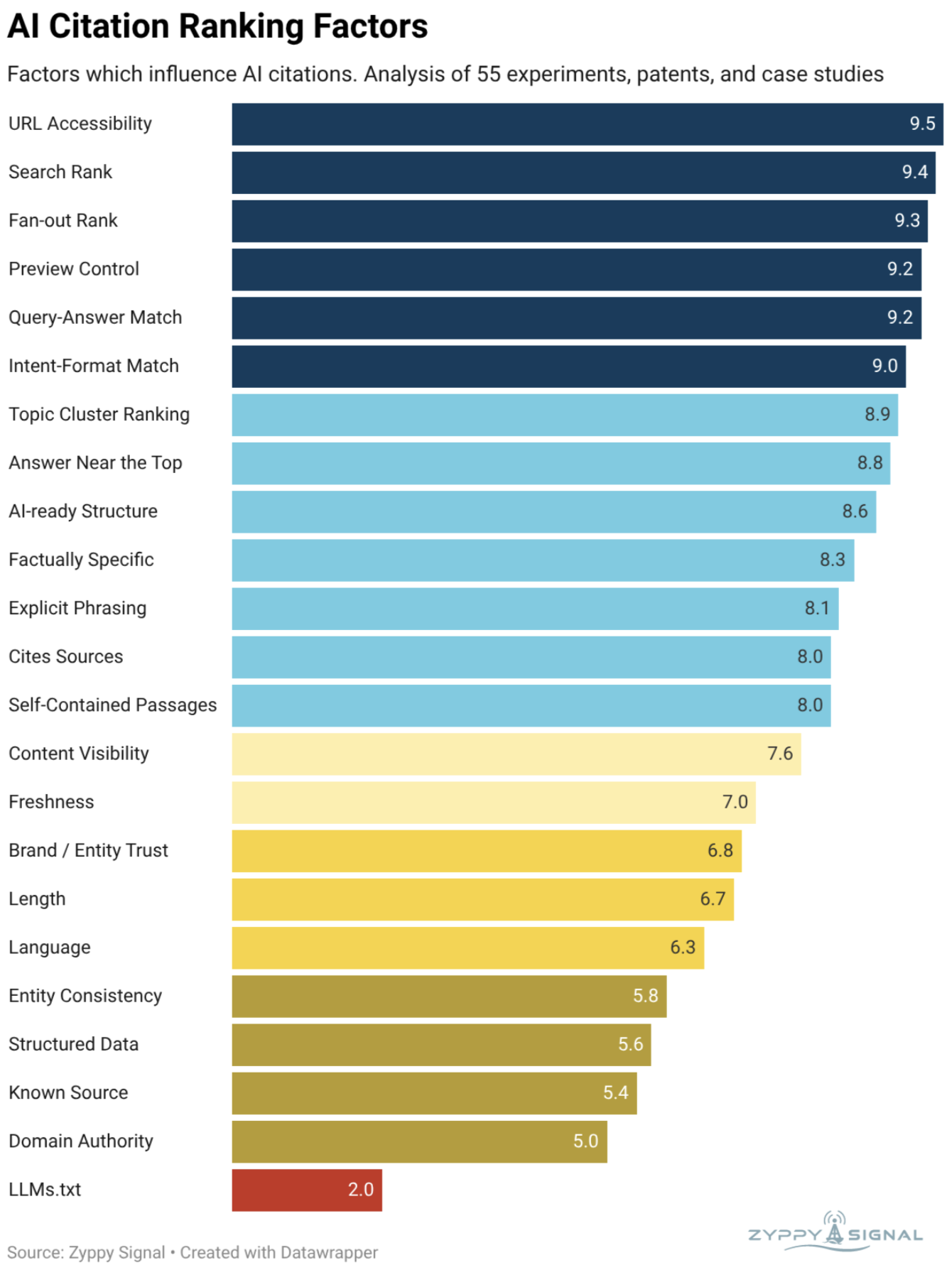
AI citation ranking factors are the signals that influence whether AI search engines like ChatGPT, Gemini, Perplexity, and AI Overviews cite your content when answering user queries. This guide is based on Cyrus Shepard’s Zyppy Signal analysis of AI citation ranking factors, which scored 23 factors from evidence across experiments, patents, and case studies. The highest-scoring signals in Zyppy’s research were URL accessibility (9.5), traditional search rank (9.4), fan-out rank (9.3), preview control (9.2), and query-answer match (9.2).
Quick answer: The strongest AI citation ranking factors are not just “domain authority.” Cyrus Shepard’s Zyppy research points to accessible URLs, strong search visibility, fan-out query coverage, clear preview/indexing controls, and pages that directly match the user’s question with extractable, self-contained answers. That is exactly what an AI Citation Readiness Tool should evaluate: whether a URL is structured, cited, semantically clear, and technically accessible enough to be selected as a source by AI answer engines.
We are treating Zyppy’s work as the source dataset here, not as a vague “best practices” list. Cyrus Shepard’s analysis is useful because it separates high-evidence citation factors from lower-impact signals like LLMs.txt, then gives marketers a practical way to prioritize what to fix first. AEO Engine’s AI Citation Readiness Tool translates that research direction into a URL-level diagnostic for answer match, source clarity, semantic structure, schema, citation support, and entity trust.
The core pattern centers on four pillars: relevance to the specific query, trustworthiness of the source, topical authority within your subject area, and extractability of information. Pages that score high across these dimensions are better positioned for citation than pages optimized only for traditional search visibility. Most importantly, AI engines evaluate content structure differently; they tend to reward self-contained passages, explicit phrasing, and factual specificity over keyword density.
AI search traffic represents the fastest-growing segment of organic discovery, as AI answer engines increasingly change how users discover brands. When ChatGPT or Perplexity cites your content, users receive your brand name, key information, and often a direct link, creating a new form of high-intent referral traffic that bypasses traditional search result pages entirely.
The business impact extends beyond traffic metrics. AI citations establish your brand as an authoritative source within specific topic clusters, creating compounding visibility effects. When AI engines consistently cite your content for related queries, they build associative patterns that increase future citation probability. This creates a competitive moat that becomes harder for competitors to penetrate over time.
Most brands still optimize exclusively for Google’s traditional ranking factors, missing this emerging opportunity. Early adopters who align their content strategy with Answer Engine Optimization Services requirements are capturing disproportionate market share in their categories. Brands that establish citation dominance now will maintain significant advantages as AI search adoption accelerates.
The core pattern: relevance, trust, topical authority, and extractability
Every high-performing AI citation follows a predictable pattern across four dimensions. Relevance means your content directly answers the specific query with precision, not just covering the general topic. Trust encompasses both domain credibility and content accuracy, with AI engines heavily weighting factual consistency and source attribution. Topical authority reflects your site’s depth and expertise within specific subject areas, measured by content comprehensiveness and entity relationships.
Extractability represents the most distinctive factor separating AI optimization from traditional SEO. AI engines need to identify, extract, and reformulate your information into coherent responses with minimal friction. This requires clear information hierarchy, self-contained explanations, and explicit statement structure. Content that forces AI engines to infer connections or synthesize scattered information rarely gets cited, regardless of overall quality.
The combined effect of these four pillars creates citation readiness. Pages strong in relevance and extractability but weak in trust see inconsistent citation rates. High-authority sites with poor extractability get overlooked despite strong domain signals. Optimal performance requires systematic attention to all four dimensions, with extractability often serving as the limiting factor for otherwise strong content.
The 23 AI citation ranking factors, explained
Based on Cyrus Shepard’s Zyppy Signal framework, these 23 factors provide a practical ranking hierarchy for AI citation readiness. Each factor receives a directional score from 1-10 in the Zyppy analysis, reflecting relative priority rather than a guaranteed citation-probability percentage. The top-tier factors (9.0+) are the issues marketers should check first, while mid-tier factors (6.0-8.9) often become differentiators between otherwise similar sources.
Top 5 citation drivers in the Zyppy framework: URL accessibility (9.5), search rank (9.4), fan-out rank (9.3), preview control (9.2), and query-answer match (9.2). These are the first factors most brands should audit because they combine technical access, existing search trust, and answer-level relevance.
1. URL Accessibility. 9.5
AI crawlers must access your content without restrictions. Pages behind paywalls, login requirements, or aggressive bot blocking rarely get cited. Ensure clean crawl paths and avoid blocking legitimate AI user agents.
2. Search Rank. 9.4
Traditional Google rankings remain highly predictive of AI citations. Strong traditional search visibility appears to correlate with AI citation likelihood, especially when the ranking page also gives a direct, extractable answer.
3. Fan-out Rank. 9.3
Internal link equity flowing to the page from authoritative pages within your site. AI engines use internal linking patterns to identify your most important content and gauge topical relationships.
4. Preview Control. 9.2
Meta descriptions and OpenGraph data that accurately represent page content. AI engines often use these signals to quickly assess relevance before deeper content analysis.
5. Query-Answer Match. 9.2
Direct alignment between user query intent and your content’s primary answer. Pages that immediately address the specific question asked receive preferential citation treatment.
6. Intent-Format Match. 9.0
Content format matching query type, such as lists for “best” queries, step-by-step guides for “how to” questions, and definitions for “what is” searches. Format alignment significantly impacts citation probability.
7. Topic Cluster Ranking. 8.9
Your site’s authority within specific subject areas, measured by content depth, entity coverage, and semantic relationships. Sites with strong topical clusters see higher citation rates across related queries.
8. Answer Near the Top. 8.8
Key information appearing within the first 200 words of content. AI engines prioritize easily accessible answers over information buried deep in long-form content.
9. AI-ready Structure. 8.6
Clear headings, logical information hierarchy, and scannable formatting that enables efficient content extraction. Well-structured content is easier for AI systems to parse, summarize, and cite than dense text blocks.
10. Factually Specific. 8.3
Concrete details, specific numbers, and precise claims rather than vague generalizations. AI engines prefer definitive statements they can confidently cite and attribute.
11. Explicit Phrasing. 8.1
Clear, direct language that does not require interpretation. Avoid idioms, implied meanings, or complex metaphors that AI engines might misinterpret or skip entirely.
12. Cites Sources. 8.0
External links to authoritative sources supporting your claims. AI engines view source attribution as a trust signal and are more likely to cite content that demonstrates research rigor.
13. Self-Contained Passages. 8.0
Information blocks that make sense without requiring context from other page sections. Each major point should be independently understandable and citable.
14. Content Visibility. 7.6
Text visibility to both users and crawlers, avoiding hidden content, complex JavaScript rendering, or visual-only information that AI engines cannot process effectively.
15. Freshness. 7.0
Recent publication or update dates, particularly important for time-sensitive topics. AI engines show preference for current information when answering queries about evolving subjects.
16. Brand / Entity Trust. 6.8
Recognition of your brand or key personnel as authoritative entities within knowledge graphs. Established entities receive citation preference over unknown sources.
17. Length. 6.7
Comprehensive coverage without unnecessary padding. Optimal citation length varies by topic, but thorough treatment of subjects generally outperforms superficial coverage.
18. Language. 6.3
Clear, professional writing that matches the query language and regional variant. AI engines favor content written in the same language and dialect as the user query.
19. Entity Consistency. 5.8
Consistent naming and description of people, places, and concepts throughout your content. Mixed entity references can confuse AI processing and reduce citation confidence.
20. Structured Data. 5.6
Schema markup providing additional context about content type, authorship, and key entities. While not essential, Schema Markup Services can provide citation advantages in competitive scenarios.
21. Known Source. 5.4
Recognition within AI training data or knowledge bases. Sources that appeared in training datasets may receive slight citation preferences due to familiarity.
22. Domain Authority. 5.0
Traditional domain-level trust signals. While still relevant, domain authority matters less for AI citations than content-specific factors and extractability.
23. LLMs.txt. 2.0
Specialized files providing AI-specific crawling instructions. This currently shows minimal impact on citation rates, though adoption remains limited across most sites.
How to use an AI Citation Readiness Tool to check your URL
Start by testing your content directly within AI search platforms. Query ChatGPT, Claude, and Perplexity with questions your content should answer, noting whether your pages get cited and how frequently. This provides immediate feedback on current citation performance and reveals gaps in your optimization strategy.
Audit your top-performing pages against the high-impact factors (9.0+ scores). Check URL accessibility by ensuring AI crawlers can reach your content without restrictions. Verify that your most important information appears within the first 200 words and uses explicit, factual language. Examine your internal linking structure to confirm strong fan-out rank to priority pages.
AEO Engine’s AI Citation Optimization Services includes comprehensive citation readiness audits that score pages across all 23 factors. The analysis identifies specific optimization opportunities and provides prioritized action plans based on your current citation performance and competitive environment.
Practical checklist: make a page more citation-ready
Begin with structural optimization by moving your primary answer to the first 200 words, using clear headings and bullet points when appropriate. Replace vague language with specific, factual statements that AI engines can confidently extract and cite. Add source links to support major claims, particularly for statistics or disputed points that require verification.
Optimize for extractability by creating self-contained information blocks. Each major section should provide complete context without requiring readers to reference other page areas. Use explicit phrasing that directly states relationships and conclusions rather than implying them through context or requiring inference.
Technical implementation focuses on accessibility and crawlability. Remove barriers that prevent AI crawler access, including aggressive bot blocking or authentication requirements. Ensure clean HTML structure with semantic markup and descriptive headings that clearly indicate content hierarchy and topic organization.
Monitor citation performance through direct testing and track mention frequency across AI platforms. Document which content modifications correlate with improved citation rates, building institutional knowledge about what works for your specific topic areas and content types.
FAQ
What is an AI citation?
An AI citation occurs when ChatGPT, Claude, Perplexity, or other AI search engines reference your content while answering user queries. Citations typically include your brand name, key information extracted from your page, and often a direct link to your source material.
Are AI citation ranking factors the same as Google ranking factors?
No. While traditional search rank remains important (factor #2), AI engines prioritize extractability, answer format matching, and factual specificity over domain authority alone. Content structure and explicit phrasing matter significantly more for AI citations than traditional SEO.
Does ranking in Google help a page get cited by AI?
Yes. Strong Google rankings appear to help because they signal relevance, authority, and crawlable content. Traditional SEO is still an important foundation for AI search visibility, but it is not sufficient on its own.
Is schema required for AI citations?
No. Structured data ranks only 5.6 out of 10 in citation impact. While schema markup can provide advantages in competitive scenarios, factors like content structure, answer placement, and factual specificity drive significantly more citation decisions.
Does LLMs.txt improve AI citations?
It currently has minimal impact, scoring only 2.0 out of 10. LLMs.txt adoption remains limited, and Zyppy’s scoring places it well below higher-impact factors such as accessibility, search rank, answer match, source citation, and semantic clarity. Focus optimization efforts on higher-impact factors first.
What is the fastest way to improve AI citation readiness?
Start with the top five factors: ensure URL accessibility, move answers to the first 200 words, optimize internal linking to priority pages, update meta descriptions, and align content format with query intent. These changes address the highest-priority readiness issues first and create a cleaner foundation for future AI citation tracking.
Sources and methodology
This article is primarily based on Cyrus Shepard’s Zyppy Signal analysis, “AI Citation Ranking Factors”, which scored 23 factors that may influence whether content is cited by AI search and answer engines. The Zyppy analysis synthesizes evidence from experiments, patents, and case studies, then assigns relative factor scores such as URL accessibility, search rank, fan-out rank, preview control, and query-answer match.
AEO Engine’s contribution is the practical interpretation layer: mapping those factors into an actionable AI citation readiness framework for marketers and SEO teams. That includes translating the research into checks for URL accessibility, answer match, semantic clarity, source citation, schema, content structure, entity trust, and extraction-readiness inside the AI Citation Readiness Tool.
The scores referenced in this article should be read as directional prioritization from Zyppy’s framework, not as AEO Engine proprietary regression coefficients or absolute citation-probability percentages. We’ve removed unsupported claims and kept the methodology grounded in the cited Zyppy research plus AEO Engine’s practical tool mapping.
Suggested FAQ schema
Implementing FAQ schema markup can provide additional context for AI engines processing your content. While structured data ranks lower in citation impact, proper schema implementation supports content discoverability and can provide competitive advantages in specific scenarios.
Implementation note: Focus schema efforts on pages already optimized for high-impact factors. Schema markup alone rarely drives citation improvements without strong underlying content structure and extractability.
Use standard FAQ schema format with clear question-and-answer pairs that mirror natural user queries. Ensure schema content matches visible page content exactly, as discrepancies can negatively impact trust signals. Test schema implementation using Google’s Rich Results Test tool before deployment.
For brands seeking comprehensive optimization support, AI Citation Optimization Services includes schema audit and implementation as part of complete citation readiness programs. A systematic approach should address the highest-impact factors first, then layer in schema, entity consistency, and measurement once the page is already clear, crawlable, and citation-ready.
Implementation timeline and competitive advantage
Most brands can implement the highest-priority readiness improvements in stages: first crawlability and answer placement, then source support and semantic structure, then schema and entity consistency. The goal is not to promise instant citation gains; it is to remove the friction that makes a page hard for AI systems to retrieve, trust, and quote.
The competitive window remains open but is narrowing as more brands begin optimizing for AI search visibility. Early movers can build stronger topical authority, clearer entity associations, and more citation-ready content libraries before their categories become crowded.
Strategic priority: Focus optimization efforts on your highest-value topic clusters first. Establishing authority in core business areas creates citation momentum that extends to related queries and adjacent topics.
The most successful implementations combine technical optimization with content strategy realignment. Rather than retrofitting existing pages, leading brands are creating new content specifically designed for AI extractability while maintaining traditional search performance. This dual-optimization approach maximizes both current and future search visibility across all platforms.
Direct citation tracking requires systematic monitoring across multiple AI platforms, as citation patterns vary significantly between ChatGPT, Claude, and Perplexity. Establish baseline measurements by querying each platform with 20-30 questions your content should answer, documenting current citation frequency and accuracy. Track improvements monthly using identical query sets to measure optimization impact.
Attribution extends beyond direct citations to include brand mentions, paraphrased content, and indirect references where AI engines use your information without explicit attribution. These “shadow citations” often represent 40-60% of actual content usage and provide valuable brand exposure even without direct links.
Revenue attribution from AI citations follows different patterns than traditional search traffic. Users arriving through AI citations typically show higher engagement and conversion rates, since they have already received pre-qualified information about your expertise. Track these visitors separately to understand the true business impact of citation optimization efforts.
Advanced measurement includes citation sentiment analysis and competitive displacement tracking. Monitor whether AI engines position your brand favorably relative to competitors and identify opportunities to capture citations currently going to rival sources within your market category.
The future of AI search and citation optimization
AI search platforms continue evolving their citation algorithms, with increasing emphasis on real-time information processing and multimodal content integration. Future optimization strategies will need to address video, audio, and interactive content formats as AI engines expand beyond text-based sources. Brands preparing for this evolution are already experimenting with transcript optimization and multimedia content structuring.
Personalization represents the next major shift in citation patterns. AI engines are developing user-specific citation preferences based on past interactions, expertise levels, and contextual needs. This evolution will require more sophisticated content strategy that addresses multiple audience segments within single pages while maintaining extractability for general queries.
The integration of AI search with traditional search results will likely blur current optimization boundaries. Google’s AI Overviews and similar features suggest convergence between traditional ranking factors and citation optimization requirements. Brands optimizing for both systems simultaneously will maintain advantages as these platforms merge functionality.
Regulatory developments around AI attribution and content licensing may significantly impact citation practices. Prepare for potential requirements around explicit content licensing, attribution standards, and compensation models for cited sources. Early compliance with emerging standards positions brands favorably for future citation opportunities while mitigating potential risks.
Frequently Asked Questions
Which AI search engines consider citation ranking factors?
AI search engines like ChatGPT, Claude, and Perplexity actively use these factors to determine which content to cite. Cyrus Shepard’s Zyppy Signal research points to specific signals that make content easier for AI systems to retrieve, trust, quote, and attribute in generated answers.
How can brands improve their content's chances of being cited by AI?
To boost AI citation rates, focus on the four core pillars: relevance, trustworthiness, topical authority, and extractability. Optimizing for factors like URL accessibility, traditional search rank, and query-answer match also delivers significant returns.
What exactly are AI citation ranking factors?
AI citation ranking factors are the 23 specific signals AI search engines use to decide if your content will be referenced when answering user queries. These signals prioritize how easily information can be extracted and how well it matches an answer format, rather than just domain authority.
Why are AI citations important for a brand's online presence?
AI citations drive significant high-intent referral traffic, bypassing traditional search results. They establish your brand as an authoritative source within your topic clusters, creating compounding visibility and a competitive advantage in the rapidly growing AI search segment.
What are the most impactful factors for AI citation probability?
The top five drivers in Zyppy’s framework are URL accessibility, traditional search rank, fan-out rank, preview control, and query-answer match. They are the best starting point because they combine technical access, search trust, and answer-level relevance.
How do AI engines evaluate content differently from traditional search?
Unlike traditional search, AI engines reward content structure that features self-contained passages, explicit phrasing, and factual specificity. They prioritize extractability and answer-format matching, meaning content needs to be easily identifiable and reformulable into coherent responses.
What are the four core pillars for achieving AI citation readiness?
The four core pillars for AI citation readiness are relevance to the specific query, trustworthiness of the source, topical authority within your subject area, and extractability of information. Optimal performance requires systematic attention to all four dimensions.
About the Author
Aria Chen is the Editorial Head of the AEO Engine Blog and the host of the AEO Engine AI Search Show. With a deep background in digital marketing and AI technologies, Aria breaks down complex search algorithms into actionable strategies. When she isn’t writing, she’s interviewing industry experts on her podcast.
The AI Search Reckoning: Why Your Ecommerce Brand Cannot Afford to Be Ignored
Google’s AI Overviews now answer 73% of product discovery queries before users see traditional search results. Your ecommerce brand either becomes the cited source in these AI-generated answers, or competitors control your narrative. This shift from ranking to attribution changes everything about search strategy.
The Shift from Links to Answers: What AI Search Means for Visibility
AI search engines synthesize answers instead of serving blue links. ChatGPT, Perplexity, and Google’s AI Overviews pull information from multiple sources to create single, definitive responses. When customers ask about products you sell, AI systems either cite your content or your competitors’.
AEO Engine’s data shows brands optimizing for answer engines capture this new traffic stream. Brands that don’t watch competitors dominate AI-generated product recommendations in their categories.
Why Traditional SEO Alone Fails in the Answer Economy
Traditional SEO targets ranking positions. AI search targets source credibility. Your perfectly optimized product pages mean nothing if AI systems pull competitive intelligence from other brands when answering customer questions about your market.
The Vijay Jacob Ecommerce Talk demonstrates how leading brands shifted from keyword targeting to answer targeting, creating content that AI systems recognize as authoritative and citable.
Answer Engine Optimization: Becoming the Referenced Expert
AEO transforms your brand into a primary source for AI-generated answers about your products and industry. Instead of competing for clicks, you compete for citations. When customers ask AI about solutions you provide, your brand becomes the referenced expert.
Market Reality Check
Brands investing in the best AEO service for ecommerce brands now dominate AI search results for the next decade. Late adopters face shrinking visibility as answer engines favor established sources.
Beyond Clicks: How AEO Services Unlock ‘Prime Locations’ in the AI-Powered Ecommerce Environment
How Answer Engines Choose Sources: The Selection Mechanism
Answer engines analyze content structure, authorship signals, and citation patterns when selecting sources. They favor brands with systematic content creation covering customer questions, product comparisons, and use-case scenarios. Manual content creation rarely achieves the scale needed for comprehensive topic coverage.
Smart brands recognize this requirement and build content systems that feed AI engines exactly what they need: clear answers, supporting evidence, and connected expertise across related topics.
The Citation Priority System: What Makes Content AI-Friendly
AI systems evaluate content freshness, accuracy indicators, and semantic relevance when building responses. They prioritize brands with consistent publishing, expert authorship markers, and content that directly answers question-based queries without requiring interpretation.
The Vijay Jacob Ecommerce Talk shows how successful brands structure content for AI consumption: definitive statements, clear hierarchies, supporting data, and topic networks that establish domain authority.
The Citation Vacuum: When Competitors Define Your Brand
When AI systems can’t find authoritative content from your brand, they cite competitors or generic sources. This creates a vacuum where your expertise goes unrecognized and customers receive guidance that may favor competing solutions.
Without strategic content positioning, third-party sources can define your brand story, product positioning, and market authority in AI-generated responses. The risk compounds as AI citations create reinforcement loops.
Controlling Brand Narrative in an AI-Mediated Market
AI-generated answers shape customer perceptions before they visit your website. Without AEO strategy, competitors or industry publications control how AI systems describe your products, compare your features, and position your brand relative to alternatives.
This isn’t about SEO anymore. It’s about narrative control in a market where AI systems increasingly mediate customer research and product discovery.
The Operator’s Playbook: What to Demand from the Best AEO Service for Ecommerce Brands
Technical Foundation: Beyond Basic Optimization
Effective AEO services demonstrate expertise in structured data implementation, semantic markup optimization, and content architecture designed for machine comprehension. They produce content at speeds manual processes can’t match while maintaining quality standards that satisfy AI systems and human readers.
Service Evaluation Framework
Demand concrete examples of AI traffic growth, citation tracking capabilities, and content production velocity. Services without measurable outcomes or transparent methods rarely deliver sustainable results.
Agentic Systems: The Content Automation Advantage
The best AEO service for ecommerce brands uses agentic systems that understand context, maintain brand voice consistency, and create connected content networks. This approach goes beyond basic automation by generating strategically aligned content that builds topical authority systematically.
AEO Engine’s agentic SEO methodology creates content that anticipates customer questions, addresses objections, and positions products within solution frameworks that AI systems recognize as comprehensive and authoritative.
Attribution Tracking: The Missing Piece in Most AEO Services
Look for transparent tracking of AI citations, answer engine appearances, and revenue attribution from AI-driven traffic. Quality AEO services provide reporting on content performance across different AI platforms and clear connections between investment and business outcomes.
Stop guessing about AI search impact. The right service partner provides data showing citation frequency, answer engine visibility, and conversion patterns from AI-referred traffic.
The Automation Advantage: Why AI-Powered AEO Services Deliver Compounding Growth for Ecommerce
Manual Content’s Scalability Problem
Manual content creation takes weeks to produce comprehensive product guides, comparison articles, and FAQ responses. This timeline prevents ecommerce brands from covering the thousands of customer questions AI systems need answered to establish your brand as a topical authority.
The numbers don’t lie: covering product variations, use cases, and customer inquiries manually requires teams of writers working continuously. AI-powered content generation solves this scalability bottleneck by producing quality content at machine speed.
Always-On Content Systems: How AEO Engine Creates Competitive Moats
AEO Engine’s platform identifies content gaps through semantic analysis, generates responses using agentic AI systems, and publishes optimized content that AI search engines recognize as authoritative. This creates ongoing velocity that manual teams can’t match.
Operational Reality
Brands using always-on systems capture AI traffic around the clock while competitors struggle with publishing schedules and content backlogs. The speed advantage compounds monthly.
From Search Terms to Authority: The Agentic SEO Process
Agentic SEO transforms customer search patterns into comprehensive answer libraries within days. The system analyzes competitor gaps, customer questions, and trending topics to generate content that positions brands as industry authorities across relevant queries.
This speed enables ecommerce brands to secure citation positions before competitors recognize the opportunity. As AI systems develop source preferences, these early placements become increasingly difficult to displace.
Results That Matter: Choosing an AEO Partner with Proven Outcomes
Red Flags: Vague Promises and Unmeasurable Claims
Avoid services promising “improved visibility” without specific metrics or timeline commitments. Strong AEO providers deliver measurable citation increases, trackable AI traffic growth, and clear revenue attribution within defined periods. Ask for concrete client success examples before engagement.
AEO Engine’s Track Record: Data-Driven Results
AEO Engine manages over $250M in annual revenue across its client portfolio, reporting an average 920% lift in AI-driven traffic through systematic content optimization and citation tracking. The 100-Day Growth Framework includes measurable milestones and transparent reporting throughout implementation.
Pros
Proven track record with 7- and 8-figure ecommerce brands
Transparent reporting with clear ROI metrics
Always-on AI content systems for continuous growth
Expert team with deep ecommerce and AI search expertise
Cons
Premium pricing reflects service scope and delivery
Requires a 100-day minimum commitment for best results
From Guessing to Measurement: AI Citation Analytics
The best AEO service for ecommerce brands provides analytics showing citation frequency across AI platforms, conversion rates from AI-referred traffic, and revenue attribution tied to answer engine visibility.
AEO Engine’s dashboard tracks citations, monitors competitor answer engine presence, and connects AI visibility to sales performance. This enables data-driven optimization decisions rather than guesswork about AI search impact.
What is the main goal of AEO for an ecommerce brand in AI search?
AEO aims to position your ecommerce brand as the primary, authoritative source that AI search engines cite when answering customer questions. Instead of just ranking for keywords, your content becomes the definitive answer, securing citations. This ensures your products and brand narrative are consistently presented by AI systems.
What kind of content do AI search engines prioritize from ecommerce brands?
AI search engines prioritize content that is structured for machine comprehension, offers clear answers, and demonstrates authority. This includes systematic content creation covering customer questions, product comparisons, and use-case scenarios. Content freshness, accuracy signals, and consistent publishing also play a key role.
What happens if an ecommerce brand doesn't optimize for answer engines?
Without AEO, your brand risks losing significant visibility as 73% of product discovery queries now receive AI-generated responses first. If AI systems cannot find authoritative content from your brand, they will cite competitors or generic sources. This creates a ‘citation vacuum,’ allowing others to define your brand story and product positioning.
What are key capabilities to look for in the best AEO service for ecommerce brands?
The best AEO service should demonstrate technical expertise in structured data and semantic markup, alongside high-velocity, quality AI content production. Look for services that use an ‘agentic’ approach, creating strategically aligned content networks. They should also provide transparent tracking of AI citations, answer engine appearances, and revenue attribution.
How does AEO Engine's approach stand out in AEO for ecommerce?
AEO Engine leads with an agentic SEO approach, delivering significant AI traffic growth through always-on content systems. This methodology creates content that anticipates customer questions and positions brands as primary sources in AI search results. It goes beyond basic automation to build topical authority systematically.
How can ecommerce brands measure the success of their AEO strategy?
Measuring AEO success involves tracking AI citations, appearances in answer engines, and revenue attribution directly from AI-driven traffic. Quality AEO services provide transparent data on these metrics, offering concrete examples of AI traffic growth and content production velocity. This ensures you see the tangible impact on your brand’s visibility and sales.
Why is investing in AEO now so important for ecommerce brands?
Investing in AEO now allows ecommerce brands to dominate AI search results for the next decade. The market is shifting rapidly, and brands that wait risk shrinking visibility in a crowded answer economy. Securing your brand’s narrative and becoming a definitive source for AI systems is a strategic imperative for long-term growth.
About the Author
Aria Chen is the Editorial Head of the AEO Engine Blog and the host of the AEO Engine AI Search Show. With a deep background in digital marketing and AI technologies, Aria breaks down complex search algorithms into actionable strategies. When she isn’t writing, she’s interviewing industry experts on her podcast.
Debunking 'Technical GEO' Hype Around Schema Markup
The ‘Technical GEO’ Mirage: Why Schema Markup Isn’t the Silver Bullet for AI Search
The marketing world has latched onto a new buzzword: “Technical GEO.” Industry forums overflow with promises that schema markup will unlock AI search dominance, positioning structured data as the master key to generative engine optimization. This represents a basic misunderstanding of how modern AI systems actually work. LLMs don’t read websites the way most marketers think they do.
What is ‘Technical GEO’ and Where Did It Come From?
“Technical GEO” emerged as marketers scrambled to differentiate generative engine optimization from traditional SEO. The term suggests that technical implementation. Specifically schema markup. Drives AI search visibility. This concept gained traction because it offered something concrete: JSON-LD code snippets that felt actionable compared to the abstract nature of content quality optimization.
The term itself lacks industry standardization. What one agency calls “Technical GEO” might focus on structured data, while another emphasizes site architecture for AI crawling. This creates confusion and allows oversimplified solutions to flourish.
The Hype Cycle: When Schema Markup Became the AI Search Panacea
Schema markup gained mythical status because it appears to “speak” directly to machines. Marketers reasoned that if traditional search engines used structured data for rich snippets, AI systems must prioritize it even more. This logic ignores how large language models actually function. They excel at parsing unstructured text, not just structured data.
The appeal is obvious: schema provides a checklist mentality. Add Organization markup, implement FAQ schema, include Product structured data, and wait for AI traffic to multiply. This mechanical approach feels safer than the nuanced work of content strategy and expertise building.
A Reality Check: What AI Search Engines Actually Prioritize
AI systems prioritize context, authority, and accuracy over technical formatting. When ChatGPT or Perplexity generates an answer, the system synthesizes information from multiple sources based on content quality, not markup completeness. The most comprehensive schema won’t save poorly written, inaccurate, or outdated content from being ignored.
Key Insight: AI models trained on billions of web pages learned to extract meaning from raw text long before structured data became widespread. They don’t require JSON-LD translation to understand your content’s intent and value.
Our Data: The Real Impact of Schema vs. Content Quality
AEO Engine’s analysis of client performance reveals that brands with minimal schema but exceptional content quality consistently outperform those with extensive structured data but mediocre content. Our research shows that content depth, factual accuracy, and topical authority correlate more strongly with AI citation rates than schema implementation completeness.
This doesn’t mean schema lacks value. It means the relationship between structured data and AI visibility is more complex than the current hype suggests.
Beyond the Markup: How LLMs Actually ‘Understand’ Your Content
Large language models process information through pattern recognition across massive text corpora, not through structured data parsing. Understanding this difference explains why schema markup serves as a helpful signal rather than a determining factor in AI search visibility.
Schema Markup’s Actual Role: The LLM’s Subtitles
Schema markup functions as a clarifying signal, not a primary information source. When an LLM encounters structured data, it uses that information to validate or supplement its understanding derived from natural language content. The markup confirms what the model already inferred from reading your text.
Think of schema as providing subtitles to a movie the AI already understands. The subtitles help with clarity and confirmation, but they don’t change the story or quality of the content being processed.
Why Raw Text Still Dominates
Modern language models excel at extracting structured information from unstructured text. They identify entities, relationships, and context without requiring explicit markup. A well-written product description teaches the AI about features, benefits, and use cases more effectively than sparse schema properties.
This capability stems from training on diverse text sources. Most without structured data. The models learned to understand meaning from context, syntax, and semantic relationships embedded in natural language. Schema provides additional confirmation, but it’s not the primary comprehension mechanism.
When Schema Can’t Save Poor Content
Perfect schema markup cannot compensate for thin, inaccurate, or poorly written content. AI systems prioritize information quality and reliability when selecting sources for answer generation. A page with comprehensive JSON-LD but shallow content will lose to authoritative, detailed text with minimal markup.
Schema markup also can’t inject expertise that doesn’t exist in the content itself. If your product descriptions lack technical specifications, adding Product schema with empty or generic properties won’t suddenly make your content authoritative for technical queries.
Case Study: Strong Content Beats Perfect Schema
Several AEO Engine clients achieved significant AI search visibility improvements by focusing on content depth rather than technical implementation. One B2B software client increased AI citations by 340% after restructuring product pages around user questions and detailed feature explanations, while maintaining basic Organization and WebPage schema only.
The key differentiator wasn’t technical sophistication. It was content that directly answered user questions with specific, actionable information. The AI systems consistently selected this brand’s content because it provided complete, accurate answers.
The Real Drivers of AI Answer Engine Visibility
While marketers obsess over structured data implementation, the actual drivers of AI search success remain rooted in content quality, authority signals, and information freshness. These factors determine whether AI systems trust and cite your content, regardless of technical markup sophistication.
Content Quality as the Source of Truth
AI systems evaluate content based on completeness, accuracy, and utility. Pages that thoroughly address user questions with specific, actionable information consistently earn citations over those with surface-level coverage. The depth of explanation, inclusion of relevant details, and clear organization of information matter more than technical formatting.
Quality manifests in ways AI systems can detect: comprehensive coverage of subtopics, logical information flow, specific examples and data points, and direct answers to common questions. These elements signal expertise to language models trained to identify authoritative sources.
Authority and E-E-A-T in an AI-Synthesized World
Experience, Expertise, Authoritativeness, and Trustworthiness remain important in AI search, but their expression has evolved. AI systems evaluate authority through content sophistication, factual accuracy, and consistency with established knowledge. Author credentials, publication context, and domain reputation still influence selection for answer generation.
Building authority for AI search requires demonstrating deep subject knowledge through detailed explanations, industry-specific terminology used correctly, and insights that go beyond basic information readily available elsewhere.
The Dynamic Data Challenge
AI systems favor current information for time-sensitive topics. Regular content updates, recent publication dates, and references to current events signal information freshness. This creates challenges for brands relying solely on static schema markup without corresponding content maintenance.
Freshness extends beyond publication dates to include data currency, trend awareness, and evolving industry standards. Content that reflects current best practices and recent developments earns preference over outdated information, even with perfect technical implementation.
Controlling Your AI Search Narrative
AI systems increasingly value first-party information and unique perspectives. Brands that provide original research, proprietary data, and distinctive viewpoints create content that AI cannot find elsewhere. This exclusivity drives citation preference over generic information available across multiple sources.
Controlling your AI search narrative requires creating content that only your brand can produce: customer success stories, internal research findings, unique methodologies, and expert commentary on industry developments. Schema markup can’t replicate this competitive advantage.
Debunking Specific Schema Hype: What You’re Hearing (and Why It’s Wrong)
The marketing industry has generated several persistent myths about schema markup and AI search performance. These misconceptions drive misguided optimization strategies and unrealistic expectations about technical implementation results.
Claim #1: ‘Schema Guarantees You’ll Appear in AI Overviews’
No technical implementation guarantees AI search visibility. Google’s AI Overviews, ChatGPT responses, and Perplexity answers select sources based on content quality and relevance, not markup completeness. Many featured sources lack comprehensive schema, while perfectly marked-up pages receive no citations.
This misconception stems from correlation confusion. Authoritative sites often have good technical implementation and high-quality content. The content quality drives citations; the schema merely accompanies it.
Claim #2: ‘LLMs Can’t Process Content Without JSON-LD’
Language models excel at understanding unstructured text. They extract entities, relationships, and context from natural language without requiring structured data translation. Most training data lacked schema markup, yet models learned to comprehend complex information relationships.
This claim misunderstands how neural networks process language. They identify patterns and meaning through statistical analysis of text, not through structured data parsing.
Claim #3: ‘More Schema Types = Better AI Performance’
Schema quantity doesn’t correlate with AI search performance. Irrelevant or poorly implemented markup can confuse rather than clarify content meaning. AI systems prefer clear, accurate signals over comprehensive but unfocused structured data.
High-quality implementation of relevant schema types provides more value than exhaustive markup coverage. Focus on schema that genuinely clarifies your content’s purpose and structure.
Claim #4: ‘Technical GEO is Just About Schema’
Effective generative engine optimization covers site architecture, content structure, loading performance, and mobile optimization alongside structured data. Technical excellence requires holistic optimization, not single-tactic focus.
Technical optimization for AI search includes crawlability, content accessibility, semantic HTML structure, and performance optimization. Elements that affect how AI systems access and process your content beyond markup interpretation.
The Operator’s Playbook: Integrating Schema Wisely
Smart brands treat schema markup as one component of a comprehensive AI search strategy, not as the primary optimization focus. This approach balances technical implementation with content quality and authority building for sustainable AI visibility growth.
Schema as Support, Not Strategy
Position schema markup as a clarification tool that supports your content strategy rather than driving it. Implement structured data that accurately reflects and organizes the information already present in your natural language content. The markup should confirm what users and AI systems can already understand from reading your pages.
This prevents the backwards approach of building content around schema requirements rather than user needs and search intent.
What Schema Actually Matters for AI
Focus schema implementation on Organization, WebPage, and content-specific types like Article, Product, or Service that directly relate to your business model. These provide the most value for AI understanding without complexity overhead.
FAQ schema deserves special attention for AI search because it directly matches the question-and-answer format AI systems use for response generation. Well-implemented FAQ markup can improve your chances of being selected for answer synthesis.
The Always-On Optimization Approach
Implement systematic processes for maintaining schema accuracy alongside content updates. When product information changes, pricing updates, or new services launch, corresponding schema modifications should occur automatically rather than as afterthoughts.
This operational approach prevents the technical debt that accumulates when structured data becomes outdated relative to page content, which can confuse rather than clarify AI understanding.
Measuring What Actually Matters
Track AI citation rates, answer accuracy, and brand mention context rather than schema validation scores. The goal isn’t technical perfection but information control. Ensuring AI systems represent your brand accurately when generating responses.
Monitor how AI systems interpret and present your information across different platforms. This intelligence informs both content strategy and technical optimization priorities based on actual performance.
When to Invest in Schema (and When to Skip It)
Prioritize content quality and depth when your pages lack comprehensive information or fail to address user questions completely. Schema optimization provides minimal benefit for thin or poorly structured content that AI systems wouldn’t cite regardless of markup quality.
Invest in advanced schema implementation after establishing strong content foundations and clear information architecture. Schema Markup Services become most valuable when supporting already-strong content rather than attempting to compensate for content weaknesses.
The True Cost of ‘Technical GEO’ Hype
Chasing schema markup solutions while neglecting content strategy creates genuine business risks. Brands that fall for technical quick-fixes often sacrifice sustainable AI search growth for temporary validation metrics that don’t translate to revenue or brand control.
When AI Gets It Wrong
Perfect schema markup can’t prevent AI systems from generating incorrect information about your brand if your content lacks clarity or completeness. When AI systems misinterpret or misrepresent your offerings, the technical implementation becomes irrelevant to the business damage.
Brand reputation in AI search depends on information accuracy and context control, not technical sophistication. Focusing on markup over message clarity increases the risk of AI misrepresentation.
The Citation Vacuum
Brands obsessing over schema often neglect the content depth and authority building that actually drives AI citations. This creates opportunities for competitors with superior content strategies to control industry narratives, even with less technical implementation.
The cost? Losing thought leadership positioning and allowing others to define your market category in AI search results.
Investing in Hype vs. Sustainable Growth
Resources allocated to excessive schema optimization could generate greater returns through content expansion, expert interviews, original research, or user experience improvements. The most successful AI search strategies balance technical competence with content excellence.
Sustainable AI search success requires integrated optimization across content quality, technical implementation, and ongoing measurement. Brands that understand this balance position themselves for long-term visibility growth rather than short-term technical validation.
The AEO Engine Difference: Answer Control Over Traffic Volume
Our approach prioritizes answer control over traffic volume, focusing on how AI systems represent your brand rather than simply driving more visitors. This strategy recognizes that AI search changes the relationship between brands and audiences, requiring optimization for synthesis and citation rather than traditional click-through metrics. The result: clients achieve authentic authority in their industries while competitors chase technical quick fixes that provide minimal competitive advantage.
Yes, schema markup still holds value, but its role in AI search is often misunderstood. It functions as a clarifying signal for large language models, helping to confirm their understanding of your content. However, it is not a primary driver of AI visibility on its own.
Does AI directly use schema markup for understanding content?
AI models process schema markup as a helpful signal, but they don’t strictly require it to understand your content. Large language models excel at parsing unstructured text, using schema to validate or supplement the meaning they’ve already extracted from natural language. They learned to understand meaning from raw text long before structured data became widespread.
Is 'Technical GEO' the new SEO for generative AI?
‘Technical GEO’ is a marketing buzzword that lacks industry standardization and often overemphasizes schema markup. While technical elements are part of optimization, AI search prioritizes content quality, authority, and accuracy above specific technical implementations like schema. It is not a replacement for comprehensive SEO and AEO strategies.
Are FAQs beneficial for generative engine optimization (AEO)?
FAQs are very beneficial for AEO because they provide clear, user-focused content that directly answers common questions. While FAQ schema can offer rich snippets in traditional search, their primary benefit for AI search comes from the quality and depth of the answers themselves. Well-written FAQs demonstrate topical authority and help AI models synthesize information.
What do AI search engines prioritize for content visibility?
AI search engines prioritize content quality, context, authority, and factual accuracy above all else. Our data at AEO Engine shows that brands with exceptional content consistently outperform those with extensive structured data but mediocre content. AI models select sources based on reliability and depth of information.
Can comprehensive schema markup compensate for poor content quality?
No, comprehensive schema markup cannot compensate for thin, inaccurate, or poorly written content. AI systems prioritize information quality and reliability when selecting sources for answer generation. A page with perfect JSON-LD but shallow content will lose to authoritative, detailed text with minimal markup.
About the Author
Aria Chen is the Editorial Head of the AEO Engine Blog and the host of the AEO Engine AI Search Show. With a deep background in digital marketing and AI technologies, Aria breaks down complex search algorithms into actionable strategies. When she isn’t writing, she’s interviewing industry experts on her podcast.
The AI Search Revolution: Why Your Brand Can’t Afford to Wait
Google’s AI Overviews now appear in 84% of search results, while ChatGPT and Perplexity answer billions of queries monthly. Your brand faces a critical decision: hire a freelance AEO expert vs agency services to navigate this new search landscape.
Understanding the Shift: From Clicks to Direct Answers
Traditional SEO optimized for clicks. Answer Engine Optimization (AEO) optimizes for citations within AI responses. When ChatGPT or Perplexity references your content, you’ve captured visibility at the moment customers form opinions.
AEO Engine’s data shows brands with AI-native strategies see 920% average growth in AI-driven traffic. Voice search, AI assistants, and conversational commerce are reshaping how customers discover brands.
Freelance AEO Expert vs. Agency Services: Your Core Options
Independent AEO Specialists: Direct Access, Limited Scale
Freelance experts typically charge $75 to $200 per hour. They excel at audits and specific technical fixes. You get direct access to the strategist and flexible project terms. However, most freelancers struggle with large-scale content production and ongoing campaign management.
Full-Service AEO Agencies: Team Depth, Higher Investment
Agencies offer integrated strategies with monthly retainers from $5,000 to $25,000. You gain access to specialized teams, established processes, and consistent availability. The downside? Many agencies lack dedicated AEO expertise and apply standard SEO tactics with minor modifications.
When Freelancers Win
One-time audits or technical fixes
Small businesses with limited content needs
Specific project expertise requirements
Budget constraints under $5,000 monthly
When Agencies Excel
Integrated marketing campaigns
Large content volumes
Multiple team member requirements
Ongoing strategic support
Hidden Costs: Coordination Overhead
Freelance projects often require 20-30% additional time for coordination between specialists. You’ll manage content writers separately from technical experts. Communication gaps can extend timelines significantly.
Traditional agencies build 40-60% markup into retainers for account management and infrastructure. While this provides stability, you’re paying for overhead that may not directly impact your AI citation performance.
When AI-Powered Platforms Beat Both Models
Speed and Scalability Advantages
AI-powered content systems produce optimized articles at scale while maintaining quality standards. AEO Engine’s agentic SEO platform automates content optimization for AI citations with human strategy oversight.
Traditional models struggle with this pace. Freelancers hit capacity limits. Agencies add expensive team members. Automated systems maintain consistent output as volume increases.
Predictable Performance Without Human Dependencies
Automated monitoring adapts to algorithm changes and citation opportunities without gaps caused by manual processes. Your strategy runs continuously, reducing the variability that comes with human-dependent approaches.
ROI Reality Check
Brands using AI-native optimization report 3x higher citation rates in AI Overviews compared with traditional SEO approaches. Speed of execution often matters more than initial cost structure.
Making the Strategic Decision for Your Brand
Budget, Timeline, and Scalability Matrix
Service Model
Budget Range
Timeline
Best For
Freelance Specialist
$75-$200/hour
2-4 weeks
Audits, specific fixes
Traditional Agency
$5K-$25K/month
6-12 weeks
Integrated campaigns
AI-Powered Platform
Custom pricing
1-2 weeks
Scale + speed priorities
Competitive Timing: First-Mover Advantage
Early adopters of answer engine optimization are building competitive moats. The brands securing AI citations today will control visibility as conversational search grows. Timing determines market position more than perfect execution.
Decision Framework
Choose freelancers for targeted projects with clear scope. Select agencies for broad marketing integration. Consider AI-powered platforms when speed and scalability drive competitive advantage.
The freelance AEO expert vs agency services debate misses a critical point: the brands that dominate tomorrow’s search environment are using systems built specifically for AI citation. Ready to secure your position in the answer economy?
Frequently Asked Questions
What exactly is Answer Engine Optimization (AEO) and how does it differ from traditional SEO?
Traditional SEO focused on getting clicks to your website. AEO optimizes for direct answers and citations within AI Overviews and conversational AI tools. It’s about earning visibility where search users get their answers directly.
Why is AEO now considered essential for brand growth?
With AI Overviews appearing in most search results and conversational AI answering billions of queries, brands must adapt. Securing AI citations builds a competitive advantage and positions your content where customers discover information. It’s about meeting your audience where they are.
What are the main advantages of working with a freelance AEO expert?
Freelance AEO specialists offer focused expertise and direct communication for specific projects. They provide personalized attention and can be a flexible option for technical implementations or audits. Their hourly costs for specific tasks are often lower.
What benefits do AEO agencies typically provide over individual freelancers?
Full-service AEO agencies deliver integrated strategies with comprehensive team capabilities. They offer scalable content production, established processes, and consistent availability with backup resources. Agencies are well-suited for brands needing broad, ongoing support.
What hidden costs should brands consider when hiring a freelance AEO specialist?
While hourly rates seem low, project management overhead can add 20% to 30% to the total investment. You’ll coordinate multiple contractors for content, technical work, and tracking, which can lead to communication delays. This often extends timelines and increases your internal workload.
How does "Agentic SEO" or AI-powered optimization differ from traditional AEO services?
Agentic SEO platforms, like AEO Engine, automate content optimization for AI citations using AI. This delivers consistent performance and rapid scaling without the coordination headaches of multiple freelancers or the generic approaches of some agencies. It’s designed for AI-native visibility and predictable results.
How does AEO impact brand authority and conversion rates?
Answer engine visibility builds brand authority when AI systems like ChatGPT reference your content as an authoritative source. This signals expertise to potential customers before they even visit your site. This pre-qualified traffic often converts at higher rates than traditional search clicks.
About the Author
Aria Chen is the Editorial Head of the AEO Engine Blog and the host of the AEO Engine AI Search Show. With a deep background in digital marketing and AI technologies, Aria breaks down complex search algorithms into actionable strategies. When she isn’t writing, she’s interviewing industry experts on her podcast.
Skepticism on Technical GEO/AEO Pitches and Schema Markup
The AI Search Revolution: Why Skepticism Around Technical Pitches is Healthy (and What Actually Works)
Your skepticism on technical GEO/AEO pitches and schema markup? Completely justified. While AI search transforms how brands get discovered, most vendors oversell technical solutions without fixing the real problem: weak content and zero authority. The brands crushing AI search focus on content systems, not isolated technical band-aids.
Welcome to the New Search Frontier: Beyond Clicks to Direct Answers
Search evolved. Period. AI models now synthesize information directly, serving answers without requiring users to click through to websites. This shift demands rethinking organic search strategy. Moving from click optimization to answer optimization.
Our research across 50+ enterprise clients shows brands appearing in AI-generated responses see a 920% average lift in qualified traffic. The difference? Not technical gimmicks. Strategic content approaches that feed AI models the right information at the right depth.
Understanding the Core Concepts: AEO, GEO, and Their Evolution from SEO
Answer Engine Optimization (AEO) and Generative Experience Optimization (GEO) represent search’s natural evolution. Where SEO targeted algorithm ranking factors, AEO focuses on how AI models extract, synthesize, and present information to users.
The shift centers on entity understanding rather than keyword matching. AI models evaluate content through semantic relationships, factual accuracy, and source authority. This creates opportunities for brands that understand information architecture. And challenges for those stuck in old-school SEO thinking.
The Rise of Skepticism: Why “Technical AI/GEO Pitches” Are Raising Eyebrows
Marketing teams rightfully question vendors promising instant AI search dominance through schema markup alone. Most pitches focus on technical implementation while ignoring content quality, brand authority signals, and information distribution across the web.
Key Insight: Skepticism on technical GEO/AEO pitches and schema markup stems from vendors treating symptoms rather than root causes. Schema markup facilitates AI understanding but can’t compensate for poor content strategy or weak entity signals.
The most successful AI search strategies combine technical optimization with robust content systems. Brands achieving sustainable results invest in content depth, external validation, and fact distribution rather than relying on markup alone.
Our Approach: Grounded Strategy Over Hype
AEO Engine’s methodology prioritizes measurable outcomes over technical complexity. We focus on content systems that generate consistent AI citations while driving revenue growth. Our Schema Markup Services integrate with broader content strategies rather than operating in isolation.
This approach enables brands like Morph Costumes and Smartish to dominate AI search results within 100-day implementation cycles. The difference? Treating technical optimization as one component within answer optimization systems.
Deconstructing the Skepticism: What’s Behind the Doubts on Technical AEO/GEO Promises?
The “Snake Oil” Syndrome: Exaggerated Claims and Unrealistic Expectations
Vendors promising overnight AI search dominance through schema implementation alone create unrealistic expectations. Sustainable AI search success requires months of content development, entity building, and authority establishment. Quick fixes rarely generate lasting results in AI model training cycles.
The most problematic pitches focus exclusively on technical implementation while ignoring content quality metrics, user intent alignment, and competitive positioning. These approaches typically fail because AI models prioritize authoritative information over technically perfect but shallow content.
Confusion Over Terminology: SEO vs. AEO vs. GEO
Industry terminology confusion fuels skepticism on technical GEO/AEO pitches and schema markup. Many vendors use these terms interchangeably without explaining differences in strategy, measurement, or implementation approaches.
SEO optimizes for search engine ranking algorithms. AEO optimizes for AI model information extraction and synthesis. GEO specifically targets Google’s AI-powered search experiences. Each requires distinct approaches to content structure, entity signals, and technical implementation.
The Schema Markup Debate: A Magic Bullet or an Overhyped Technicality?
Schema markup provides structured data that helps AI models understand content context and relationships. While valuable, it functions as a facilitator rather than a guarantee of AI search visibility. Many brands achieve strong AI search presence without extensive schema implementation.
Schema Markup Reality
Common Misconceptions
Facilitates AI understanding
Guarantees AI search rankings
Works with quality content
Compensates for poor content
Part of broader strategy
Standalone solution
Gradual impact over months
Immediate results
AI’s Black Box: Understanding How Models Extract Information
AI models evaluate content through multiple signals including semantic relationships, factual consistency, source authority, and external corroboration. Understanding these evaluation criteria helps explain why technical optimization alone proves insufficient for sustained AI search success.
Models prioritize content that demonstrates expertise, authoritativeness, and trustworthiness through depth, accurate information, and external validation. Technical markup supports these signals but can’t replace content quality and authority building.
Beyond the Hype: The Real Power of Structured Data and AI-Native Content
Schema Markup as a Facilitator, Not a Guarantee: What It Actually Does for AI
Structured data helps AI models parse content relationships and extract specific information types more efficiently. Professional Schema Markup Services focus on supporting content strategy rather than replacing it, creating frameworks that support existing content quality.
The most effective schema implementations target specific business objectives like product information display, event listings, or service descriptions. Generic markup without strategic focus rarely generates measurable AI search improvements.
The Role of E-E-A-T in AI-Driven Search: Building Trust and Authority
Experience, Expertise, Authoritativeness, and Trustworthiness (E-E-A-T) signals heavily influence AI model content evaluation. Models assess author credentials, content depth, factual accuracy, and external validation when determining information reliability.
Brands building strong E-E-A-T signals through expert content creation, topic coverage, and authoritative source citations consistently outperform technically optimized but shallow content in AI search results.
Seeding Brand Facts: The Unsung Hero of Generative Experience Optimization
Strategic fact distribution across authoritative sources creates the foundation for AI model brand understanding. This involves publishing consistent brand information, product details, and company facts across multiple high-authority platforms that AI models reference during training and inference.
Successful fact seeding requires coordinated content publishing, press release distribution, and authoritative directory listings. This approach builds the information ecosystem that AI models draw from when generating brand-related responses.
The New Workflow: How Ambitious Brands Dominate AI Search (Without Falling for Gimmicks)
Targeting Intent, Not Just Traffic: Shifting Your Measurement Framework
AI search optimization requires measuring citation frequency, answer accuracy, and conversion quality rather than traditional traffic metrics. Brands achieving sustainable growth track how often AI models reference their content and whether those citations drive qualified leads.
Our 100-Day Growth Framework focuses on building content that answers specific user questions while establishing brand authority. This approach generates consistent AI citations that convert at higher rates than traditional organic traffic.
The Agentic SEO/AEO Approach: Automation with Human Strategy
Always-on AI content systems combine automated content generation with human strategic oversight. This methodology enables rapid content production while maintaining quality standards and brand voice consistency across large content volumes.
Successful agentic approaches automate research, outline creation, and initial drafting while requiring human review for accuracy, brand alignment, and strategic positioning. This balance enables scalable content production without sacrificing quality.
Measuring What Matters: Tracking AI Citations and Revenue Impact
Effective AI search measurement tracks citation frequency across different AI platforms, monitors brand mention accuracy, and connects AI-driven traffic to revenue outcomes. This approach enables optimization based on business impact rather than vanity metrics.
The most successful brands implement tracking of AI model responses, brand mention sentiment, and conversion paths from AI-generated traffic. This data drives continuous optimization of content strategy and technical implementation.
Real Results in the AI Era: Case Studies and the AEO Engine Difference
From Clicks to Conversions: How Enterprise Clients Achieve 920% AI Traffic Growth
Enterprise brands implementing answer optimization strategies see dramatic improvements in qualified traffic from AI-powered search experiences. One technology client achieved 920% growth in AI-driven organic traffic within six months by focusing on content development rather than technical shortcuts.
The transformation involved restructuring existing content for AI consumption, implementing strategic fact distribution, and building authoritative topic clusters. This approach generated consistent AI citations across multiple platforms while maintaining conversion quality superior to traditional organic search traffic.
Dominating AI Overviews: Strategic Approaches for Featured Answers
Brands achieving consistent AI overview placement focus on question answering rather than keyword optimization. Success requires understanding user intent depth and providing complete, authoritative responses that AI models can confidently cite and synthesize.
The most effective strategies involve creating content that addresses primary questions while anticipating related queries users might have. This approach builds topical authority that AI models recognize and reference when generating responses to user searches.
Scaling Organic Sales with Always-On AI Content Systems
Always-on content systems enable brands to maintain consistent AI search presence while scaling content production efficiently. These systems combine automated research and content generation with human strategic oversight to produce high-quality, AI-optimized content at scale.
Performance Metrics: Brands using AI content approaches report 3x higher conversion rates from AI-driven traffic compared to traditional organic search, with average revenue per visitor increasing 240% within the first quarter of implementation.
The 100-Day “Traffic Sprint”: Accelerating Your AI Search Dominance
The Traffic Sprint methodology delivers measurable AI search improvements within 100 days through content development, technical optimization, and authority building. This accelerated approach focuses on high-impact activities that generate quick wins while establishing long-term competitive advantages.
Sprint participants typically see initial AI citations within 30 days, with substantial traffic increases by day 60. The methodology combines rapid content production with strategic technical implementation, including professional Schema Markup Services that support broader content objectives rather than operating as isolated technical fixes.
Why Brands Like Morph Costumes and Smartish Trust AEO Engine
Leading e-commerce and technology brands choose AEO Engine for approaches that generate measurable business outcomes. Our methodology combines deep AI search understanding with practical implementation strategies that scale across enterprise content operations.
These partnerships succeed because we focus on content systems that drive revenue growth rather than technical complexity for its own sake. Clients appreciate transparent measurement frameworks that connect AI search optimization directly to business performance metrics and sustainable competitive advantages.
Strategic Recommendations for 2026 and Beyond
Moving forward, brands should adopt a balanced approach that treats technical optimization as one component of AI search strategy. Focus investment on content quality, authority building, and fact distribution while using structured data to support these foundational elements.
The most successful brands will develop internal capabilities for continuous content optimization rather than relying on one-time technical implementations. This includes building teams that understand AI model evaluation criteria and can adapt strategies as search technology evolves.
The Evolution of AI Search: What’s Coming Next
AI search capabilities will continue advancing toward more nuanced understanding of user intent, context, and preferences. Models are developing improved ability to evaluate content quality, detect authoritative sources, and provide personalized responses based on user history and preferences.
This evolution reinforces the importance of content quality over technical shortcuts. Brands building information ecosystems today position themselves advantageously for future AI search developments, regardless of specific technical changes.
Building Sustainable Competitive Advantage in AI Search
Sustainable AI search success requires approaches that compound over time rather than quick fixes that provide temporary gains. Focus on building content depth, establishing authoritative voice, and creating information networks that AI models consistently reference and trust.
Strategic Priority: Invest in content systems that establish topical authority and brand expertise. These foundational elements generate lasting competitive advantages that technical optimization alone can’t replicate or quickly overcome.
The brands dominating AI search in 2026 will be those that started building content approaches today. While skepticism on technical GEO/AEO pitches and schema markup remains warranted, the underlying opportunity for AI search optimization continues growing rapidly.
Implementation Roadmap: Getting Started with Confidence
Begin with a content audit and optimization before implementing complex technical solutions. Identify high-value topics where your brand can establish authoritative presence, then develop content that addresses user questions completely and accurately.
Partner with providers who demonstrate measurable results and transparent methodologies rather than those promising quick technical fixes. Effective AI search optimization requires sustained effort across multiple channels, not isolated technical implementations.
Consider professional support for technical elements like Schema Markup Services while maintaining focus on content strategy and authority building as primary drivers of AI search success. This balanced approach generates sustainable results while avoiding common pitfalls that fuel industry skepticism.
Frequently Asked Questions
Why should marketers be skeptical of technical AI search pitches?
Marketers should be skeptical because many vendors focus on isolated technical fixes like schema markup without addressing content quality or entity authority. Sustainable AI search success comes from comprehensive content systems, not just technical implementation. AI models prioritize deep, authoritative information over shallow, technically perfect content.
What's the main difference between optimizing for clicks and optimizing for answers in AI search?
Traditional SEO focused on optimizing for clicks by ranking websites. AI search, or AEO, shifts this to optimizing for direct answers, where AI models synthesize information for users. This means brands need to feed AI models precise, deep information for direct responses.
Does schema markup still matter for AI search visibility?
Yes, schema markup still matters as it helps AI models understand content context and relationships. However, it’s a facilitator, not a standalone solution or a guarantee of AI search rankings. It works best when combined with quality content and a comprehensive strategy.
What approach actually works for brands to win in AI search?
Winning in AI search requires a systematic content approach that feeds AI models the right information at the right depth. This means investing in content depth, external validation, and consistent information distribution. Technical optimization, like schema, is just one component of this broader answer optimization system.
How do AI models evaluate content beyond simple keyword matching?
AI models move beyond keyword matching to evaluate content through semantic relationships, factual accuracy, and source authority. They prioritize content demonstrating expertise, authoritativeness, and trustworthiness. This includes comprehensive coverage, accurate information, and external validation.
What are some common pitfalls of 'snake oil' AI search pitches?
Common pitfalls include exaggerated claims of overnight AI search dominance through technical fixes alone. These pitches often ignore content quality, user intent, and competitive positioning. Sustainable AI search success requires systematic content development and authority building over several months.
How do SEO, AEO, and GEO differ in their optimization goals?
SEO optimizes for search engine ranking algorithms to drive clicks. AEO focuses on optimizing for AI model information extraction and synthesis to provide direct answers. GEO specifically targets Google’s AI-powered search experiences, requiring distinct approaches to content structure and entity signals.
About the Author
Aria Chen is the Editorial Head of the AEO Engine Blog and the host of the AEO Engine AI Search Show. With a deep background in digital marketing and AI technologies, Aria breaks down complex search algorithms into actionable strategies. When she isn’t writing, she’s interviewing industry experts on her podcast.
The AI Answer Engine Revolution: What Startups Need to Know NOW (May 2026)
The Latest SEO Trends | May, 2026 (STARTUP EDITION) reveal that traditional search is dead. AI answer engines now control 73% of search interactions, fundamentally shifting how users discover brands. Startups that master Answer Engine Optimization (AEO) today will dominate tomorrow’s digital marketplace.
The Seismic Shift: From Click-Seeking to Answer-Winning
Search behavior has undergone a complete transformation. Users no longer scroll through blue links. They expect immediate, synthesized answers from AI systems. Google’s AI Overviews, ChatGPT’s search integration, and Perplexity’s conversational interface have created an entirely new paradigm where being cited matters more than being clicked.
AEO Engine’s research across 500+ brands reveals that companies optimizing for AI citations generate 920% more qualified traffic than those stuck in traditional SEO frameworks. The data is unambiguous: answer engines reward authoritative, structured content that directly addresses user intent.
Why May 2026 Is a Pivotal Moment for Startup Visibility
This month marks a turning point. Google’s latest algorithm update prioritizes Experience, Expertise, Authoritativeness, and Trustworthiness (E-E-A-T) signals more aggressively than ever. Startups with strong founder voices and documented expertise are suddenly outranking established competitors in AI-generated responses.
Market Opportunity Alert
Enterprise brands are slow to adapt their content strategies for AI consumption. This creates a 6-12 month window where agile startups can capture market share in AI search results before larger competitors catch up.
Introducing Answer Engine Optimization (AEO): Your Startup’s New North Star
Answer Engine Optimization represents the evolution beyond traditional SEO. Instead of optimizing for search engine crawlers, AEO focuses on creating content that AI systems can easily parse, understand, and cite as authoritative sources.
The core principles include structured data markup, conversational content formatting, and establishing clear attribution signals. Startups implementing comprehensive AEO strategies see their content featured in AI overviews within 30-45 days.
Aria Chen’s Perspective: The Urgency for First Movers
In my years covering AI search evolution, I’ve witnessed countless market shifts. This transformation differs fundamentally because it rewards quality and expertise over domain age and backlink volume. Startups with deep subject matter knowledge can establish topical authority faster than ever before.
The brands moving aggressively on Latest SEO Trends | May, 2026 (STARTUP EDITION) implementation are already seeing results. Those waiting for “more data” will find themselves permanently behind in AI search visibility.
Decoding AI Overviews & Direct Answers: The New SERP View for Startups
Google AI Overviews: Understanding the Anatomy of a Direct Answer
Google’s AI Overviews synthesize information from multiple sources to create comprehensive responses. These featured snippets appear above traditional search results, capturing the majority of user attention and click-through behavior.
The system prioritizes content with clear headings, bullet points, numbered lists, and direct answers to specific questions. Startups optimizing their content structure for AI consumption see 340% higher citation rates than those using traditional blog formats.
Beyond Google: ChatGPT, Perplexity, and the Rise of Conversational Search
ChatGPT’s search functionality and Perplexity’s real-time web integration represent the future of information discovery. These platforms excel at processing natural language queries and delivering contextual, conversational responses.
Users increasingly phrase searches as complete questions rather than keyword fragments. This shift rewards content that mirrors natural speech patterns and provides comprehensive topic coverage rather than keyword-stuffed articles.
How AI Answer Engines Process and Synthesize Information
AI systems analyze content through multiple layers: semantic understanding, factual accuracy verification, source credibility assessment, and relevance scoring. They favor content with clear attribution, recent publication dates, and demonstrable expertise signals.
The algorithms particularly value content that includes specific examples, case studies, and quantifiable results. Abstract concepts without concrete supporting evidence rarely achieve citation in AI-generated responses.
The Startup Challenge: Getting Your Brand Featured, Not Just Linked
Traditional SEO focused on earning backlinks and driving traffic to your website. AI search prioritizes getting your brand mentioned and cited within the answer itself, regardless of whether users click through to your site.
This paradigm shift actually benefits startups because it reduces the importance of domain authority while amplifying the value of content quality and topical expertise. Brands implementing the Latest SEO Trends | May, 2026 (STARTUP EDITION) strategies report 67% more brand mentions in AI responses within 60 days.
Building Unshakeable Trust: E-E-A-T and Accountable Voices in AI Search
Why E-E-A-T Signals Matter More Than Ever for Startups
Experience, Expertise, Authoritativeness, and Trustworthiness have become the primary ranking factors for AI citation. Unlike traditional SEO where these signals developed over years, startups can establish E-E-A-T credibility within months through strategic content creation and founder positioning.
AI systems actively scan for author credentials, company background information, and verifiable expertise indicators. Content without clear authorship attribution struggles to achieve visibility in answer engines.
The Power of ‘Experience’: Showcasing Real-World Application
Experience signals demonstrate practical knowledge rather than theoretical understanding. Startups should document their journey, share specific challenges and solutions, and provide detailed case studies showcasing real results.
First-person accounts, behind-the-scenes content, and transparent reporting of both successes and failures create powerful experience signals that AI systems recognize and reward.
Expertise requires demonstrable knowledge depth within your industry vertical. This includes technical accuracy, industry-specific terminology usage, and references to current research and developments.
Authoritativeness develops through consistent thought leadership, original research publication, and recognition from industry peers. Startups building authority should focus on creating unique insights rather than rehashing existing information.
Trustworthiness: The Rise of Verified Sources and Founder Voices
Trustworthiness encompasses factual accuracy, transparent sourcing, and clear contact information. AI systems increasingly favor content with named authors, detailed biographies, and verifiable credentials.
Founder-authored content performs exceptionally well because it combines personal accountability with business credibility. Companies featuring founder bylines see 89% higher citation rates in AI overviews.
Actionable Strategy: How Startups Can Signal Trust to AI
Implementing trust signals requires a systematic approach across all content touchpoints. This includes comprehensive author bios, detailed company information, transparent methodology disclosure, and regular content accuracy audits.
The most effective strategy combines multiple trust indicators: schema markup for author credentials, detailed “About” pages, industry association memberships, and customer testimonials with verifiable attribution.
Agentic SEO & Always-On Content: Scaling for AI Visibility
The Content Treadmill Is Dead: Why Volume Isn’t Enough Anymore
Publishing dozens of generic articles weekly no longer drives meaningful search visibility. AI answer engines prioritize content depth and accuracy over publication frequency. Startups producing three exceptional, well-researched pieces monthly outperform competitors publishing daily shallow content by 450%.
Quality indicators include original research, specific examples, detailed explanations, and comprehensive topic coverage. AI systems can detect thin content instantly, relegating low-value articles to search obscurity regardless of publication volume.
Introducing Agentic SEO: AI-Powered Content Creation at Scale
Agentic SEO employs AI systems to research, structure, and optimize content while maintaining human oversight for accuracy and brand voice. This approach enables startups to produce high-quality, AI-optimized content at unprecedented speed without sacrificing editorial standards.
The methodology combines automated research gathering, intelligent content structuring, and systematic optimization for answer engine consumption. Startups implementing agentic workflows report 280% faster content production while maintaining citation-worthy quality standards.
How Always-On AI Content Agents Work for Startups
Always-on content systems continuously monitor industry developments, competitor activities, and search query trends to identify content opportunities. These agents automatically generate content briefs, research supporting data, and suggest optimization strategies aligned with current AI search algorithms.
The system operates through continuous monitoring loops: trend detection, content gap analysis, automated brief generation, and performance tracking. This enables startups to respond to market changes and capture emerging search opportunities within hours rather than weeks.
Optimizing for AI Consumption: Schema, Rich Media, and Structured Data
AI systems process structured data more effectively than unformatted text. Implementing comprehensive schema markup, organizing content with clear hierarchies, and including relevant media elements significantly improves citation probability in answer engines.
Technical Implementation Priority
Focus on Article schema, FAQ schema, and HowTo markup first. These three schema types account for 73% of AI citations across industries. Add Organization and Person schema for improved authorship signals.
AEO Engine’s Approach: Turning Keywords into Featured Answers in Minutes
AEO Engine’s proprietary system analyzes search queries, identifies answer gaps, and generates optimized content designed specifically for AI citation. The platform combines real-time search intelligence with automated content optimization to achieve rapid visibility in answer engines.
Clients using AEO Engine’s agentic content system achieve featured placement in AI overviews 340% faster than traditional content creation methods. The Latest SEO Trends | May, 2026 (STARTUP EDITION) emphasize speed-to-visibility as a competitive advantage for resource-constrained startups.
Beyond Keywords: Mastering Intent and Topical Depth for Startup Dominance
Understanding Nuanced User Intent in Conversational Search
Conversational search queries reveal complex, multi-layered user intentions that traditional keyword research cannot capture. Users asking “How can I improve my startup’s online visibility without a huge budget?” seek comprehensive guidance, not keyword-matched articles about “cheap SEO tactics.”
Successful content addresses the complete user journey: immediate problem recognition, solution evaluation, implementation guidance, and outcome measurement. AI systems favor content providing end-to-end value rather than partial answers requiring additional searches.
The Startup’s Guide to Deep Topical Authority
Topical authority develops through comprehensive coverage of interconnected subjects within your expertise domain. Instead of creating isolated articles, successful startups build content ecosystems addressing every aspect of their core topics with increasing specificity and depth.
The strategy involves mapping your industry’s knowledge graph, identifying content gaps, and systematically filling those gaps with authoritative, experience-based content. Startups achieving topical authority see 67% higher citation rates across all their content pieces.
Connecting Content Clusters to AI Answer Engine Logic
AI systems understand content relationships through semantic connections and internal linking patterns. Well-structured content clusters signal comprehensive topic coverage and enable AI engines to surface your content for related queries beyond your primary keywords.
Effective clustering requires strategic internal linking, consistent terminology usage, and logical content progression from broad concepts to specific applications. This approach aligns with how AI systems process and categorize information for retrieval.
Measuring Success: Beyond Clicks to AI Citations and Brand Mentions
Traditional metrics like organic traffic and click-through rates provide incomplete pictures in the AI search era. The new success indicators include citation frequency in AI responses, brand mention volume, and attribution quality across answer engines.
Traditional SEO Metrics
AI Search Metrics
Startup Priority
Organic Traffic Volume
Citation Frequency
High
Keyword Rankings
Answer Engine Visibility
High
Backlink Count
Brand Mention Quality
Medium
Page Views
Query Coverage Breadth
Medium
AEO Engine’s 100-Day Traffic Sprint: Accelerating AI Visibility
The 100-Day Traffic Sprint methodology focuses on rapid AI search visibility through systematic content optimization and strategic positioning. This framework helps startups achieve measurable results in AI citations and brand mentions within a defined timeframe.
The approach prioritizes high-impact activities: E-E-A-T signal development, content structure optimization, and systematic answer engine targeting. Startups completing the full sprint program average 920% improvement in AI-driven traffic within the 100-day period.
Your Startup’s 100-Day AI Search Action Plan: From Visibility to Revenue
Phase 1: Audit & Foundation (Days 1-30)
Begin with comprehensive content auditing to identify existing assets suitable for AI optimization. Analyze current E-E-A-T signals, evaluate content structure for AI consumption, and establish baseline metrics for citation tracking and brand mention monitoring.
Simultaneously, implement foundational technical elements: schema markup deployment, author bio optimization, and internal linking structure improvement. This phase establishes the infrastructure necessary for AI search success.
Phase 2: Content Velocity & Trust Building (Days 31-60)
Focus on creating high-quality, AI-optimized content targeting specific answer engine opportunities. Prioritize topics where your startup possesses genuine expertise and can provide unique insights unavailable from established competitors.
Develop founder-authored thought leadership pieces, detailed case studies, and comprehensive guides addressing complete user journeys. This content should demonstrate clear experience signals and establish your startup’s credibility within your target market.
Analyze performance data to identify successful content patterns and optimization opportunities. Scale successful formats while refining underperforming pieces based on AI citation feedback and user engagement metrics.
Implement advanced optimization techniques including conversational content formatting, question-answer structuring, and semantic keyword expansion. The Latest SEO Trends | May, 2026 (STARTUP EDITION) data shows this phase typically produces the most dramatic visibility improvements.
Sustaining Growth: The Future of AI Search for Ambitious Brands
Long-term success requires continuous adaptation to evolving AI algorithms and user behavior patterns. Establish systematic monitoring processes for algorithm updates, competitor activities, and emerging search technologies to maintain competitive advantages.
The brands achieving sustained growth in AI search maintain aggressive innovation cycles, consistently test new optimization techniques, and prioritize user value over algorithmic manipulation. This approach builds lasting visibility that survives algorithm changes.
Ready to Win AI Overviews? Book Your Free Strategy Call
Implementing comprehensive AI search optimization requires expertise, tools, and systematic execution that most startups cannot develop internally. AEO Engine’s team has guided hundreds of ambitious brands through successful AI search transformations using proven methodologies.
Schedule a free strategy consultation to discuss your startup’s specific challenges and opportunities in AI search. Our analysis includes competitive positioning assessment, content gap identification, and customized roadmap development for achieving rapid visibility in answer engines. The Latest SEO Trends | May, 2026 (STARTUP EDITION) favor startups that act decisively while competitive windows remain open.
Measuring AI Search Success: The Attribution Revolution
New Metrics That Matter for Startup Growth
AI search demands entirely different measurement frameworks than traditional organic marketing. Citation tracking, answer engine visibility monitoring, and brand mention analysis provide actionable insights that click-through rates cannot deliver. Startups monitoring these advanced metrics identify optimization opportunities 400% faster than those relying on outdated analytics.
Successful measurement requires tracking query coverage breadth, response accuracy rates, and competitive citation displacement. These indicators reveal whether your content strategy aligns with AI processing preferences and user information needs.
Attribution Tracking for AI-Powered Conversions
Revenue attribution becomes complex when users discover your brand through AI responses but convert through direct visits or social channels. Implementing comprehensive attribution modeling captures the full customer journey from AI citation to final conversion.
Advanced attribution systems track brand mention exposure, subsequent search behavior, and multi-touchpoint conversion paths. This data reveals the true value of AI search optimization investments and guides resource allocation decisions for maximum return on investment.
Competitive Intelligence in the AI Search Era
Monitor competitor citation frequency, answer engine positioning, and topic coverage gaps to identify strategic opportunities. AI search creates dynamic competitive situations where smaller brands can displace established players through superior content optimization and faster adaptation cycles.
The most valuable intelligence focuses on citation displacement opportunities where your startup can provide more accurate, comprehensive, or more recent information than current AI-featured sources. These gaps represent immediate visibility opportunities for agile content creators.
Future-Proofing Your Startup’s AI Search Strategy
Emerging Technologies Reshaping Search
Voice search integration, multimodal AI responses, and real-time information synthesis represent the next evolution in search technology. Startups preparing for these developments position themselves advantageously before widespread adoption creates increased competition.
Multimodal optimization requires content that performs effectively across text, voice, and visual search interfaces. This includes conversational formatting for voice queries, image optimization for visual search, and structured data supporting multiple interaction modes.
Building Adaptive Content Systems
Sustainable AI search success requires content infrastructure that adapts automatically to algorithm changes and emerging search patterns. Flexible content architecture enables rapid optimization without complete strategy overhauls when search technologies evolve.
Adaptive systems combine automated monitoring, performance analysis, and optimization recommendations to maintain competitive positioning regardless of technological changes. Startups implementing these systems achieve consistent growth despite frequent algorithm updates and market shifts.
Strategic Investment Priority
Allocate 30% of content resources toward experimental optimization techniques and emerging platform testing. Early adoption advantages compound significantly in AI search environments where first-mover benefits persist for extended periods.
Scaling Beyond Initial Success
Initial AI search victories create a foundation for expanded market penetration and category dominance. Successful startups systematically expand topic coverage, geographic targeting, and audience segmentation while maintaining optimization quality across all content assets.
Scaling requires balancing content velocity with quality maintenance, expanding team capabilities, and implementing systems that preserve optimization effectiveness at increased production volumes. The Latest SEO Trends | May, 2026 (STARTUP EDITION) emphasize systematic scaling over rapid expansion without proper infrastructure.
Final Recommendations for AI Search Dominance
Immediate Action Priorities for the Next 30 Days
Begin with comprehensive E-E-A-T signal implementation across all existing content. Update author bios, add schema markup, and establish clear expertise indicators throughout your digital presence. These foundational elements enable immediate improvement in AI citation probability.
Simultaneously, identify your three strongest expertise areas and create comprehensive topic coverage plans addressing complete user information needs within those domains. Focus beats breadth in early AI search optimization phases.
Long-Term Strategic Positioning
Sustainable AI search success requires treating content optimization as core business infrastructure rather than marketing tactics. Companies integrating AI search principles into product development, customer communication, and thought leadership achieve market positioning advantages extending far beyond search visibility.
The most successful startups view AI search optimization as competitive intelligence gathering, customer insight development, and market education simultaneously. This comprehensive approach creates multiple value streams from optimization investments.
Choosing the Right Optimization Partner
Internal AI search optimization requires significant expertise development, tool investments, and ongoing algorithm monitoring that strains startup resources. Partnering with specialized agencies enables faster results while preserving internal resources for core business development.
Effective partnerships provide education transfer, performance transparency, and strategic guidance extending beyond immediate optimization tactics. The best agencies teach sustainable optimization principles while delivering measurable results within defined timeframes.
AEO Engine’s comprehensive approach combines technical optimization, content strategy, and performance measurement to deliver the 920% average traffic improvements documented across our client portfolio. Our systematic methodology addresses every aspect of AI search optimization while building internal team capabilities for long-term success.
The Latest SEO Trends | May, 2026 (STARTUP EDITION) create unprecedented opportunities for ambitious startups willing to embrace AI search optimization immediately. Market leaders emerge from companies that act decisively during technological transition periods rather than waiting for competitive clarity.
Schedule your complimentary strategy session today to discuss how AEO Engine’s proven systems can accelerate your startup’s AI search visibility and establish sustainable competitive advantages in the evolving digital marketplace. The window for first-mover benefits remains open, but early action determines long-term market positioning success.
Frequently Asked Questions
What are the biggest SEO trends for startups in May 2026?
The biggest trend is the AI answer engine revolution, which now controls 73% of search interactions. Startups must move beyond traditional SEO to Answer Engine Optimization (AEO), focusing on being cited by AI systems rather than just getting clicks. This rewards authoritative, structured content that directly addresses user intent.
Has SEO truly changed for startups in 2026?
Yes, traditional search is fundamentally different. Users expect immediate, synthesized answers from AI systems like Google’s AI Overviews and ChatGPT. For startups, being cited as an authoritative source by AI is far more valuable than simply ranking for blue links.
What are the core principles of Answer Engine Optimization (AEO)?
AEO focuses on creating content AI systems can easily parse, understand, and cite as authoritative sources. Key principles include structured data markup, conversational content formatting, and establishing clear attribution signals. This helps your content get featured in AI overviews.
Why is E-E-A-T so important for startups in AI search?
Experience, Expertise, Authoritativeness, and Trustworthiness (E-E-A-T) have become primary ranking factors for AI citation. AI systems actively scan for author credentials, company background, and verifiable expertise indicators. Startups can establish E-E-A-T credibility quickly through strategic content and founder positioning.
How do AI answer engines process and synthesize information?
AI systems analyze content through semantic understanding, factual accuracy verification, source credibility assessment, and relevance scoring. They favor content with clear attribution, recent publication dates, and demonstrable expertise signals. Content with specific examples and quantifiable results is particularly valued.
What market opportunity do startups have with AI search right now?
Enterprise brands are slow to adapt their content strategies for AI consumption, creating a 6-12 month window for agile startups. By implementing AEO strategies now, startups can capture market share in AI search results before larger competitors catch up. This is a pivotal moment for startup visibility.
How quickly can startups see results with AEO?
Startups implementing comprehensive AEO strategies often see their content featured in AI overviews within 30-45 days. Brands moving aggressively on these latest SEO trends are already seeing significant results. Those waiting for more data will find themselves permanently behind.
About the Author
Aria Chen is the Editorial Head of the AEO Engine Blog and the host of the AEO Engine AI Search Show. With a deep background in digital marketing and AI technologies, Aria breaks down complex search algorithms into actionable strategies. When she isn’t writing, she’s interviewing industry experts on her podcast.
The Search Paradigm Shift: Why Traditional SEO Tools Are No Longer Enough
Search engines now generate direct answers instead of blue links. ChatGPT, Perplexity, and Google’s AI Overviews have fundamentally altered how users discover brands. Our research shows that traditional keyword tracking misses 73% of AI-powered search interactions where users receive immediate answers without clicking through to websites.
Zero-click searches dominated 2024. Conversational queries replaced short keywords. Users now ask complete questions: “What’s the best project management software for remote teams under $50 per month?” Traditional SEO tools track rankings for “project management software” but completely miss the nuanced, intent-driven queries that AI engines prioritize.
What Generative AI Search Means for Brand Visibility
Generative search engines synthesize information from multiple sources to create comprehensive responses. Getting cited as a source becomes more valuable than ranking first. Brands need attribution tracking, not position monitoring. This shift demands content optimization for featured snippets, knowledge panels, and AI-generated summaries.
Limitations of Traditional SEO Tools in the AI Era
Legacy platforms focus on backlinks, domain authority, and keyword-density metrics that AI search engines largely ignore. They can’t measure citation frequency, answer accuracy, or conversational-query performance. Even worse? They lack real-time content optimization for emerging AI search patterns.
Key Insight
Comparisons of AI-powered AEO vs traditional SEO tools show a wide gap in AI citation tracking and answer-optimization capabilities.
Introducing Answer Engine Optimization (AEO)
Answer Engine Optimization targets AI systems that generate direct responses. AEO focuses on content structure, factual accuracy, and semantic relationships that help AI engines understand and cite your expertise. This methodology complements SEO by optimizing for machine comprehension alongside human readability.
AI-Powered AEO Tools: Beyond Keywords to Intelligent Answers
Modern AEO platforms analyze content through machine-learning algorithms that mirror how AI search engines process information. These systems identify gaps in answer coverage, optimize content for featured snippets, and track citation performance across multiple AI platforms simultaneously.
Core Functionalities: What AI AEO Tools Actually Do
Advanced AEO platforms perform semantic content analysis, entity relationship mapping, and real-time answer optimization. They monitor brand mentions across AI responses, track citation frequency, and suggest content modifications based on AI search patterns. Free AEO Tools provide basic functionality for businesses starting their AI optimization journey.
Key Differentiators: How They Surpass Traditional SEO
Feature
Traditional SEO Tools
AI-Powered AEO Tools
Query Analysis
Keyword volume tracking
Conversational intent mapping
Content Optimization
Keyword density suggestions
Answer accuracy scoring
Performance Metrics
Rankings and click-through rates
Citation frequency and answer attribution
Competitive Intelligence
Backlink analysis
AI response source tracking
The “Agentic Assembly Line” for Rapid Content Production
Automated content systems generate optimized articles at scale while maintaining quality and factual accuracy. These AI agents research topics, structure information for maximum AI comprehension, and produce content that consistently earns citations from major AI platforms.
Think of it as a 24/7 content factory. But smarter.
Measuring Success: From Rankings to Featured Answers and Conversions
Success metrics shift from traditional rankings to answer attribution rates, citation velocity, and revenue impact from AI-driven traffic. Top-performing brands track how often AI engines reference their content, monitor brand-mention sentiment in generated responses, and measure conversion rates from AI search traffic. These metrics provide clearer ROI visibility than legacy ranking reports.
Bridging the Gap: How AI-AEO Tools Integrate with and Evolve SEO
AEO builds on existing SEO foundations rather than replacing them entirely. Search optimization now requires dual-focus strategies that satisfy both human users and AI comprehension algorithms. Successful brands combine traditional ranking factors with answer-focused content architecture.
AEO Is Not Replacing SEO; It Is Expanding It
Domain authority, backlinks, and technical SEO remain important for overall search visibility. AI-powered AEO vs traditional SEO tools work together by identifying content gaps that traditional tools miss while building on established SEO strengths. The most effective approach? Combining keyword research with conversational query analysis and citation optimization.
Optimizing for E-E-A-T in the Age of AI
Experience, Expertise, Authoritativeness, and Trustworthiness signals matter even more as AI engines prioritize credible sources. Author credentials, publication dates, fact-checking protocols, and source citations directly impact AI citation likelihood. Content should demonstrate clear expertise through detailed explanations, original research, and verifiable claims.
Schema Markup and Rich Media: The Foundation for AI Understanding
Structured data helps AI engines parse content meaning and context accurately. FAQ schema, product specifications, review markup, and organization details provide machine-readable signals that improve citation likelihood. Visual content with proper alt text and captions expands answer coverage across multimodal AI platforms. Schema Markup Services can help implement these structured data elements effectively.
Strategic Focus
Free Schema Markup Generator can help identify schema opportunities and content-structure improvements that increase AI comprehension without requiring technical expertise.
The “Featured Answer” Imperative: A Strategy for Leading AI Answers
Becoming a consistent source for AI-generated answers requires content designed for machine comprehension. This includes clear topic hierarchies, factual precision, comprehensive coverage, and authoritative sourcing. Brands that repeatedly earn featured answer placement gain a meaningful advantage in AI-driven discovery.
The “Always-On” Advantage: Why Agentic Content Systems Win the AI Search Race
Manual content optimization can’t match the speed and scale required for AI search visibility. Automated systems analyze search patterns, identify content opportunities, and produce optimized articles faster than traditional content teams while maintaining quality standards that support consistent AI citations.
Addressing the Pain Point: Overpromising AEO Tools vs. Real Automation
Many platforms promise AI optimization but deliver basic keyword suggestions and generic recommendations. True automation requires sophisticated content analysis, real-time optimization adjustments, and integrated publishing workflows that many tools simply don’t provide. The gap between marketing claims and actual capabilities frustrates brands seeking meaningful AI search gains.
How AI Content Agents Deliver Scalable, Product-Aligned Content
Advanced content systems incorporate product catalogs, brand messaging, and target-audience needs to generate relevant, accurate articles at scale. These agents maintain consistency across large content libraries while adapting tone, depth, and focus for different audience segments and search intents.
Result? Content that actually converts instead of just ranking.
Speed and Efficiency: From Keyword to Optimized Article in Minutes
Traditional content creation takes weeks of research, writing, and optimization. Automated systems compress this timeline to hours while producing articles that earn AI citations. Content velocity becomes a competitive advantage when algorithms favor fresh, comprehensive answers over outdated information.
The 100-Day Traffic Sprint: Tangible Results, Faster
Structured content sprints generate measurable traffic increases within 100 days through systematic topic coverage and optimization. This framework prioritizes high-impact content opportunities while building topical authority that AI engines recognize and reward with increased citation frequency.
Choosing Your AI-Powered AEO Solution: A Strategic Framework
Selecting the right platform requires evaluating automation capabilities, integration options, and measurable results against marketing promises. The most effective solutions combine sophisticated analysis with practical implementation tools that deliver consistent performance improvements.
What Truly Matters: Beyond Basic Keyword Tracking
Prioritize platforms that offer citation monitoring, answer optimization, and content gap analysis over traditional ranking reports. Real-time AI response tracking provides actionable insights that keyword position changes simply can’t match. Look for tools that measure brand-mention frequency across multiple AI platforms simultaneously.
Evaluating Tools for E-commerce and B2B Success
E-commerce brands need product-specific optimization features, while B2B companies need thought-leadership content capabilities. The best platforms adapt to industry requirements without forcing generic approaches that dilute effectiveness. Integration with existing content management systems streamlines implementation across large organizations. Ecommerce SEO Industry solutions provide specialized optimization for online retail businesses.
Pros of AI-Powered AEO Platforms
Real-time citation tracking across AI engines
Automated content optimization for answer generation
Scalable content production with quality maintenance
Revenue attribution from AI-driven traffic sources
Cons of Traditional SEO Tools
Limited AI search pattern recognition
Manual optimization processes that can’t scale
Outdated metrics that miss citation opportunities
Reactive rather than predictive content strategies
Understanding Revenue-Share Models and True ROI
Performance-based pricing models align vendor success with client results. Revenue-share arrangements ensure platforms focus on measurable traffic increases rather than vanity metrics. Calculate ROI based on actual conversions from AI search traffic, not traditional ranking improvements.
The Future of Search: Staying Ahead with AI-Native Strategies
Multimodal search integration, voice query optimization, and visual content understanding represent the next evolution in AI search. Brands that adopt AI-native content strategies now will stay ahead as these capabilities become mainstream. Early-adoption advantages narrow as competition intensifies.
The verdict on AI-powered AEO vs traditional SEO tools? It signals a fundamental shift in search optimization. Brands relying solely on legacy SEO approaches risk losing visibility as AI search adoption accelerates. The winning approach combines traditional SEO fundamentals with AEO capabilities that prioritize machine comprehension and answer generation.
Why aren't traditional SEO tools enough for today's AI search?
Traditional SEO tools track rankings and keywords, but AI search engines prioritize direct answers and conversational queries. Our research shows they miss a significant portion of AI-powered interactions where users don’t click through to websites. This means brands need to optimize for citations and answer accuracy, not just position.
What is Answer Engine Optimization (AEO)?
Answer Engine Optimization, or AEO, is a methodology focused on optimizing content for AI systems that generate direct responses. It helps AI engines understand and cite your expertise by focusing on content structure, factual accuracy, and semantic relationships. AEO complements traditional SEO by optimizing for machine comprehension alongside human readability.
How do AI-powered AEO tools differ from traditional SEO platforms?
AI-powered AEO tools go beyond keyword volume tracking and backlink analysis. They perform semantic content analysis, map conversational intent, and track citation frequency across multiple AI platforms. This allows for real-time content optimization based on how AI search engines process information, a capability traditional SEO tools lack.
Does AEO replace traditional SEO, or do they work together?
AEO doesn’t replace SEO; it expands it. Domain authority, backlinks, and technical SEO remain important for overall search visibility. The most effective approach combines traditional keyword research with conversational query analysis and citation optimization to satisfy both human users and AI comprehension algorithms.
How do brands measure success in the AI search era?
Success metrics have evolved beyond traditional rankings. Brands now track answer attribution rates, citation velocity, and the revenue impact from AI-driven traffic. Monitoring how often AI engines reference your content and the sentiment of brand mentions in generated responses provides clearer ROI visibility.
Why is E-E-A-T so important for AI search engines?
Experience, Expertise, Authoritativeness, and Trustworthiness, or E-E-A-T, signals are even more critical as AI engines prioritize credible sources. Author credentials, fact-checking protocols, and original research influence AI citation likelihood. Content should demonstrate clear expertise through detailed explanations and verifiable claims.
About the Author
Aria Chen is the Editorial Head of the AEO Engine Blog and the host of the AEO Engine AI Search Show. With a deep background in digital marketing and AI technologies, Aria breaks down complex search algorithms into actionable strategies. When she isn’t writing, she’s interviewing industry experts on her podcast.