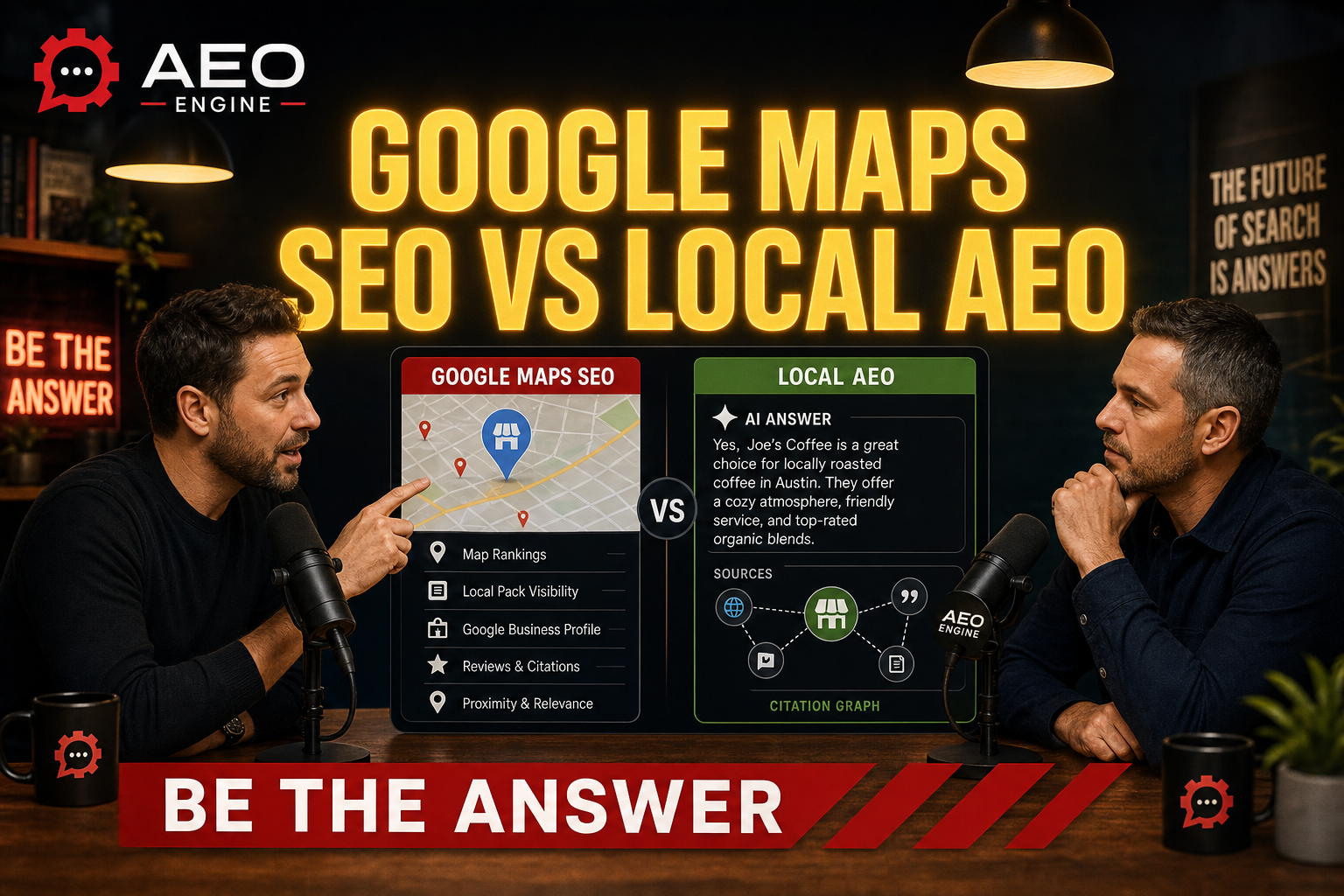
Google Maps SEO vs local AEO differences
The evolving dynamics of local search demand a clear understanding of the distinctions between Google Maps SEO and local Answer Engine Optimization (AEO). Marketers and business owners often conflate these two practices, but their objectives, methods, and outcomes differ significantly. Recognizing the Google Maps SEO vs local AEO differences is essential for brands aiming to dominate local visibility across both traditional map listings and emerging AI-driven search answers.
Key Takeaways
- Google Maps SEO aims to improve a business’s ranking in map listings, while local AEO targets visibility in AI-generated search answers.
- Businesses need separate strategies for each approach because Maps SEO relies on location signals and reviews, but local AEO focuses on answering specific questions.
- Combining both practices allows brands to capture traffic from traditional map results and from AI-driven voice or text responses.
- As AI search grows, local AEO will become a necessary complement to Maps SEO for maintaining strong local visibility.
This analysis explores the core distinctions and operational scopes of Google Maps SEO vs local AEO differences, emphasizing how each targets unique search outputs. Insights draw from AEO Engine’s extensive research and the Local Business SEO and AEO Industry framework, designed to help brands manage this complex environment.
The Difference Between Google Maps SEO and Local AEO: More Than Just Semantics
What Google Maps SEO Actually Controls (Rankings, Map Pack, Reviews)
Google Maps SEO is focused primarily on optimizing a business’s presence within Google’s local map listings and pack results. This includes influencing rankings on the map interface that appears in local search queries, securing prominent placement within the “Local Pack,” and managing user-generated signals such as reviews and ratings. The ranking factors are traditionally tied to parameters like proximity to the searcher, relevance of categories, and the volume and quality of local reviews.
Control here means improving a business’s ability to appear in these specific map-centric search features, which drive foot traffic and phone calls. Optimization includes claiming and verifying Google Business Profiles, ensuring accurate Name, Address, and Phone number (NAP) data, and encouraging high-quality customer feedback. These signals contribute directly to how Google ranks and displays local businesses on maps.
What Local AEO Actually Controls (AI-Generated Answers, Voice Search, Knowledge Panels)
Local Answer Engine Optimization shifts focus from traditional map results to AI-driven answers, voice search responses, and improved knowledge panels. Unlike Google Maps SEO, local AEO addresses how artificial intelligence models, including large language models (LLMs), extract and synthesize local business information to provide concise, conversational answers. This covers voice assistant responses on devices like Google Assistant and Alexa, as well as the summarized data shown in knowledge panels on search engine results pages.
Local AEO controls the input quality and structure that AI engines rely on when generating responses. This involves optimizing for structured data, ensuring factual accuracy, and crafting content tailored to question-answer formats. The goal is to influence which local entities AI highlights when users ask location-specific inquiries, rather than simply appearing on a map or directory.
| Aspect | Google Maps SEO | Local AEO |
|---|---|---|
| Primary Focus | Map rankings and local pack visibility | AI-generated answers, voice search, knowledge panels |
| Key Optimization Elements | Google Business Profile, reviews, NAP consistency | Structured data, answer-ready content, AI citation quality |
| Search Outputs Targeted | Local pack, map listings, review snippets | Voice assistant responses, AI knowledge panels |
| User Interaction | Clicking map results, calling or visiting business | Conversational queries, voice commands, direct answers |
| Measurement Metrics | Rankings, impressions, clicks in map pack | AI answer citations, voice search traffic, knowledge panel accuracy |
Understanding these distinctions equips marketers to tailor their strategies effectively. While Google Maps SEO remains essential for driving traditional local discovery, local AEO addresses the expanding frontier where AI and voice search shape consumer decisions. Brands integrating both approaches through frameworks like the Local Business SEO and AEO Industry position themselves for comprehensive visibility.
Why Optimizing for Google Maps No Longer Guarantees Visibility in AI Answers

The Citation Vacuum: How AI Models Choose Their Sources for Local Answers
AI-driven answer engines source local business information from a diverse and often opaque pool of data, creating what AEO Engine research identifies as a “citation vacuum.” Unlike Google Maps SEO, which relies heavily on verified business listings and user reviews, AI models pull from a wide range of digital signals including structured data, third-party directories, website content, and user-generated Q&A.
This wide net means that dominance in Google Maps rankings does not automatically translate to authoritative AI citations. AI models prioritize sources based on accuracy, recency, and trustworthiness signals that differ from traditional map ranking factors. If a business lacks structured data markup or fails to maintain consistent, AI-friendly citations across multiple platforms, it risks being overlooked or inaccurately represented in AI-generated answers.
Real Examples of Businesses Losing Voice Search Traffic Despite High Map Rankings
AEO Engine data highlights cases where businesses with top Google Maps placement saw significant declines in voice search traffic and AI answer visibility. One regional service provider maintained first-page map rankings but experienced a 35% drop in voice-driven calls over six months. Investigation revealed discrepancies between their Google Business Profile and the structured data on their website, leading to inconsistent AI citations.
Another example involves a local restaurant chain that ranked prominently in the map pack but was missing from AI knowledge panels that power voice assistants. This gap resulted from incomplete FAQ content and lack of schema markup for menu and hours, causing AI engines to source competitor information instead. These cases illustrate that strong Google Maps SEO alone no longer ensures local AI answer ownership.
The Overlap: Where Local SEO and AEO Converge (and Where They Diverge)
While Google Maps SEO and local Answer Engine Optimization (AEO) target distinct search outputs, they are not entirely separate disciplines. A foundational understanding reveals significant overlap in the underlying data and user signals that both systems value. Core elements of traditional local SEO, such as maintaining accurate and consistent Name, Address, and Phone number (NAP) information across the web, remain paramount. This consistency assures search engines and AI models that your business information is reliable, reducing ambiguity and bolstering trustworthiness.
Additionally, the quality and quantity of customer reviews continue to play a dual role. For Google Maps SEO, reviews directly impact ranking and local pack placement. For local AEO, AI models analyze review sentiment and content for insights into customer experience, business reputation, and service offerings. Structured data markup, particularly schema for LocalBusiness, is another essential shared component. Properly implemented schema provides a clear, machine-readable format for entities like operating hours, services, and contact details, which both traditional search algorithms and AI answer engines can readily interpret.
Shared Foundation: NAP Consistency, Reviews, Structured Data
The bedrock of visibility in any local search context is a solid foundation of accurate business information. Name, Address, and Phone number (NAP) consistency across your Google Business Profile, website, and all online directories is non-negotiable. This principle is fundamental not just for map rankings but also for AI’s ability to correctly identify and attribute information to your business. Inconsistent NAP data is a primary driver of AI errors and missed opportunities.
Customer reviews serve a dual purpose. They are a direct ranking factor for Google Maps SEO, influencing placement and appearing as social proof. For local AEO, AI models analyze the content of reviews to understand customer sentiment, common issues, and service specifics. This qualitative data helps AI determine the business’s relevance and trustworthiness when answering user queries. Similarly, implementing structured data markup, such as `LocalBusiness` schema, provides search engines and AI with easily digestible information about your business attributes, hours, services, and location. This structured data is a direct input for AI answer generation and knowledge panel creation.
Divergent Tactics: Keyword-Driven Optimization vs Question-Answer Formatting
The tactical execution where Google Maps SEO and local AEO diverge becomes apparent when considering the user’s intent and the desired search output. Traditional Google Maps SEO often focuses on optimizing for specific keywords that users might search when looking for local services (e.g., “plumber near me,” “best pizza downtown”). This involves incorporating these terms into your Google Business Profile descriptions, website content, and local citations. The goal is to signal relevance to the map algorithm for these explicit search queries.
Local AEO, conversely, shifts focus toward answering implicit or explicit questions that AI models will process. Instead of optimizing for search terms, the strategy involves optimizing for answers. This means formatting your website content to clearly address common customer questions about your business, services, pricing, or hours. It requires creating content that AI can easily extract and present as a direct response, often in a conversational tone. This divergence means that while keyword optimization is essential for map pack presence, question-answer formatting and semantic clarity are key for AI-generated answers. Grasping the Google Maps SEO vs local AEO differences requires this shift in mindset.
Visualizing the Overlap
Imagine a Venn diagram. The left circle represents Google Maps SEO, focusing on map pack rankings, local reviews, and business listings. The right circle represents Local AEO, concentrating on AI-generated answers, voice search, and knowledge panels. The overlapping section in the center signifies foundational elements essential to both: accurate NAP data, schema markup, and a strong overall online reputation derived from authentic customer feedback. While each circle has unique optimization tactics, the core data integrity and structured presentation of business information are shared pillars.
- NAP Consistency: Essential for both map ranking and AI attribution.
- Customer Reviews: Direct ranking factor for maps; qualitative data for AI.
- Structured Data (Schema): Provides machine-readable context for both systems.
- Website Authority: Overall domain and page authority impacts both traditional and AI visibility.
- Business Information Accuracy: Essential for trust signals in both traditional and AI search.
How to Build a Local Presence That Wins in Both Google Maps and AI Answer Engines
Achieving comprehensive local visibility requires a dual-pronged strategy that addresses both traditional Google Maps SEO and the newer demands of local Answer Engine Optimization (AEO). Brands must move beyond optimizing solely for map pack placement and instead focus on constructing an online presence that provides AI systems with clear, accurate, and readily accessible information. This approach ensures your business is not only discoverable on maps but also authoritative in AI-generated answers and voice search results. To master the Google Maps SEO vs local AEO differences, brands must adopt this dual strategy.
The following playbook outlines a systematic approach to building this resilient local presence. It integrates essential local SEO practices with specific AEO tactics, creating a unified strategy for maximum local impact. By focusing on data integrity, content clarity, and AI-friendly formatting, businesses can secure their position in the evolving local search ecosystem. This integrated strategy is central to the effectiveness of the Local Business SEO and AEO Industry.
-
Step 1: Audit Your Current Local SEO Foundation
Begin by conducting a thorough audit of your existing local SEO performance. This involves verifying the accuracy and consistency of your business’s NAP information across all major online directories and platforms. Review your Google Business Profile completeness, optimize your business categories, and analyze your current review quantity, quality, and response rate. Assess your website’s mobile-friendliness and loading speed, as these remain significant factors for both Google Maps and AI indexing. Identify any gaps in your local citation profile and pinpoint areas where your business information might be inconsistent or outdated.
-
Step 2: Create Answer-Ready Content for Local Queries
Local AEO requires content that directly answers user questions. Shift your content strategy to focus on creating comprehensive, clear, and concise answers to frequently asked questions about your services, products, hours, pricing, and location. Think about the natural language queries customers might use when interacting with a voice assistant or AI search engine. Format this information logically on your website, using headings, bullet points, and direct statements. Ensure your content is not just keyword-stuffed but semantically rich and provides definitive information that AI models can easily extract and cite.
-
Step 3: Implement Structured Data for Local Entities
Structured data, particularly schema markup, is indispensable for signaling your business information to AI. Implement `LocalBusiness` schema markup on your website, ensuring it accurately details your business name, address, phone number, opening hours, services offered, and even specific offerings like menus or appointment booking links. This markup provides a machine-readable layer of context that AI engines rely on for generating accurate and specific answers. Properly structured data reduces the risk of AI misinterpreting your business details and ensures your information is presented authoritatively in knowledge panels and direct answers.
-
Step 4: Monitor AI Citations and Adjust
Visibility in AI answers is dynamic. Implement tools and processes to monitor how AI systems are referencing your business information. This means tracking mentions in AI-generated answers, voice search results, and knowledge panels. Pay close attention to AI citations. Where the AI claims to have sourced its information. If you find inaccuracies or missing information in AI-generated responses, it is a clear signal to adjust your structured data, website content, or citation strategy. This continuous monitoring and adjustment loop is essential for maintaining accuracy and dominance in the evolving AI search ecosystem.
Your Local Presence Checklist: Maps & AI
- ✓ Comprehensive NAP audit completed.
- ✓ Google Business Profile fully optimized (categories, services, photos).
- ✓ Review acquisition strategy in place.
- ✓ Customer review responses are timely and professional.
- ✓ Website content structured to answer common local queries.
- ✓ `LocalBusiness` schema markup implemented correctly on website.
- ✓ Website mobile-friendly and loads quickly.
- ✓ Monitoring tool or process for AI citations established.
- ✓ Regular review of AI-generated answers for accuracy.
- ✓ Citation consistency checked across top 10-20 local directories.
The Business Risk of Ignoring Local AEO: What Happens When AI Answers Your Customers Wrong

The shift toward AI-driven local answers is not merely a technical nuance; it carries direct financial and reputational consequences for businesses that fail to adapt. When local Answer Engine Optimization (AEO) is neglected, control over the narrative about your business passes to algorithms that may source inconsistent or outdated information. The result is not just a missed opportunity but an active erosion of trust with potential customers who rely on AI-generated answers to make fast purchase decisions. Ignoring the Google Maps SEO vs local AEO differences creates significant risk.
How Inaccurate AI Citations Hurt Trust and Revenue
Inaccurate AI citations can misrepresent core business details such as hours of operation, service availability, pricing, or even your physical location. When a voice assistant or AI search engine provides incorrect information, the customer’s first point of blame often falls on the business itself, not the underlying technology. A single wrong answer about weekend closures or service specialties can cause immediate frustration, leading the customer to choose a competitor whose digital presence is more coherent and trustworthy.
The revenue impact compounds over time because AI models learn from repeated queries and corrections. If your business consistently appears with erroneous data across multiple AI platforms, the model’s confidence in citing you decreases. AEO Engine research shows that brands with fragmented or missing structured data lose an average of 40% of potential voice search interactions compared to optimized peers. This gap narrows the audience you would otherwise capture from conversational queries that dominate mobile and smart speaker usage.
Trust is also undermined when AI fails to reflect customer reviews accurately. If a knowledge panel omits recent positive feedback or misrepresents your rating, the perceived quality of your service drops. Since AI-generated summaries often appear before any traditional map result, they set the first impression. An incorrect or incomplete AI answer can permanently skew a potential customer’s view before they ever visit your website or Google Business Profile.
Case Example: A Local Service Business Losing Calls Due to Wrong AI-Generated Hours
Consider the experience of a mid-sized plumbing company in the Chicago metro area. The business invested heavily in using the Local Business SEO and AEO Industry framework to maintain a top-three map pack position for emergency plumbing searches. Yet, the company failed to extend its optimization to structured data and answer-ready content on its website. Consequently, a major voice assistant began sourcing operating hours from a third-party directory that listed outdated Sunday hours.
Over a three-month period, the company recorded a 22% drop in incoming calls on Sundays. When the owner investigated, customers reported that their voice assistants had stated the business was closed on Sundays, despite the map showing the correct hours. The discrepancy existed because the AI engine had prioritized structured data from a directory with incorrect information, not the verified Google Business Profile. The company lost an estimated $14,000 in revenue during that quarter from missed emergency service calls alone.
This example illustrates how a seemingly minor data inconsistency can cascade into real revenue loss and brand damage. The map pack placement remained strong, but AI answers independent of the map algorithm failed to reflect the accurate business status. Only after the company adopted a comprehensive local AEO strategy that included complete schema markup and FAQ sections did the voice assistant citations align with actual hours. The recovery required weeks of monitoring and adjustment, but the initial period of lost calls could have been prevented by integrating AEO alongside traditional local SEO efforts.
Risk Callout: In the current AI search ecosystem, a single inaccurate local citation can propagate across multiple answer engines, causing repeat errors that damage customer trust and erode revenue. The Local Business SEO and AEO Industry framework is designed to close these gaps by aligning structured data, content, and citation sources for consistent AI attribution. Neglecting local AEO means accepting that AI will define your business narrative without your input, and the cost is measured in lost calls, lost trust, and lost market share.
References
Frequently Asked Questions
What is the main difference between Google Maps SEO and local AEO?
Google Maps SEO and local AEO differ in their primary focus and optimization methods. Google Maps SEO targets map rankings and local pack visibility through Google Business Profile, reviews, and NAP consistency. Local AEO targets AI-generated answers, voice search, and knowledge panels using structured data and answer-ready content.
Why does high Google Maps ranking not guarantee visibility in AI answers?
High Google Maps ranking does not guarantee visibility in AI answers because AI models use a different set of data sources and ranking signals. Google Maps SEO relies on verified listings and reviews, while AI engines pull from structured data, third-party directories, and website content in a citation vacuum. A business can dominate map rankings but lack the structured data needed for AI citations.
How does local AEO affect voice search results?
Local AEO directly influences voice search results by optimizing business information for AI-driven responses. When users ask voice assistants like Google Assistant or Alexa for local recommendations, the AI synthesizes data from structured markup, FAQ content, and consistent citations. Local AEO ensures that a business appears in these conversational answers, not just in map listings.
What is a citation vacuum in local search?
A citation vacuum in local search refers to the gap between the sources Google Maps uses and the wider set of data AI models rely on. While Google Maps SEO focuses on a few verified platforms, AI engines pull from many digital signals including structured data, directories, and Q&A content. Businesses that ignore this broader citation pool risk being missed or misrepresented in AI answers.
Can a business lose voice search traffic if they have good map rankings?
Yes, a business can lose voice search traffic even with top Google Maps rankings. AEO Engine data shows cases where map leaders saw voice-driven calls drop because of inconsistencies between their Google Business Profile and website structured data. Missing schema markup for hours, menu, or FAQs caused AI engines to source competitor information instead.
What optimization elements are needed for local AEO compared to Google Maps SEO?
Local AEO requires different optimization elements than Google Maps SEO. Google Maps SEO centers on Google Business Profile, review management, and NAP accuracy. Local AEO demands structured data markup, answer-ready content designed for question formats, and consistent AI-friendly citations across many platforms. Both are needed for comprehensive local visibility.

About the Author
Aria Chen is the Editorial Head of the AEO Engine Blog and the host of the AEO Engine AI Search Show. With a deep background in digital marketing and AI technologies, Aria breaks down complex search algorithms into actionable strategies. When she isn’t writing, she’s interviewing industry experts on her podcast.
🎙️ Listen on Spotify · Apple Podcasts · YouTube
Leave a Reply