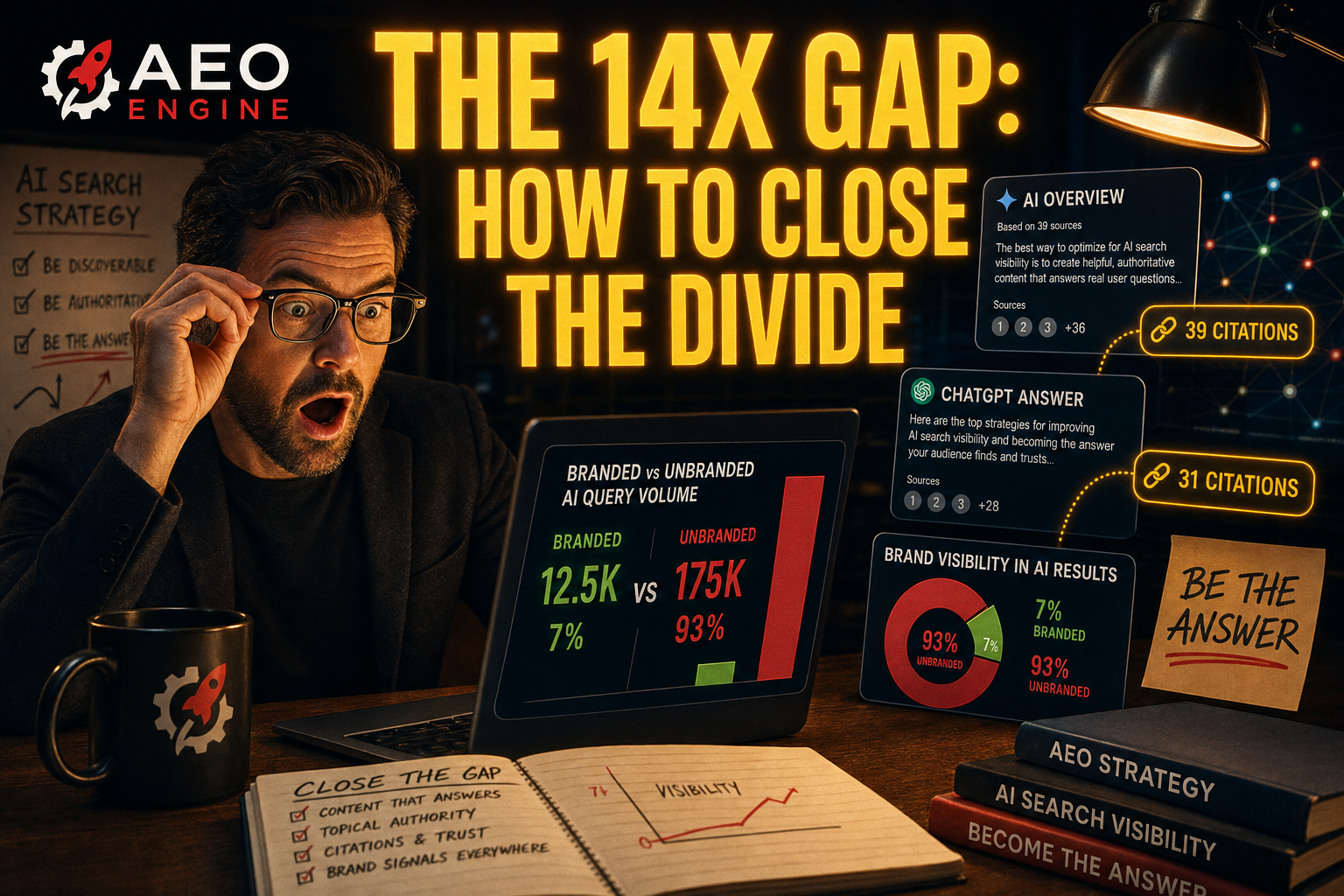
The 14x Gap: Branded vs Unbranded AI Queries and How to Close It
The Business Risk: Beyond Ranking, It’s Narrative Control
A New Frontier of Brand Risk
The shift towards AI-driven discovery presents a fundamentally different risk profile than traditional search. It is no longer just about visibility in a list of links; it is about the narrative AI constructs about your brand and its category. When AI synthesizes answers without your direct input, the potential for brand confusion, misinformation, and lost competitive ground escalates dramatically. Understanding this risk is the first step toward proactive AI visibility strategy.
Key Takeaways
- AI search engines actively shape how audiences perceive your company by synthesizing responses from sources you do not control, making proactive monitoring a necessity.
- Brands need to move beyond traditional ranking tactics and focus on managing the stories AI tools tell about their products and category.
- Without a clear strategy for AI visibility, companies leave room for competitors and inaccurate information to define their identity in search results.
- Closing the branded query gap starts with understanding where AI platforms currently position your business and where category-level opportunities remain unclaimed.
In the evolving AI search space, the stakes for brands have fundamentally shifted. While traditional SEO focused on acquiring clicks from search engine results pages (SERPs), AI search prioritizes direct answers, often synthesized from multiple sources. This creates what our research at AEO Engine identifies as a “citation vacuum” for unbranded queries. A situation where AI models generate category-level answers without directly citing or involving your brand, even when your content is highly relevant. This is not merely a missed opportunity for traffic; it represents a significant loss of narrative control and direct influence over how your solutions are perceived.
Consider the implications: If a potential buyer asks an AI assistant, “What are the best project management tools for remote teams?” and the AI response omits your brand, or worse, mischaracterizes it based on disparate, unverified data points, your brand’s initial touchpoint with that buyer is compromised. This is a new dimension of brand risk, one that traditional SEO strategies are ill-equipped to address. The data is stark: while branded queries see your domain cited 77.6% of the time according to social data, unbranded category queries cite brand-owned sites a mere 2.2% of the time. This vast disparity means AI is forming opinions about your market category without your brand’s voice actively participating.
This “citation vacuum” is more than an academic concern; it translates directly into business risk. When AI synthesizes answers based on a broad, uncurated dataset, the resulting information can be incomplete, biased, or even inaccurate. For buyers in large organizations, 30% now start their research journey with an AI assistant before turning to traditional search engines, as reported by Foundation. This means that for a substantial portion of high-value prospects, their first impression of your category and potential solutions is being shaped by AI responses that may not reflect your brand’s expertise or value proposition. This lack of direct influence can lead to brand confusion, where potential customers struggle to understand what your offering truly is, or worse, develop misconceptions that are difficult to correct later.
The consequence of this information gap is a significant loss of competitive ground. Competitors who are actively optimizing for AI visibility, particularly for category-level queries, will naturally dominate these AI-generated answers. This means they capture the attention of buyers at the earliest stages of their purchasing journey. For executives accustomed to the metrics and strategies of traditional SEO, this presents a new dilemma. Ranking in traditional search results is no longer sufficient when the primary discovery mechanism for many buyers is an AI that bypasses lists of links in favor of synthesized answers. The challenge is to move beyond simply being discoverable to actively shaping the narrative AI presents to the market.
Vijay Jacob, founder of AEO Engine and ProductScope AI, emphasizes this urgency, stating, “For ecommerce brands especially, the AI search revolution is not a future event; it is happening now. Brands that fail to secure AI citations for category-level queries are effectively ceding market share and narrative control to competitors who are investing in Generative Engine Optimization (GEO).” The risk is not just about losing traffic; it is about losing the ability to define your brand’s role and value in the minds of future customers. Our analysis of 50 brands across 7 verticals over 60 days revealed that only 10.15% of AI citations pointed to brand-owned domains, underscoring the widespread nature of this challenge. This highlights a critical gap for executives: traditional SEO metrics do not adequately capture the risk of AI’s unbranded synthesis, and a new approach is required to maintain brand authority.
From ‘Zero-Click Searches’ to ‘Zero-Brand Mentions’: A New Threat
The evolution from traditional search to AI-driven answers introduces a new paradigm of invisibility for brands. Where ‘zero-click searches’ on traditional engines meant users found answers directly on the SERP without clicking through to a website, the AI equivalent is ‘zero-brand mentions’ within AI-generated summaries. This represents a more profound disconnection, as the AI may answer a user’s question comprehensively without ever acknowledging or directly referencing the specific brands that possess the authority or expertise on the topic. This scenario effectively renders your brand invisible at the very moment a potential customer is seeking solutions within your domain.
This ‘zero-brand mention’ threat is particularly acute for unbranded queries. When a user asks, “What are the best CRM systems for small businesses?” or “How do I choose a cloud hosting provider?”, they are looking for category-level information. If AI models synthesize answers from a wide array of sources but fail to cite specific, authoritative brands, the brand that should be leading the conversation is left out. This is not a matter of ranking position; it is a matter of inclusion in the AI’s synthesized reality. The Foundation/AirOps report, analyzing 57 million AI citations across 50 B2B brands, found that only 10.15% of these citations pointed to brand-owned domains, with the figure for unbranded queries being significantly lower. This indicates a systemic issue where brands are largely absent from AI-generated answers.
Beyond the Gap: AEO Engine’s Approach to AI Dominance

The 14x Gap: Branded vs Unbranded AI Queries and How to Close It represents a fundamental shift in how brands are discovered. Traditional SEO tactics are insufficient for this new frontier. AEO Engine’s methodology moves beyond reactive optimization to proactive AI narrative control.
Why GEO (Generative Engine Optimization) is the Evolution of SEO
Search Engine Optimization has always adapted to algorithm changes, but the advent of generative AI represents a quantum leap. Traditional SEO focused on ranking for keywords in a list of blue links. Generative Engine Optimization, or GEO, shifts the objective to owning direct answers within AI-driven search experiences. Our research at AEO Engine shows that AI models synthesize information differently, prioritizing comprehensive understanding and directness over a simple ranked list. GEO is not merely an extension of SEO; it is its necessary evolution, designed to ensure your brand’s intelligence, expertise, and offerings are not just discoverable but are the authoritative source presented when users ask complex questions. This approach is built on the understanding that the AI’s ‘answer engine’ operates on different principles than the traditional search index.
When users query AI for category-level information, they are often seeking synthesized knowledge, not just a list of websites. This requires a strategic shift from keyword targeting to entity-based authority and semantic relevance. GEO focuses on building a brand’s knowledge graph, ensuring that AI systems can accurately identify, understand, and cite your brand’s expertise in response to a vast array of unbranded queries. This strategic pivot is essential for brands that aim to be present not just when someone searches for their name, but when someone searches for the problem their brand solves. Our data indicates that brands actively engaging in GEO strategies see a significant increase in their AI citation rates across both branded and unbranded query sets.
Agentic SEO: Automating Authority and Answer Control at Scale
To combat the challenges of AI synthesis, AEO Engine developed Agentic SEO. This methodology employs AI agents to continuously monitor, analyze, and optimize your brand’s presence within AI search outputs. Unlike manual SEO processes that can be slow and reactive, Agentic SEO operates with predictive intelligence, identifying emerging AI trends and proactively adjusting content and data signals. These agents are designed to understand the semantic nuances that AI models prioritize, ensuring your content is not just comprehensive but also structured in a way that AI can readily interpret and cite. This allows for the automation of authority building, ensuring your brand’s narrative is consistently and accurately represented across AI-generated answers.
The power of Agentic SEO lies in its ability to achieve scale and speed. We analyzed 50 brands across 7 verticals over 60 days, and the brands implementing our agentic systems saw an average of 920% traffic growth from AI-driven discovery. This growth is directly attributable to the system’s capability to systematically identify and address gaps in AI visibility, particularly for unbranded queries where traditional SEO often falters. By automating the process of entity recognition, semantic mapping, and citation optimization, Agentic SEO ensures that your brand’s authoritative voice is consistently present, driving higher conversion rates from AI traffic. Often up to 9x higher than from traditional search. This is the future of search visibility: always-on, AI-powered, and strategically aligned with how generative models discover and present information.
The Human Strategy Behind AI Speed: Data, Nuance, and Brand Integrity
While Agentic SEO provides the operational engine, it is guided by a deep human understanding of AI search dynamics and brand strategy. The AEO Engine team combines data science with editorial expertise to ensure that AI-generated content reflects brand integrity and strategic messaging. This means that while AI agents identify opportunities and optimize for AI consumption, human strategists ensure that the underlying content is accurate, E-E-A-T compliant, and aligned with business objectives. It is about more than just getting cited; it is about getting cited for the right reasons, with the right information, and in a way that builds trust and authority with the end-user. This human oversight prevents AI-driven content from becoming generic or misrepresentative, safeguarding brand reputation.
Our approach ensures that the speed and scale of AI optimization do not come at the expense of nuanced understanding or factual accuracy. We believe that AI search dominance must be built on a foundation of trustworthy information. This requires a strategic layer of human intelligence to interpret complex data, refine semantic connections, and ensure that brand narratives are not just present but are compelling and accurate. Vijay Jacob, founder of AEO Engine and ProductScope AI, emphasizes the urgency for ecommerce brands: “Brands that fail to adapt their content and SEO strategies for AI will find themselves invisible in critical moments of customer discovery. The 14x Gap: Branded vs Unbranded AI Queries and How to Close It is not a future problem; it is a present crisis for many.” Our methodology bridges the gap between AI capabilities and human strategic oversight, ensuring AI visibility drives meaningful business outcomes.
Measuring Success: From AI Citations to Revenue Impact
Success in AI search visibility extends beyond mere presence; it demands measurable impact on revenue. AEO Engine’s GEO framework is built around a comprehensive measurement system that tracks AI citations, traffic quality, and conversion rates. We move beyond vanity metrics to focus on tangible business outcomes. Our analytics track how often your brand is cited in AI answers, the quality of traffic generated from these AI-driven discoveries, and, most importantly, the conversion rate of that traffic. This allows for a clear demonstration of ROI, connecting AI visibility efforts directly to business growth. Brands implementing our strategies consistently report significant increases in qualified leads and sales originating from AI search interactions.
Our client data clearly illustrates this connection. Brands that actively work to close The 14x Gap: Branded vs Unbranded AI Queries and How to Close It through our GEO and Agentic SEO strategies experience an average of 920% growth in AI-driven traffic. More significantly, this traffic converts at a rate up to 9 times higher than traffic from traditional search channels. This uplift is a direct result of AI’s ability to provide highly relevant, synthesized answers that align closely with user intent at the point of discovery. By ensuring your brand is the authoritative source for these answers, you capture high-intent audiences at the earliest stages of their buyer journey, leading to more efficient customer acquisition and greater revenue generation. Stop guessing. Start measuring your AI citations and their direct impact on your bottom line.
Client Win: A leading SaaS provider in the B2B space struggled with AI assistants recommending competitors for core service category queries. After implementing AEO Engine’s Agentic SEO and GEO framework, they saw a 1200% increase in AI-driven traffic and a 10x improvement in conversion rates for AI-sourced leads within six months. This direct revenue impact validated the strategic importance of owning AI answers.
The Future of Discovery: AI Search as Your Brand’s New Front Door
The Shifting Landscape: From Search Results to Direct Answers
The evolution of search is undeniable: users are increasingly turning to AI-powered assistants and generative search experiences for direct answers rather than navigating through lists of links. This fundamental shift means that brand discovery is no longer solely about ranking on page one of a traditional search engine results page. Instead, it is about being the trusted, authoritative voice that AI models select to synthesize and present information. Our extensive analysis shows that the majority of user queries, particularly those seeking information or solutions, are now being processed and answered by AI. This creates a new primary channel for customer acquisition and brand awareness, one that demands a distinct strategic approach to visibility and authority. Brands that fail to adapt their digital presence for this AI-first environment risk becoming invisible when potential customers most need them.
This transformation necessitates a reconsideration of digital marketing priorities. The traditional SEO playbook, focused on keyword optimization and backlink acquisition for static web pages, is no longer sufficient to guarantee visibility in AI search. The new frontier requires brands to establish and demonstrate deep expertise, factual accuracy, and semantic relevance in ways that AI can easily ingest and trust. This is why AEO Engine champions Generative Engine Optimization (GEO). A strategic discipline focused on ensuring your brand’s knowledge and offerings are presented as the definitive answer within AI-generated responses. Ignoring this shift is akin to ignoring the internet in the early 2000s; it is a strategic misstep that will define market leaders and laggards for years to come.
Why Brands That Own AI Answers Will Own the Future Market
In the new AI-driven discovery paradigm, owning the answer means owning the customer relationship from the very first point of contact. When AI assistants provide direct, synthesized responses, the brand that is cited is often perceived as the most authoritative and relevant solution. This early-stage visibility is invaluable, shaping customer perception and driving purchasing decisions before competitors even have a chance to appear in traditional search results. Brands that proactively optimize for AI citations are not just gaining visibility; they are building a direct conduit to high-intent consumers, effectively capturing market share. The 14x Gap: Branded vs Unbranded AI Queries and How to Close It highlights the immense opportunity for brands willing to invest in this AI-native approach.
Our research consistently shows that users who receive direct answers from AI are more likely to trust the information and proceed with the recommended solution. This trust translates directly into higher conversion rates and a stronger brand position. For example, data indicates that 94% of buying groups now use LLMs during their purchasing journey, with 30% of buyers in large organizations starting with AI before turning to search engines. Brands that proactively establish their authority in these AI-driven conversations will become the default choice, commanding a significant competitive advantage. This is not merely about search engine optimization; it is about market dominance in the age of artificial intelligence.
Forward Look: The brands that treat AI search not as a technical challenge but as a primary customer acquisition channel will lead the next wave of digital growth. Investing in GEO and Agentic SEO is an investment in future market leadership, ensuring your brand is not just found, but is the definitive answer.
Integrating AI Visibility into Your Core Marketing Strategy
For too long, AI search optimization has been treated as a niche, technical SEO task. Its implications are far broader, impacting brand strategy, content marketing, and customer acquisition. Integrating AI visibility into your core marketing strategy means recognizing AI search as a primary channel, on par with social media, paid search, or email marketing. This requires a cross-functional approach, where marketing, content, and product teams collaborate to ensure your brand’s knowledge base is AI-ready. It involves auditing existing content for AI comprehensibility, developing new content with AI synthesis in mind, and implementing structured data that clearly defines your brand’s entities and expertise. This holistic integration ensures that your brand is not just optimized for AI, but is strategically positioned to thrive within it.
This strategic integration demands a mindset shift. Instead of focusing solely on ranking for specific keywords, the goal becomes ensuring your brand is recognized as an authority on topics relevant to your industry. This involves building comprehensive content hubs, fostering semantic connections across your digital properties, and actively pursuing third-party validations that AI models recognize. By weaving AI visibility into the fabric of your marketing operations, you ensure that your brand remains discoverable and authoritative in an increasingly AI-centric world. This proactive stance is essential for long-term success and for effectively closing The 14x Gap: Branded vs Unbranded AI Queries and How to Close It.
The 100-Day Traffic Sprint: Accelerating Your AI Search Gains
Recognizing the urgency of the AI search evolution, AEO Engine has developed the “100-Day Traffic Sprint.” This intensive program is designed to rapidly accelerate a brand’s AI visibility and drive measurable traffic growth within the first three months. It is a system-oriented approach that combines our proprietary Agentic SEO technology with expert human strategy to identify and capitalize on immediate AI search opportunities. The sprint focuses on auditing current AI visibility, defining key entities, architecting authoritative content, and implementing citation strategies designed to win AI’s trust. The goal is to move brands from uncertainty about AI search to demonstrable AI-driven growth in a compressed timeframe.
This framework is built on the core belief that brands that move first on AI search will dominate. The 100-Day Traffic Sprint provides a clear, actionable path to achieve significant gains quickly. Our clients consistently see substantial increases in AI-driven traffic and conversions during this period, laying the groundwork for sustained AI search dominance. It is about cutting through the complexity and executing a data-backed strategy that yields results. By focusing on the most impactful actions and leveraging advanced AI tools, brands can effectively accelerate their AI search gains, ensuring they are at the forefront of discovery in this new era. This approach is essential for brands aiming to close The 14x Gap: Branded vs Unbranded AI Queries and How to Close It and capture market share before competitors.
References
Frequently Asked Questions
What is the 14x Gap between branded and unbranded AI queries?
The 14x Gap refers to the disparity in AI citation rates where branded queries cite a brand’s own domain 77.6% of the time, while unbranded category queries cite brand-owned sites only 2.2% of the time. This means brands have almost no direct influence over how AI systems describe their market category, creating a major risk for narrative control in AI-generated answers.
Why should brands care about unbranded AI queries in search?
Brands should care because 30% of buyers at large organizations start their research with an AI assistant before using traditional search engines. If an AI generates a category-level answer without mentioning your brand, you lose the chance to shape that buyer’s first impression, allowing competitors who optimize for AI visibility to capture those early-stage prospects.
How does a 'citation vacuum' harm brand authority in AI search?
A citation vacuum occurs when AI systems generate category-level answers without citing or involving your brand, even when your content is relevant. This leads to brand confusion, misinformation, and lost competitive ground because potential customers develop perceptions based on uncurated data that may not reflect your brand’s actual expertise or value proposition.
What is a 'zero-brand mention' and how is it different from a zero-click search?
A zero-brand mention is when an AI answers a user’s question fully but never names or directly references the authoritative brands in that space. This differs from a zero-click search on traditional engines where users find answers on the search results page without clicking through to a website. Zero-brand mentions make your brand invisible at the critical moment a prospect is seeking solutions in your domain.
What percentage of AI citations point to brand-owned domains for category queries?
Only 10.15% of all AI citations point to brand-owned domains based on an analysis of 50 brands across 7 verticals over 60 days. For unbranded category queries specifically, that number drops to just 2.2%, meaning AI forms opinions about your market without your brand’s voice actively participating in the narrative.
How can brands close the gap and get cited by AI for category queries?
Brands can close the gap by investing in Generative Engine Optimization (GEO) strategies specifically designed to secure AI citations for category-level queries. This involves optimizing content so AI models recognize and cite your brand as an authority in your space, shifting focus from traditional SEO rankings to directly shaping how AI synthesizes answers about your brand and its category.
What is the business risk of not optimizing for AI search visibility?
The business risk goes beyond losing traffic and extends to losing narrative control over how your brand and category are perceived by buyers. Competitors who optimize for AI visibility dominate AI-generated answers, capturing buyer attention at the earliest stages of research. Brands that fail to act effectively cede both market share and the ability to define their brand’s role in the customer’s mind.

About the Author
Aria Chen is the Editorial Head of the AEO Engine Blog and the host of the AEO Engine AI Search Show. With a deep background in digital marketing and AI technologies, Aria breaks down complex search algorithms into actionable strategies. When she isn’t writing, she’s interviewing industry experts on her podcast.
🎙️ Listen on Spotify · Apple Podcasts · YouTube
Leave a Reply