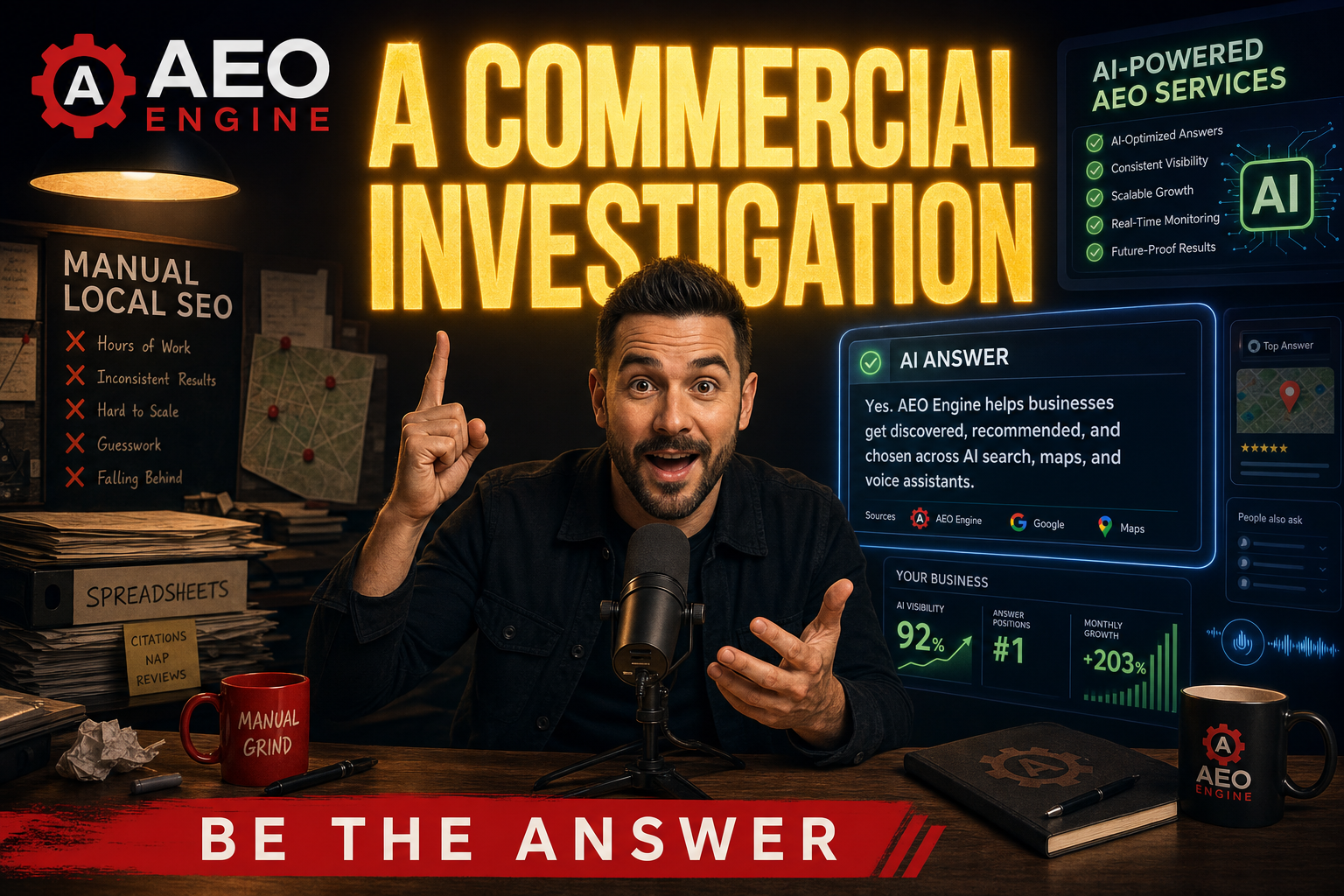
manual local SEO vs AI-powered AEO services comparison
The seismic shift in search engine technology, driven by advanced AI, is reshaping how consumers discover and interact with local businesses. Traditional methods that once guaranteed visibility face an existential challenge. For ambitious brands, understanding this evolution is about securing future market share. At AEO Engine, our research indicates a fundamental divergence in how search engines process information and deliver answers, moving beyond simple keyword matching to entity understanding and direct response generation. This necessitates a re-evaluation of local search strategies. This investigation examines the core differences between manual local SEO and the emerging paradigm of AI-powered AEO services, providing a clear framework for commercial decision-making.
Key Takeaways
- AI search engines now prioritize entity understanding over keyword matching, fundamentally changing how local businesses get discovered online.
- Traditional local SEO tactics alone can no longer guarantee visibility as search platforms shift toward direct response generation.
- Brands must evaluate both manual local SEO and AI-powered AEO services to make informed decisions about their search investments.
- Early adopters of AEO strategies are positioned to capture market share before competitors catch up to the new search paradigm.
The question for many businesses has become: are you optimizing for a list of links or for the answer engine itself? Our analysis of the current Local Business SEO and AEO Industry reveals that while manual techniques build foundational authority, AI-driven approaches are increasingly necessary for direct visibility in conversational search results and AI overviews. This manual local SEO vs AI-powered AEO services comparison aims to equip you with the insights needed to navigate this juncture, moving beyond guesswork to data-backed strategy. We will examine what each approach optimizes for, the true cost implications, and the practical pathways to sustained growth in the age of AI search.
Manual Local SEO vs AI-Powered AEO: What Each Actually Optimizes For
Manual local SEO has long been the bedrock for businesses seeking to appear in geographically relevant search results. Its core mechanisms involve meticulous management of Google Business Profile (GBP) listings, ensuring NAP (Name, Address, Phone number) consistency across directories, and optimizing on-page content with local keywords. The objective is to signal relevance and proximity to search engines, aiming for higher rankings in the traditional “three-pack” or organic local listings. This process is resource-intensive, requiring consistent effort in citation building, review management, and local content creation, all geared towards earning a spot on a static results page.
In contrast, AI-powered AEO (Answer Engine Optimization) shifts the focus from ranking for keywords to optimizing for direct answers within AI-driven search experiences. This method centers on structured data, entity extraction, and formatting content to be readily digestible by AI models. The goal is to ensure your business information is accurately represented and prioritized when an AI search engine synthesizes information to answer a user’s query directly, often bypassing traditional links. This is about becoming the authoritative source that AI models cite, a distinction in the evolving search environment where zero-click searches now account for over 50% of all queries, according to Search Engine Land data.
Defining manual local SEO: GBP management, citation consistency, and on-page signals
Traditional manual local SEO focuses on establishing a strong online presence through foundational signals. This includes diligent management of Google Business Profile, ensuring all information is current, accurate, and compelling. Citation consistency across online directories, aggregators, and review sites is paramount, as search engines use this data to verify business legitimacy and accuracy. On-page optimization involves integrating relevant local keywords into website content, meta descriptions, and title tags to clearly articulate a business’s services and geographic service area. The success of this approach is measured by improvements in traditional ranking positions, such as placement in the local map pack or organic search results.
Defining AI-powered AEO: entity extraction, structured data, and conversational answer formatting
AI-powered AEO operates on a different set of principles, using AI’s ability to understand context and relationships between data points. Instead of just keywords, it focuses on entities. The real-world objects, concepts, and people that search engines increasingly understand. This involves implementing structured data (like Schema.org markup) that clearly defines business attributes, services, and relationships with other entities. Content is then optimized for conversational query formats, ensuring it can be directly extracted and presented as an answer by AI search agents. The aim is to become a trusted source that AI models can cite with confidence, moving beyond mere visibility to authoritative attribution in AI-generated responses.
The structural shift: traditional rankings versus answer engine visibility
The fundamental shift lies in what constitutes “visibility.” For years, success in local search meant climbing the rungs of traditional search result pages, aiming for that coveted top spot. Manual local SEO is designed to achieve precisely this by optimizing for the algorithms that rank websites. The advent of AI search engines and conversational interfaces means users are increasingly receiving direct answers without ever clicking through to a website. AI-powered AEO is built to thrive in this environment, optimizing content for direct extraction.
Time to Results, Scalability, and the Human-in-the-Loop Advantage

Organizations evaluating their local search strategy often face a question: how quickly can they expect to see meaningful impact, and how well does the chosen method scale to meet evolving demands? Traditional manual local SEO tactics, while foundational, typically require a significant lead time. Our research indicates that achieving noticeable ranking gains and improved visibility through methods like Google Business Profile optimization, citation building, and on-page adjustments can often take between three to six months. This extended timeline is a direct consequence of the iterative nature of manual work, waiting for search engine algorithm updates to recognize changes, and the volume of tasks involved.
In contrast, AI-powered AEO services operate on a different timeline. By focusing on structured data, entity extraction, and direct answer formatting, AI systems can identify and capitalize on opportunities for immediate inclusion in AI overviews and answer boxes. This means businesses can begin seeing placements in weeks, rather than months. This accelerated pace is about adapting to the rapid shift in user behavior. With zero-click searches now accounting for over 50% of all queries, according to industry analyses, the ability to appear directly in an answer is paramount for visibility and capturing user intent before they consider clicking through to a website.
Incremental Ranking Gains from Manual Outreach Versus AI Batch Production
The progression of manual local SEO is often characterized by incremental gains, a steady climb fueled by consistent effort. Each new citation, updated business description, or optimized review response contributes to a gradual improvement in search engine perception. This approach builds authority over time, but it is inherently limited by human capacity. A team can only manage so many profiles, submit to so many directories, or conduct so many local link-building campaigns before hitting diminishing returns. The process is thorough but slow, requiring sustained investment for each small step forward.
AI-powered AEO shifts this paradigm to batch production and rapid deployment. Instead of individual, manual tasks, AI systems can process vast amounts of data, identify patterns, and generate optimized content or structured data at scale. This allows for a much faster rate of deployment across multiple platforms and formats. AI content production can reduce per-article creation time by up to 80% compared to manual writing, enabling businesses to scale their visibility efforts dramatically. This batch approach is effective for businesses with extensive product or service catalogs, or those operating in competitive markets where rapid content velocity is a significant advantage.
The Citation Vacuum: What Happens When AI Engines Rewrite Local Business Facts
As AI search engines become more sophisticated, they are increasingly synthesizing information from various sources to generate direct answers. This creates a phenomenon sometimes referred to as a “citation vacuum,” where the AI’s synthesized answer becomes the primary point of reference for users, potentially bypassing traditional citations entirely. If a business’s fundamental information. Its address, operating hours, key services. Is not accurately represented or structured for AI consumption, the AI might generate an answer based on outdated or incorrect data. This can lead to users receiving misleading information, directly impacting customer acquisition and brand trust. The AI’s ability to “rewrite” business facts means that being present in directories is not enough; the information must be harmonized and presented in a way that AI can reliably extract and trust.
This shift underscores the need for proactive AI-powered AEO. Instead of relying on search engines to correctly interpret fragmented data, businesses must ensure their core information is clean, consistent, and machine-readable. For local businesses, this means meticulously managing their presence across all relevant platforms, not just for human searchers but for AI crawlers. The Local Business SEO and AEO Industry is rapidly evolving to address this, recognizing that AI’s interpretation of business facts can influence customer interaction. Ensuring AI-generated answers are accurate and favorable requires a strategic approach that goes beyond traditional citation management.
Human Oversight as Risk Control: Preventing Hallucination and Brand Drift
While AI offers benefits in speed and scale, it is not without its risks. A significant concern is the potential for AI “hallucination”. Generating confidently stated but factually incorrect information. In the context of local search, this could manifest as incorrect service offerings, misleading pricing, or even fabricated customer testimonials. AI systems, if not properly guided, can lead to “brand drift,” where the generated content or answers do not accurately reflect the brand’s voice, values, or specific value proposition. This can dilute brand identity and confuse potential customers.
This is where the human-in-the-loop advantage becomes indispensable. Expert oversight is necessary for validating AI-generated outputs, ensuring factual accuracy, and maintaining brand integrity. A skilled human operator can review AI-generated content, check structured data for errors, and confirm that answers align with business objectives and E-E-A-T (Experience, Expertise, Authoritativeness, Trustworthiness) principles. For local businesses, this means pairing the efficiency of AI with the judgment and contextual understanding of human experts. This hybrid approach ensures that while AI accelerates content creation and optimization, human review acts as a quality control mechanism, preventing the propagation of misinformation and safeguarding brand reputation. Businesses that adopt both manual trust signals and AI answer formatting often report higher overall search presence than those relying on either approach alone.
Scaling Content Velocity Without Sacrificing E-E-A-T or Local Intent
The pressure to produce content at scale is immense in the current digital environment, especially for local businesses needing to reach a geographically specific audience. Traditional methods of scaling content velocity often involve hiring more writers or increasing agency retainers, which can become prohibitively expensive and time-consuming. The challenge lies in increasing output without compromising the quality, authenticity, and local relevance that search engines and users demand. Sacrificing E-E-A-T signals or neglecting the nuanced intent of local search queries in favor of sheer volume will lead to diminished results.
AI-powered AEO offers a path to content velocity because it automates many of the labor-intensive aspects of content creation and optimization. AI can generate multiple content variations, draft structured data markup, and format information for AI overviews at a speed that manual processes cannot match. To scale successfully without sacrificing E-E-A-T or local intent, human guidance is paramount. This involves training AI models with specific brand guidelines, providing accurate local business data, and ensuring that the AI-generated content is reviewed by subject matter experts who understand the local market. The goal is not to replace human expertise but to augment it, allowing teams to focus on strategy, high-level quality assurance, and the unique elements that define their brand and local appeal. This fusion of AI efficiency and human intelligence is key to achieving scalability in the answer engine era.
Pros
- Manual Local SEO: Builds deep, established authority over time; strong foundation for traditional search rankings; human oversight ensures nuanced brand voice and local context.
- AI-Powered AEO: Rapid deployment of content and data for AI overviews; significantly faster time-to-visibility in weeks; scales content production exponentially; efficient for capturing zero-click search traffic.
Cons
- Manual Local SEO: Slow to show results (3-6 months); limited scalability due to human capacity; high ongoing labor costs; can be outpaced by AI-driven visibility.
- AI-Powered AEO: Risk of AI hallucination and factual errors without human review; potential for brand drift if not properly guided; requires structured data expertise and ongoing AI model management; may miss subtle local nuances if solely automated.
When to Choose Manual Local SEO, AI AEO, or a Hybrid Playbook
Navigating the evolving search environment requires a strategic decision about resource allocation and tactical focus. For many businesses, the choice is not strictly binary between manual local SEO and AI-powered AEO. Instead, it is about identifying the most effective approach based on specific business needs, market conditions, and growth objectives. Our extensive analysis of the Local Business SEO and AEO Industry suggests that while distinct strategies exist, a hybrid model often yields the most comprehensive results, blending the foundational strengths of traditional methods with the forward-looking capabilities of AI. Understanding your business context is the first step in crafting this optimal strategy.
Decision Framework by Business Size, Industry, and Competitive Density
The optimal path forward depends heavily on your business’s unique profile. Smaller businesses with limited resources might initially focus on mastering manual local SEO fundamentals, particularly Google Business Profile management and citation consistency, as these offer foundational visibility with manageable effort. As businesses grow or operate in competitive sectors, the limitations of manual work become apparent. In such cases, AI-powered AEO becomes essential for breaking through the noise and securing direct answers, which are increasingly preferred by searchers. Industries with complex service offerings or a high volume of transactional queries benefit significantly from AI’s ability to parse and present detailed information accurately. Analyzing your competitive density is also key; in saturated markets, manual efforts alone may not suffice to gain an edge.
Building a Hybrid Model: Manual Trust Signals Paired with AI Answer Formatting
The most effective approach for many businesses involves integrating manual local SEO practices with AI-powered AEO. This hybrid model capitalizes on the strengths of both. Manual efforts continue to build core trust signals: maintaining accurate GBP listings, managing customer reviews, and ensuring NAP consistency across the web. These actions form a bedrock of authority that AI systems can then interpret and amplify. AI-powered AEO complements this by structuring the business’s data for AI consumption, optimizing content for conversational queries, and ensuring prominent placement in AI overviews and direct answer formats. This synergy means businesses not only rank well traditionally but also appear as authoritative sources when AI synthesizes information, leading to higher overall search presence than using either method in isolation, as indicated by industry findings.
Step-by-Step Integration: Aligning GBP Data, Schema, and Answer-First Content
Integrating AI AEO with existing local SEO requires a systematic approach. Begin by auditing your current Google Business Profile and ensuring all information is accurate and complete. Next, implement structured data markup (Schema.org) on your website that clearly defines your business, services, products, hours, and location. This structured data acts as a direct feed for AI engines. Concurrently, adapt your content strategy to favor answer-first formats. Addressing common user questions directly and concisely. The goal is to create a harmonized data ecosystem where your GBP, website schema, and content all speak the same machine-readable language. This alignment is fundamental for AI engines to accurately extract and present your business information, driving visibility in the new search paradigm.
This strategic integration is important for local businesses aiming to capture high-intent searchers. Local businesses that optimize for AI answers, by implementing structured data and answer-first content, often see up to 3x more direct phone calls from search results. The manual local SEO vs AI-powered AEO services comparison highlights that while manual methods build the foundation, AI AEO is the engine that drives direct engagement in the current search climate. A well-executed hybrid strategy ensures that your business is discoverable through both traditional search rankings and direct AI-driven answers, maximizing your market reach and conversion potential.
Attribution Mechanics: Tracking Citations, AI Overview Shares, and Revenue Lift
Measuring success in the AI-driven search era demands a shift in attribution models. While tracking traditional citations and ranking improvements remains relevant, it is no longer sufficient. Businesses must now monitor AI overview shares. The instances where their business information is directly featured in AI-generated answers. This requires specialized analytics tools that can identify AI-driven visibility. Furthermore, the ultimate measure of success is revenue lift. By correlating AI overview placements with increases in direct calls, form submissions, or in-store visits, businesses can quantify the ROI of their AEO efforts. This attribution is the cornerstone for understanding the true impact of AI-powered strategies, moving performance measurement beyond vanity metrics to tangible business outcomes.
The manual local SEO vs AI-powered AEO services comparison reveals that effective attribution is key to justifying investment. While manual SEO offers clear, albeit slower, metrics, AI AEO’s impact on direct conversions can be more immediate and harder to track without the right systems. A comprehensive tracking strategy should encompass both traditional signals and emerging AI visibility metrics. By diligently measuring citation consistency, AI answer placements, and ultimately, the revenue generated from these channels, businesses can refine their approach and ensure they are investing in strategies that deliver measurable growth in the competitive local business arena.
Frequently Asked Questions
What is the difference between manual local SEO and AI-powered AEO?
Manual local SEO focuses on optimizing Google Business Profile, citations, and on-page content to rank in traditional local search results. AI-powered AEO, or Answer Engine Optimization, optimizes structured data and entity extraction so AI search engines directly cite your business in conversational answers. The core difference is optimizing for a list of links versus optimizing for direct answer visibility.
How long does it take to see results from manual local SEO?
Manual local SEO typically requires three to six months to show noticeable ranking gains in the local pack or organic results. This timeline comes from the iterative work of citation building, review management, and on-page adjustments. For faster direct visibility in AI overviews, businesses often combine manual SEO with AI-powered AEO services.
Why is answer engine optimization important for local businesses now?
Answer engine optimization is important because over 50% of all searches result in zero clicks, where users get answers directly from AI without visiting a website. AI-powered AEO ensures your business information is extracted and cited by AI search engines in those direct responses. Relying only on manual local SEO risks losing visibility in this growing zero-click search environment.
What does AI-powered AEO optimize for instead of keywords?
AI-powered AEO optimizes for entities rather than keywords, focusing on the real-world objects and concepts that AI models understand. This involves implementing structured data markup, formatting content for conversational queries, and clearly defining business attributes and relationships. The goal is to become an authoritative source that AI search engines trust for direct answer generation.
How does structured data help in AI-powered AEO?
Structured data, like Schema.org markup, helps AI search engines extract and understand your business attributes, services, and relationships with other entities. By clearly defining this information in a machine-readable format, your content becomes more eligible for direct citation in AI-generated answers. Manual local SEO alone does not prioritize this type of semantic markup for answer engines.
Is manual local SEO still relevant with the rise of AI search?
Manual local SEO remains relevant because it builds foundational authority through Google Business Profile management, citation consistency, and on-page local signals. These factors still influence traditional rankings and can support AI-powered AEO by verifying business legitimacy. The most effective strategy combines manual SEO for baseline visibility with AEO for direct answer presence.

About the Author
Aria Chen is the Editorial Head of the AEO Engine Blog and the host of the AEO Engine AI Search Show. With a deep background in digital marketing and AI technologies, Aria breaks down complex search algorithms into actionable strategies. When she isn’t writing, she’s interviewing industry experts on her podcast.
🎙️ Listen on Spotify · Apple Podcasts · YouTube
Leave a Reply