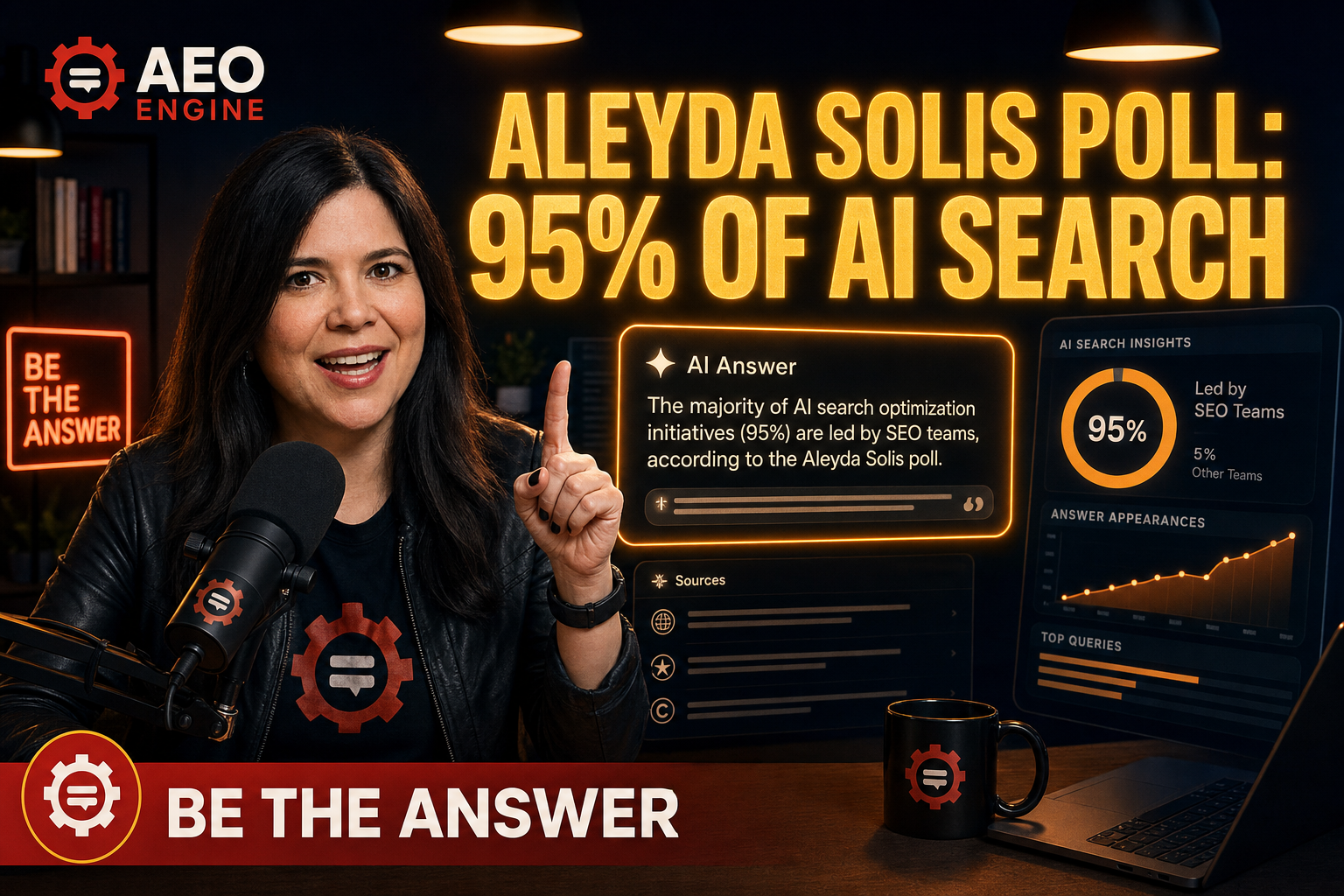
Aleyda Solis poll: 95% of AI search optimization led by SEO teams
The search engine environment is undergoing its most significant transformation since the advent of Google. Generative AI is not just a new feature; it’s a fundamental shift in how users discover information and how brands are found. In this evolving paradigm, understanding who is driving the optimization efforts is paramount. Our research and data from industry leaders point to a clear trend: SEO teams are not just adapting; they are leading the charge into AI search optimization.
Key Takeaways
- Aleyda Solis’s poll reveals that SEO teams are overwhelmingly responsible for AI search optimization, not other departments.
- Generative AI is changing how users discover content, and SEO professionals are the ones adapting strategies to meet this shift.
- Brands that ignore the role of SEO in AI search risk losing visibility as traditional search methods evolve.
- The poll results confirm that SEO expertise is now essential for optimizing content in AI-driven search environments.
This dominance isn’t accidental. It stems from the inherent skills SEO professionals possess. Analytical thinking, data interpretation, and a deep understanding of how search engines process and present information. As AI models become the new gateway to answers, the principles of visibility, authority, and accuracy that SEO has always championed are more important than ever. Ignoring this shift means risking obsolescence in a future where AI-generated answers will increasingly dictate brand discovery.
The 95% Poll Explained: Why SEO Teams Already Own AI Search
A recent poll conducted by Aleyda Solis revealed a striking statistic: 95% of AI search optimization efforts are being led by SEO teams. This figure, derived from a survey of 1,212 professionals, underscores a profound reality in the industry. It signifies that the expertise required to navigate the complexities of AI-driven search discovery is already concentrated within the domain of traditional search engine optimization.
This outcome is not an anomaly. It aligns with, and significantly surpasses, other industry observations. For example, a survey by SEOFOMO indicated that 75% of SEOs reported their team was in charge of AI search strategy. The 95% figure from Aleyda Solis’s poll suggests an even more solidified ownership. This overwhelming majority points to a widespread recognition that the skills and methodologies honed in traditional SEO are directly transferable and essential for success in the AI search era. The urgency is palpable, with SEOFOMO also reporting that 91% of decision-makers or clients have inquired about AI search visibility in the past year.
The question then becomes: why are SEO teams, rather than newly formed AI departments or other marketing silos, overwhelmingly taking the reins? The answer lies in the foundational competencies of SEO. SEO professionals are already adept at understanding search engine algorithms, content structure, keyword intent, and the technical underpinnings of website visibility. They possess the analytical rigor to interpret complex data and the strategic foresight to adapt to algorithmic shifts. As generative AI search begins to synthesize information and provide direct answers, the need for content to be discoverable, accurate, and authoritative. Core SEO tenets. Becomes paramount. New AI departments often lack this direct experience with search visibility mechanisms, making SEO teams the natural custodians of this evolving discipline.
| Survey/Poll | Lead Responsibility for AI Search Optimization | Data Source |
|---|---|---|
| Aleyda Solis Poll (n=1,212) | 95% SEO Teams | Aleyda Solis X Post |
| SEOFOMO AI Search Optimization Survey (2026) | 75% SEO Teams | SEOFOMO Survey |
| SEOFOMO AI Search Optimization Survey (2026) | 91% of decision-makers/clients asked about AI search visibility | SEOFOMO Survey |
Key Takeaway: AI Search Ownership
The data overwhelmingly indicates that SEO teams are the primary drivers behind AI search optimization strategies. This trend reflects the direct applicability of SEO expertise to the new challenges and opportunities presented by generative AI in search. Brands that recognize this will be better positioned to maintain and grow their visibility.
Traditional SEO vs. AI Search Optimization: The Structural Shift

The evolution from traditional SEO to AI search optimization represents a fundamental structural shift in how search engines operate and how brands can achieve visibility. At its core, traditional SEO has long focused on optimizing web pages to rank highly in a list of blue links returned by a search engine. Success was measured by click-through rates, organic traffic to a website, and ranking positions for specific queries. This involved understanding relevance signals, authority metrics, and user engagement signals to satisfy search engine algorithms.
AI Search Optimization (AEO) and Generative Experience Optimization (GEO) move beyond this link-centric model. Instead of merely ranking links, search engines are increasingly designed to extract information directly from the web and synthesize it into a direct answer presented within the search results page itself. This means the objective shifts from “How do I get users to click my link?” to “How do I ensure my brand’s information is accurately and favorably cited or included in the AI-generated answer?” This requires a deeper focus on content clarity, factual accuracy, structured data, and the ability for AI models to confidently source information from a brand’s digital assets. The Aleyda Solis framework for measuring AI presence highlights this shift towards understanding how AI models perceive and use brand content.
Consequently, traditional indexing metrics no longer fully predict AI visibility. Factors like page authority, keyword density, or even backlink profiles, while still important for foundational SEO, are insufficient on their own for AEO. Search engines now prioritize structured, factual, and easily digestible content that LLMs can process without ambiguity. The mechanism of extraction and synthesis means that if a brand’s information is buried in complex jargon, fragmented across multiple pages, or lacks clear factual grounding, it is unlikely to be selected or correctly represented by AI models. This necessitates a re-evaluation of content strategy, technical SEO implementation (especially structured data), and the very definition of “visibility” in the AI-driven search era. Brands must now optimize for being understood and cited by machines, not just ranked for human clicks.
| Aspect | Traditional SEO | AI Search Optimization (AEO/GEO) |
|---|---|---|
| Primary Goal | Rank web pages in search results (blue links) | Ensure brand information is accurately cited/included in AI-generated answers |
| Mechanism | Indexing, ranking algorithms, click-through rates | Information extraction, synthesis by LLMs, citation accuracy |
| Key Metrics | Keyword rankings, organic traffic, conversion rates from clicks | AI citations, answer inclusion rates, accuracy of AI-generated summaries, revenue tied to AI interactions |
| Content Focus | Relevance, authority, user engagement signals | Factual accuracy, clarity, structured data, machine readability, direct answerability |
| Visibility Definition | Position in SERPs for relevant queries | Presence and accuracy within AI-generated answers and summaries |
| Expertise Needed | Keyword research, on-page optimization, link building, technical SEO | Content structuring for extraction, schema markup, LLM understanding, prompt engineering insights, data accuracy |
Why Most SEO Teams Miss the AI Synthesis Layer
Despite the clear ownership of AI search optimization by SEO teams, a significant gap exists in their approach: the AI synthesis layer. While many SEO professionals are focused on ensuring their content is discoverable and technically sound for AI crawlers, they often overlook the critical process by which AI models *synthesize* information into coherent answers. This omission is where brands risk losing control of their narrative and, consequently, their visibility and reputation in AI search results.
The core of this challenge lies in what we call the “citation vacuum.” When AI models extract information from multiple sources without clear attribution or context, brands can lose ownership of their intellectual property and brand messaging. An AI might pull a statistic from your site, a definition from a competitor, and a conclusion from a third source, presenting it as a unified answer where your brand’s specific contribution is diluted or misrepresented. This fragmentation means brands are no longer in direct control of how their information is presented to users seeking answers, leading to a loss of narrative authority. The risk of being cited incorrectly by generative models is substantial, potentially damaging credibility and leading users away from accurate brand information. Understanding the importance of AI citations is the first step in avoiding this vacuum.
Why SEO Teams Excel in AI Search
- Technical Foundation: Deep understanding of indexing, crawling, and site structure.
- Data Analysis: Proficient in interpreting search behavior and performance metrics.
- Adaptability: Proven track record of adjusting to search algorithm changes.
- Content Acumen: Experience in creating relevant, authoritative content.
Gaps in the AI Synthesis Layer
- Lack of LLM Understanding: Limited insight into how LLMs process and synthesize information.
- Fragmented Content Debt: Legacy content structures designed for humans, not AI extraction.
- Citation Control: Difficulty in ensuring accurate and prominent citation by AI models.
- Narrative Dilution: Risk of brand messaging being lost or misrepresented in AI summaries.
- Accuracy Misattribution: Potential for AI to incorrectly attribute information or facts.
Content debt is a significant contributor to this problem. Websites built for traditional search often feature fragmented pages, deep content hierarchies, and a reliance on interlinking that is effective for human navigation but opaque to AI extraction. LLMs struggle to “ground” their answers when the relevant information is scattered across dozens of pages, or when the context required to understand a specific fact is missing. This leads to the AI either omitting the brand’s contribution or, worse, synthesizing it incorrectly due to insufficient contextual clues. For brands in competitive sectors, like e-commerce, where precise product details and claims are critical, this can result in significant brand risk. The AEO Engine Answer Engine Optimization Podcast often features discussions on how to address this content debt and structure information for AI extraction.
The critical oversight for many SEO teams is failing to optimize for AI’s *synthesis* process. This leads to a loss of narrative control, incorrect citations, and diluted brand authority in generative search results. Addressing this requires moving beyond traditional indexing to focus on structured, factual, and contextually rich content that AI models can confidently and accurately attribute.
The Operator Playbook: Three Actions to Capture AI Citations
The insights from the Aleyda Solis poll, indicating that 95% of AI search optimization is led by SEO teams, underscore the readiness of these professionals to tackle the new search paradigm. However, transitioning from traditional SEO to AI-driven visibility requires a strategic shift in how content is structured and presented. The objective is no longer solely to rank for user queries but to ensure brand information is accurately and favorably extracted and synthesized by AI models. This requires a proactive approach to content architecture and data formatting, moving beyond basic keyword optimization to focus on machine readability and contextual clarity.
To effectively capture AI citations and maintain narrative control, SEO teams must implement a system-oriented approach. This involves three core actions: restructuring existing content for direct answer extraction, deploying structured data to improve machine readability, and aligning product or service data with commerce feeds for transactional AI interactions. These steps are not merely tactical adjustments; they represent a foundational re-evaluation of a brand’s digital assets through the lens of generative AI. By focusing on these actionable areas, brands can move from a state of passive observation to active participation in the AI search ecosystem, ensuring their authoritative contributions are recognized and used.
Action One: Restructure Content for Direct Answer Extraction
The first critical action is to audit and restructure your content to facilitate direct answer extraction by AI models. This means deconstructing lengthy, narrative-heavy articles into more digestible, fact-based segments. Think of it as creating atomic units of information that an LLM can easily isolate and cite. This involves identifying key facts, figures, definitions, and answers within your existing content and presenting them clearly and concisely. For example, instead of a long explanation of a product’s benefits, create a dedicated section with bullet points or short, declarative sentences that directly state each benefit and its associated value proposition.
This restructuring addresses the “content debt” issue where information is fragmented across multiple pages or buried within large blocks of text. AI models struggle with context when information is not clearly delineated. By organizing content into distinct answer blocks, often using clear headings and subheadings, you provide AI crawlers with precise data points. This approach also supports the creation of more comprehensive knowledge graphs for your brand, making it easier for AI to understand relationships between concepts, products, and services. This foundational step ensures that when AI seeks specific answers, your brand’s content is the most accessible and well-organized source.
Action Two: Deploy Schema and Structured Data for Machine Readability
Schema markup and structured data are the universal languages that AI models understand. Implementing them is paramount for ensuring your content is not only discoverable but also interpretable by machines. This means going beyond basic HTML tags and employing specific schema types (like `Article`, `Product`, `FAQPage`, `HowTo`, `Recipe`) to provide explicit context about the information on your pages. For instance, using `Product` schema with properties like `name`, `description`, `offers`, and `review` gives AI models a structured understanding of your offerings, far more effectively than plain text alone.
The goal is to reduce ambiguity and provide AI models with the structured context they need to accurately extract and cite information. This includes defining entities, relationships, and attributes within your content. For example, if you have a blog post discussing a scientific concept, employing schema to define the concept, its key terms, and related research papers can significantly improve its chances of being correctly referenced in AI-generated explanations. This technical layer is where SEO teams can translate their understanding of search engine signals into direct instructions for AI, ensuring accuracy and proper attribution. The Aleyda Solis framework emphasizes the importance of this structural readiness.
Action Three: Align Product and Service Data with Commerce Feeds
For e-commerce and B2B brands, aligning product and service data with commerce feeds is a direct pathway to AI-driven transactional visibility. AI search engines are increasingly integrating commerce capabilities, allowing users to find, compare, and even purchase products directly through AI interfaces. Ensuring your product information. Including SKUs, pricing, availability, specifications, and images. Is accurate, up-to-date, and consistently formatted across your website, product feeds (like Google Shopping, Meta Product Catalog), and any relevant APIs is crucial.
This alignment ensures that when users ask AI for product recommendations or comparisons, your offerings can be accurately presented and considered. It’s about making your product catalog machine-readable and queryable for AI agents. This involves not only structured data on individual product pages but also maintaining clean, comprehensive data in your central product information management (PIM) system or e-commerce platform. The importance of AI citations for e-commerce is amplified when it leads directly to a sale. By ensuring data integrity and machine readability, brands can capture AI traffic that is highly qualified and poised for conversion.
AI Citation Capture Checklist
- Content Restructuring:
- Identify key facts, definitions, and answers within existing content.
- Break down long-form content into distinct, fact-based segments.
- Use clear headings and subheadings for AI to parse.
- Ensure each segment is contextually complete for AI extraction.
- Schema & Structured Data:
- Implement relevant schema types (Article, Product, FAQPage, etc.).
- Define entities, relationships, and attributes with schema.
- Verify schema implementation using tools like Google’s Rich Results Test.
- Ensure data accuracy and consistency across all structured data.
- Commerce Feed Alignment:
- Audit product/service data for accuracy and completeness.
- Ensure consistent formatting across website, PIM, and feeds.
- Verify data points like SKUs, pricing, availability, and descriptions.
- Integrate AI-friendly data attributes for transactional queries.
Measuring AI Presence: Aleyda’s Three-Layer Framework Applied

In the evolving AI search environment, traditional SEO metrics are insufficient for understanding a brand’s true visibility. Aleyda Solis’s three-layer framework provides a structured method for measuring AI presence, readiness, and business impact. This framework is essential for SEO teams, moving them beyond simply tracking rankings to assessing how their brand is being perceived and used by generative AI models. It offers a systematic way to identify gaps and opportunities, ensuring optimization efforts directly contribute to business objectives. The AEO Engine Answer Engine Optimization Podcast frequently discusses how to operationalize such frameworks for measurable results.
Applying this framework allows brands to move from guesswork to data-driven strategy. It helps answer critical questions: Is our brand appearing in AI answers? Is the information accurate? And most importantly, is this AI visibility translating into tangible business outcomes? By dissecting AI presence into distinct layers. Presence, readiness, and impact. SEO professionals can develop a comprehensive understanding of their performance and refine their strategies for optimal AI-driven discovery. This systematic approach is key to staying ahead in a rapidly changing search environment.
Layer One: Presence Tracking and Prompt Constraint Testing
The first layer of measurement focuses on establishing and tracking a brand’s presence within AI-generated search results. This involves actively monitoring AI answer summaries, generative experiences (like Google’s SGE or Bing Chat), and AI-powered answer boxes for mentions of your brand, products, or key services. A critical component here is prompt constraint testing. This means crafting specific, targeted prompts that are designed to elicit answers related to your brand’s offerings or industry. By varying prompt parameters. Such as question phrasing, specificity, and context. You can understand how AI models interpret your brand’s information and under what conditions it is likely to be cited.
This layer requires tools and methodologies that can systematically query AI models and analyze the resulting outputs. It’s about identifying not just *if* your brand is mentioned, but *how*. Are you being cited accurately? Is your unique selling proposition reflected? Or is your brand merely a passing mention in a synthesized answer? This proactive testing helps identify potential issues with AI understanding or content representation before they become widespread problems. It’s the foundational step in understanding your current standing in the AI search ecosystem and forms the basis for subsequent optimization efforts.
Layer Two: Structural Readiness and the Visibility Gap
Layer two delves into the structural and technical readiness of your digital assets to be effectively used by AI models. This involves assessing how well your website’s content and underlying structure support AI extraction and synthesis. Key elements to evaluate include the clarity and conciseness of your content, the logical flow of information, and the implementation of structured data like schema markup. The “visibility gap” here refers to the discrepancy between the information you believe should be visible to AI and what is actually being extracted and presented.
This layer requires a deep audit of your website’s content architecture, technical SEO implementation, and data formatting. Are your pages optimized for machine readability? Is your schema markup accurate and comprehensive? Is your content fragmented, or is it presented in easily digestible units? For instance, if an AI model struggles to find specific product details or factual statements due to poor content organization or missing schema, there’s a structural readiness gap. Analyzing this layer helps pinpoint exactly where content restructuring, schema deployment, or data cleanup is needed to improve AI’s ability to understand and cite your brand reliably. The goal is to ensure your brand’s digital assets are not just accessible but optimally structured for AI consumption.
Layer Three: Tying AI Citations to Revenue and Conversion Impact
The final and most critical layer of Aleyda’s framework is connecting AI presence and readiness to demonstrable business impact, specifically revenue and conversions. While AI citations are a positive signal, their ultimate value lies in their contribution to business goals. This layer requires advanced attribution modeling that can trace AI-driven interactions back to user journeys and conversions. It involves understanding how users who discover your brand through AI answers behave on your site and whether they are more or less likely to convert compared to users from other channels.
This measurement can be challenging, as AI-generated answers often occur within the search interface itself, making traditional click-based tracking insufficient. However, by analyzing trends in AI-driven traffic, measuring direct conversions from users who start their journey via AI-assisted search, and observing shifts in brand search volume correlated with AI mentions, brands can begin to quantify the ROI of their AI search optimization efforts. AEO Engine clients, for example, have reported a 920% average lift in AI-driven traffic and conversions that are up to 9x higher from AI-sourced leads. This layer is about proving that AI search optimization is not just about visibility but a direct contributor to growth and profitability.
Measuring AI presence requires a multi-faceted approach. Aleyda Solis’s three-layer framework. Presence Tracking, Structural Readiness, and Business Impact. Provides a clear roadmap. By systematically assessing how AI models interact with your brand, optimizing your content and data structure for machine readability, and rigorously attributing AI-driven visibility to revenue outcomes, brands can ensure their AI search optimization efforts yield significant, measurable business growth.
Ecommerce and B2B Scaling: From Manual Audits to Agentic Content Systems
The overwhelming majority of SEO teams leading AI search optimization, as highlighted by the Aleyda Solis poll showing 95% ownership, face a common bottleneck when scaling their efforts: manual optimization. While individual audits and tactical adjustments are effective for smaller sites or initial phases, they hit a ceiling quickly. For large e-commerce catalogs or complex B2B service portfolios, the sheer volume of content and the dynamic nature of product information make manual optimization an unsustainable strategy for capturing AI visibility. This is where the limitations of traditional SEO approaches become starkly apparent in the context of generative AI search.
To truly scale AI search optimization (AEO), brands must transition from reactive, manual interventions to proactive, automated systems. This involves adopting agentic content systems. AI-powered tools and processes designed to continuously monitor, analyze, and optimize content for AI search engines. These systems can manage the complexity of large datasets, ensuring consistency, accuracy, and timely updates across thousands of product pages or service listings. This shift is not about replacing human expertise but augmenting it, freeing up SEO professionals to focus on higher-level strategy and interpretation rather than granular execution. The ability to maintain always-on AI content systems is becoming a competitive differentiator for brands aiming for sustained growth in AI-driven search.
Why Manual Optimization Hits a Ceiling at Scale
Manual optimization, by its nature, is labor-intensive and time-consuming. For e-commerce businesses, this might mean auditing thousands of product pages for proper schema markup, unique descriptions, and accurate metadata. For B2B companies, it could involve reviewing hundreds of service pages, case studies, and white papers to ensure they are structured for AI extraction. The sheer scale of these tasks makes it impossible for teams to conduct them with the frequency required by AI search engines, which are constantly updating and evolving.
Furthermore, manual processes are prone to human error and inconsistency, especially when managing large volumes of data. A slight oversight in updating a product price, a missed schema implementation on a new page, or an inconsistent tone across content can lead to AI models either ignoring the brand’s information or presenting it inaccurately. This leads to a direct loss of visibility and potential revenue. The Aleyda Solis framework for measuring AI presence highlights that readiness is key, and manual methods falter when scaling this readiness. Without automation, brands will inevitably fall behind as AI search becomes more sophisticated and user expectations for instant, accurate answers grow.
How Always-On AI Content Agents Maintain AEO Consistency
Always-on AI content agents represent the next frontier in AI search optimization. These systems use artificial intelligence to automate repetitive AEO tasks, ensuring continuous optimization and consistency across a brand’s digital footprint. For example, an AI agent can be programmed to monitor product page performance, detect any deviations from best practices (like missing structured data or inconsistent descriptions), and automatically flag or even correct these issues. This capability is invaluable for managing large product catalogs where manual oversight is impractical.
These agents can also proactively identify new content opportunities or gaps by analyzing AI search trends and user queries. They can draft or suggest updates to content, ensuring it remains relevant and optimized for AI extraction. The AEO Engine Answer Engine Optimization Podcast often explores how such agentic systems are transforming AEO by providing real-time, data-driven adjustments that manual processes simply cannot match. This continuous, automated optimization is essential for maintaining high visibility in AI search results, especially for businesses with extensive product lines or service offerings.
The 100-Day Traffic Sprint: Rapid Deployment for Measurable Wins
To bridge the gap between manual limitations and the need for scalable AI search optimization, AEO Engine has developed frameworks like the “100-Day Traffic Sprint.” This approach focuses on rapid deployment of AEO strategies, using automated systems and targeted interventions to achieve measurable growth within a defined timeframe. It’s designed to move beyond theoretical discussions and deliver tangible results quickly, proving the value of AI search optimization to stakeholders.
The 100-Day Traffic Sprint involves a structured methodology: initial AI presence and readiness audits, implementation of critical structural and data optimizations (often powered by AI agents), and continuous monitoring and refinement. This sprint model allows brands, particularly those in e-commerce and B2B sectors, to see significant gains in AI-driven traffic and conversions. Often reporting a 920% average lift in AI-driven traffic and 9x higher conversions from AI-sourced leads. It’s a practical, results-oriented framework that demonstrates how sophisticated AEO systems can drive immediate business impact, proving that scaling AI visibility is achievable and highly profitable.
Benefits of Agentic Content Systems for Scaling AEO
- Scalability: Manages vast amounts of content (e.g., e-commerce catalogs) efficiently.
- Consistency: Ensures uniform application of AEO best practices across all assets.
- Speed & Agility: Enables rapid updates and adjustments in response to AI algorithm changes.
- Accuracy: Reduces human error in data entry and optimization tasks.
- Efficiency: Frees up human teams for strategic thinking and complex problem-solving.
Challenges of Transitioning to Agentic Systems
- Initial Investment: Requires resources for technology and implementation.
- Integration Complexity: May require significant technical integration with existing PIM or CMS.
- System Configuration: Needs careful setup and ongoing oversight to ensure agents perform as intended.
- Over-reliance Risk: Danger of neglecting human oversight and strategic direction.
- Learning Curve: Teams need to adapt to working alongside AI agents.
References
Frequently Asked Questions
Who Should Lead AI Search Optimization Inside an Organization?
Based on industry data, including the Aleyda Solis poll indicating 95% of efforts are led by SEO teams, it is clear that SEO professionals are the primary custodians of AI search optimization. Their foundational understanding of search algorithms, content structure, and organic visibility makes them the most qualified to navigate this evolving environment. While collaboration with AI, content, and product teams is beneficial, the strategic direction and execution should stem from the SEO department.
How Does AI Search Optimization Differ from Traditional SEO?
Traditional SEO focuses on ranking web pages for direct user queries, aiming for clicks to a website. AI search optimization (AEO) shifts this focus to ensuring a brand’s information is accurately extracted, synthesized, and cited within AI-generated answers and conversational search interfaces. It requires optimizing for machine readability, factual accuracy, and contextual completeness, rather than solely for human-readable content and click-through rates. The goal is not just visibility, but accurate representation in answers.
Can AI Search Traffic Be Directly Attributed to Revenue?
Yes, AI search traffic can be directly attributed to revenue, though it requires advanced attribution modeling. While AI answers often occur within the search interface, tracking user journeys that originate from AI interactions requires specific methodologies. Brands that effectively optimize for AI search are seeing significant returns; AEO Engine clients report a 920% average lift in AI-driven traffic and up to 9x higher conversion rates from AI-sourced leads. This demonstrates a clear link between AI visibility and business outcomes.
What Is the Fastest Way for an SEO Team to Start Optimizing for AI Answers?
The fastest way for an SEO team to start optimizing for AI answers involves a three-pronged approach: first, restructure key content into clear, fact-based segments for direct extraction; second, implement comprehensive schema markup and structured data to improve machine readability; and third, align product and service data with commerce feeds for transactional AI queries. Adopting a framework like the Aleyda Solis framework for measuring AI presence and readiness can provide immediate direction. Listening to the AEO Engine Answer Engine Optimization Podcast also offers actionable insights for rapid implementation.
Leave a Reply