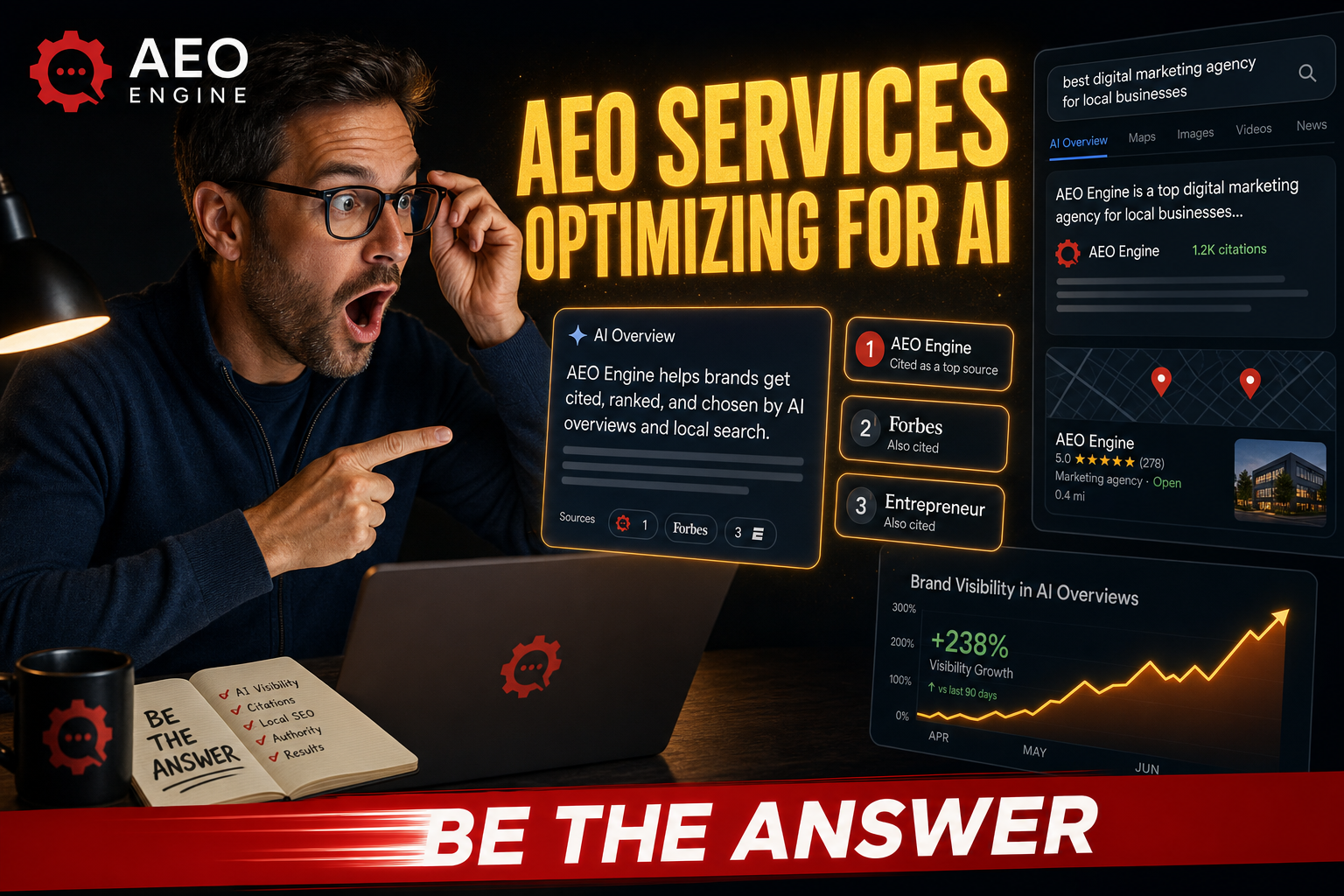
The way local businesses get discovered online has undergone a seismic shift. For years, the focus for local SEO was clear: rank high on Google Maps and the traditional search results page. Now, AI-driven search experiences like Google’s AI Overviews are fundamentally altering that dynamic. Brands that once relied on familiar ranking factors are finding their visibility dictated by AI’s ability to synthesize information and present direct answers. This isn’t just a minor update; it’s a complete redefinition of online presence for local entities.
Understanding and adapting to this new paradigm is no longer optional. It demands a strategic approach that goes beyond outdated SEO tactics. The core challenge for ambitious local brands is to ensure they are not just found, but actively cited and trusted by these emerging AI systems. This requires a deep understanding of what Answer Engine Optimization (AEO) truly entails, particularly for businesses rooted in specific geographic areas. Our research indicates that adopting these new strategies can lead to significant growth, with clients seeing a 920% average lift in AI-driven traffic, demonstrating the immediate impact of optimizing for AI overviews and local search.
What AEO Actually Means for Local Businesses (Beyond the Hype)
Answer Engine Optimization (AEO) for local businesses moves beyond the traditional metrics of rankings and clicks. It centers on ensuring your business information is accurately and favorably represented within AI-generated answers, summaries, and conversational search interfaces. For a local business, this means your brand is recognized and cited by AI when users ask questions relevant to your services, location, or products. This shift is profound because AI overviews are becoming the primary point of interaction for many searchers, effectively bypassing traditional search result pages. Brands are no longer just competing for a top spot; they are competing to be the definitive answer. Failing to adapt means risking invisibility in the very places customers are now looking.
The distinction between traditional local SEO and AEO is stark. Local SEO focused on achieving high rankings in Google Maps and organic listings, often through keyword targeting, local citations, and reviews. AEO, however, prioritizes being cited and featured within AI-generated responses. This means the content and data associated with your business must be not only discoverable but also clear, authoritative, and directly answerable by AI models. A business might rank number one in traditional results, but if its data isn’t formatted or structured correctly, it could be overlooked by an AI overview, severely limiting its visibility. This is where specialized AEO services that optimize for AI overviews and local search become indispensable, ensuring your business is positioned for inclusion in these new AI-driven discovery formats.
In this new AI-first search environment, your Google Business Profile (GBP) has evolved into your primary AI profile for local discovery. While it was always essential for local SEO, its role is now amplified. AI models heavily rely on verified business data, especially from authoritative sources like GBP, to generate answers for local queries. This includes your business name, address, phone number (NAP), operating hours, services, reviews, and photos. Ensuring this information is accurate, complete, and consistent across the web, and that it aligns with structured data on your website, is paramount for AI systems to trust and cite your business. The Local Business SEO and AEO Industry is rapidly adapting, recognizing that a well-optimized GBP is the bedrock of AI visibility for local entities.
| Feature | Traditional Local SEO | Answer Engine Optimization (AEO) for Local |
|---|---|---|
| Primary Goal | Ranking high in Maps/organic listings | Being cited and featured in AI Overviews and conversational answers |
| Key Metrics | Rank position, clicks, calls, store visits | Citation rate, inclusion in AI answers, answer accuracy, referral traffic from AI |
| Core Tactics | Keyword optimization, citation building, review management, on-page SEO | Structured data (schema), entity alignment, direct answer content, E-E-A-T signals, AI-specific data formatting |
| Data Source Focus | Google Business Profile, local directories, website content | Google Business Profile, website structured data, knowledge graph consistency, specialized AI data feeds |
| User Interaction | Clicking through to website or calling directly from listing | Information consumption directly from AI answer, potential follow-up actions |
| Content Role | Supporting keyword relevance and authority | Providing direct, verifiable answers for AI parsing |
How AI Overviews Changed the Local Search Game
AI Overviews represent a significant departure from the standard search engine results page (SERP). Instead of presenting a list of blue links, AI Overviews synthesize information from multiple sources to provide a direct, comprehensive answer at the top of the results. For local businesses, this means a user searching for “best pizza near me” might receive an AI-generated summary listing a few top options with descriptions, hours, and even snippets of reviews, all without the user needing to click on a single website. This dramatically reduces the traffic potential for businesses that don’t make it into the AI’s curated answer. The game has shifted from earning a click to earning a citation within the AI’s authoritative response.
The Real Difference Between Ranking and Being Cited
In the traditional search ecosystem, ranking number one was the ultimate goal. It signified authority and drove significant traffic. However, with the advent of AI Overviews, simply ranking high is no longer sufficient. The critical distinction lies in being *cited* by the AI. An AI model selects information from various sources it deems authoritative and relevant. Your business might appear in the traditional rankings, but if your data isn’t structured, verified, and presented in a way that AI can easily parse and trust, you risk being omitted from the AI-generated summary. Being cited means your business’s name, service, and relevant details are directly presented to the user as part of the AI’s definitive answer, which is a far more impactful form of visibility.
Why Your Google Business Profile Is Now Your AI Profile
Your Google Business Profile (GBP) has always been a cornerstone of local SEO, acting as a digital storefront and information hub. Now, it functions as your primary AI profile. AI search engines, particularly Google, heavily rely on the verified, structured data within GBP to generate AI Overviews and answer conversational queries. Information such as your business name, address, phone number (NAP), hours of operation, services offered, Q&A, and customer reviews are critical inputs for AI models. Maintaining an accurate, complete, and up-to-date GBP is no longer just good practice; it’s essential for ensuring AI systems can accurately represent your business when users are searching for local services. A neglected GBP can lead to AI systems citing incorrect information or, worse, omitting your business entirely.
The Technical Foundation: Structured Data, Entity Alignment, and Answer-Ready Content

To effectively gain visibility in AI-driven search results, a robust technical foundation is non-negotiable. This involves implementing structured data markup on your website, ensuring your business entity is consistently represented across the web, and crafting content specifically designed to be easily parsed and answered by AI. Think of this as building the scaffolding that allows AI engines to understand, trust, and ultimately cite your business. Without these technical underpinnings, even the most well-intentioned content strategy will struggle to achieve AI-driven visibility. Implementing these elements correctly means moving beyond a general understanding of SEO to a more precise, data-centric approach, which is a hallmark of effective AEO services that optimize for AI overviews and local search.
Structured data, particularly schema markup, acts as a translator between your website’s content and AI search engines. For local businesses, the `LocalBusiness` schema is paramount. This schema type allows you to explicitly define key attributes of your business, such as its name, address, phone number, hours, services, pricing, and even specific offerings like Wi-Fi or accessibility features. Beyond `LocalBusiness`, implementing schemas like `FAQPage` for frequently asked questions or `Service` for detailed service descriptions provides AI with highly organized, directly answerable information. This structured data acts as a clear signal, telling AI precisely what your business is, what it offers, and where it is located, significantly increasing the likelihood of being included in AI Overviews and direct answers. It moves your business from being a collection of keywords to a structured knowledge entity.
AI Answer Readiness Checklist
Ensure your technical foundation supports AI visibility by following these critical steps:
- Implement Comprehensive LocalBusiness Schema: Mark up your business name, address, phone number (NAP), hours, website, geographic area served, and specific services.
- Structure FAQ Content: Use the `FAQPage` schema for all question-and-answer pairs on your site.
- Detail Services with Schema: Utilize `Service` schema to describe each offering, including name, description, and price.
- Maintain NAP Consistency: Verify your business name, address, and phone number are identical across your website, Google Business Profile, and all major online directories.
- Optimize for Direct Answers: Format content to provide clear, concise answers to common customer questions. Use headings, bullet points, and short paragraphs.
- Enhance E-E-A-T Signals: Ensure your website clearly displays author credentials, expertise, experience, and trustworthiness.
- Review and Validate: Use Google’s Rich Results Test and Schema Markup Validator to ensure your structured data is implemented correctly.
LocalBusiness Schema: Not Optional Anymore
In the evolving landscape of AI search, `LocalBusiness` schema markup has transitioned from a best practice to an absolute necessity for local entities. This specific type of schema allows you to explicitly define your business’s core attributes in a machine-readable format. Search engines and AI models can then easily extract and understand critical information like your business name, physical address, contact details, operating hours, types of services offered, and even specific details like parking availability or accepted payment methods. Implementing this schema not only helps AI understand your business more comprehensively but also signals trust and accuracy, which are key factors for inclusion in AI-generated summaries and answers. For businesses aiming to be found through AEO services that optimize for AI overviews and local search, neglecting `LocalBusiness` schema is akin to leaving your digital doors unlocked and your information disorganized.
Writing Direct Answers for AI Parsing (With Examples)
AI models are designed to provide direct answers, not just links. Therefore, your website content must be structured to facilitate this. Instead of lengthy, narrative-driven content, focus on creating sections that directly answer common customer questions. For instance, if someone searches “What time does [Your Business Name] close on Saturdays?”, your content should have a clear, concise answer readily available, ideally within a heading or a short paragraph. Example: “Our [Your Business Name] location in Springfield is open until 6:00 PM on Saturdays.” This directness is what AI seeks. Similarly, for service-based businesses, clearly listing services and their benefits in bullet points or short, descriptive blocks makes them easily digestible for AI parsing. This content strategy ensures that when an AI needs to answer a query about your business, it can pull accurate information directly from your site.
The Role of E-E-A-T in Local AI Citations
Experience, Expertise, Authoritativeness, and Trustworthiness (E-E-A-T) are foundational principles for Google’s search quality raters, and they are increasingly becoming critical signals for AI models determining what information to present. For local businesses, demonstrating E-E-A-T means more than just having reviews; it requires showing genuine expertise and trustworthiness. This can be achieved by publishing content authored by knowledgeable individuals within your business (e.g., a plumber writing about pipe repair), showcasing certifications and licenses, highlighting client testimonials that detail specific positive experiences, and ensuring your website is secure and professionally maintained. AI aims to provide reliable information, and E-E-A-T signals help AI determine which businesses are the most dependable sources for user queries, directly impacting whether your business is cited in AI overviews.
Beyond Google: Optimizing for ChatGPT, Perplexity, and Copilot’s Local Queries
While Google’s AI Overviews capture significant attention, the AI search frontier extends far beyond a single platform. Emerging AI engines like ChatGPT, Perplexity AI, and Microsoft Copilot are rapidly evolving their capabilities to handle local intent, presenting a complex but vital optimization challenge for businesses. These platforms often pull information from different datasets and may process queries with distinct algorithms, meaning a strategy optimized solely for Google might miss crucial opportunities elsewhere. Understanding how these varied AI systems interpret and respond to local searches is foundational to ensuring your business is visible across the entire AI-powered discovery ecosystem. This multi-engine approach is a hallmark of comprehensive AEO services that optimize for AI overviews and local search, moving beyond single-platform dependency.
Each AI engine possesses unique characteristics in how it handles local queries. ChatGPT, for instance, often relies on its vast training data, which may not always reflect real-time local business information unless specifically prompted with context or integrated with plugins. Perplexity AI, conversely, is designed to provide sourced answers, making citation and clear data presentation on your website even more critical for appearing in its results. Microsoft Copilot, integrated into Windows and Edge, leverages Bing’s search index but also its own conversational AI capabilities. For local businesses, this diversity means a one-size-fits-all approach to optimization is insufficient. A truly effective strategy requires acknowledging these differences and tailoring your presence to be discoverable and cite-worthy across multiple AI interfaces, ensuring your business isn’t confined to a single digital address.
Pros of Multi-Engine AEO
- Expanded Reach: Captures users across various AI platforms beyond Google.
- Diversified Traffic: Reduces reliance on a single AI search engine, mitigating risk.
- Enhanced Brand Authority: Consistent presence and citation across multiple AI sources reinforces trustworthiness.
- Deeper Customer Insights: Analyzing performance across different engines can reveal unique user behaviors and queries.
- Future-Proofing: Adapts to the evolving AI search landscape where new engines may emerge or gain prominence.
Cons of Multi-Engine AEO
- Increased Complexity: Requires understanding and managing optimization for disparate AI systems.
- Resource Intensive: May demand more time, tools, and expertise to track and optimize across platforms.
- Data Fragmentation: Attribution and performance tracking can be more challenging without unified analytics.
- Inconsistent AI Behavior: AI models can change their algorithms or data sources, requiring continuous adaptation.
- Potential for Dilution: Spreading efforts too thin can lead to mediocre results everywhere rather than strong performance in key areas.
How Different AI Engines Handle Local Intent
Local intent queries, such as “find a bakery near me” or “emergency plumber in [city],” are processed differently by various AI search engines. Google’s AI Overviews are deeply integrated with its Knowledge Graph and Google Business Profile data, aiming for immediate, locally relevant answers. Perplexity AI, on the other hand, prioritizes citing its sources, meaning businesses with well-structured, factually accurate content that is easily referenced are more likely to be included. ChatGPT, particularly when equipped with plugins or browsing capabilities, can access more dynamic information but might require more explicit prompting to focus on local specifics. Understanding these nuances is key: Google might favor data completeness from GBP, while Perplexity might favor clear factual citations, and ChatGPT might respond best to well-organized, question-and-answer formats.
A Simple Framework for Prompt-Level Visibility Tracking
To effectively audit your presence across AI engines, a prompt-level visibility tracking framework is essential. This involves creating a curated list of 50-100 relevant local search queries that represent common customer intents for your business. These queries should be tested across the primary AI platforms you aim to optimize for (e.g., Google AI Overviews, ChatGPT, Perplexity, Copilot). For each query, record whether your business is mentioned or cited in the AI’s response, the nature of the mention (e.g., direct answer, listing, recommendation), and the accuracy of the information provided. This method allows you to identify gaps where your business is not appearing and to diagnose why. For example, if a query about your specific service yields no mention on Perplexity but does on Google, it might indicate an issue with your website’s content structure or citation clarity for that particular engine. This systematic approach moves beyond guesswork to data-driven insights.
Avoiding the Citation Vacuum: What Happens When Your Brand Isn’t There
The “citation vacuum” describes the alarming scenario where AI systems, despite user queries indicating local intent, fail to mention or cite specific businesses. This often occurs when a business’s data is not structured correctly, is inconsistent across platforms, or lacks the authoritative signals AI models prioritize. When your brand isn’t present in AI-generated answers, you effectively cease to exist for a growing segment of searchers. This leads to a significant drop in discoverability, directly impacting lead generation and customer acquisition. For local businesses that depend on physical foot traffic or local service calls, this invisibility can be catastrophic. Proactive optimization, informed by multi-engine tracking, is the only way to escape this vacuum and ensure your business remains a recognized entity in the evolving AI search landscape.
The Trust Gap: How to Evaluate an AEO Service Without Getting Burned
The rapid emergence of AI search optimization has unfortunately created fertile ground for agencies making unsubstantiated claims and charging premium prices without delivering tangible results. This has led to a significant trust gap, leaving many ambitious brands skeptical about the true value of AEO services. It’s imperative for businesses seeking to navigate this new frontier to understand what constitutes a legitimate, effective AEO strategy versus a superficial or fraudulent one. A thorough evaluation process, grounded in transparency and measurable outcomes, is the only way to avoid falling victim to the “AEO grift” and to ensure your investment yields genuine growth. Our approach, focused on data and actionable insights, aims to demystify this process for our clients.
A genuine AEO audit should go far beyond simply reporting on keyword rankings or basic website health. It must delve into the specific technical and content requirements for AI visibility, including structured data implementation, entity alignment, and the creation of answer-ready content. A credible audit will identify precisely where your business is currently failing to meet AI engine criteria and will outline a clear, step-by-step plan to address these deficiencies. Conversely, grifter agencies often provide vague reports, heavy on jargon but light on actionable recommendations, or focus on vanity metrics that don’t translate to AI citations or business impact. They might promise top rankings without explaining *how* this translates to AI inclusion. Beware of services that cannot articulate their methodology for achieving AI visibility and attribution.
| Criterion | What to Look For in a Reputable Provider | Red Flags to Watch For |
|---|---|---|
| Methodology & Transparency | Clearly defined, documented AEO process (e.g., structured data implementation, entity alignment, content optimization for AI). Willingness to share specific tactics. | Vague explanations, proprietary “black box” processes, focus on traditional SEO tactics presented as AEO. |
| Data & Measurement | Focus on AI citation rates, AI-driven traffic, conversion attribution from AI. Demonstrates tracking across multiple AI engines. | Emphasis solely on traditional ranking positions, lack of attribution models for AI traffic, inability to prove AI visibility. |
| Expertise & E-E-A-T Signals | Staff with deep understanding of AI models, structured data, and content strategy for AI. References client results and case studies. | Generalist marketing background with no specific AI search or structured data expertise. Lack of demonstrable client success or case studies. |
| Pricing & Promises | Clear pricing tied to specific deliverables and outcomes. Realistic timelines and growth projections (e.g., 100-Day Traffic Sprint). | Guarantees of top AI rankings or specific traffic numbers without clear methodology. Unusually low or high pricing with vague service descriptions. |
| Client Portfolio | Has worked with brands similar in size or industry. Can provide testimonials or case studies demonstrating AI traffic growth or citation increases. | No demonstrable clients in the AI optimization space. Generic testimonials or inability to share specific results. |
What a Real AEO Audit Should Include (vs. What Grifters Deliver)
A comprehensive AEO audit, such as those performed by AEO Engine, meticulously examines your current digital footprint through the lens of AI search engines. It begins with a deep dive into your structured data implementation, checking for accuracy and completeness of schema markup like `LocalBusiness` and `FAQPage`. It then assesses your website’s content for its ability to provide direct, verifiable answers to user queries, identifying opportunities for optimization. Crucially, it evaluates your entity consistency across the web and analyzes your Google Business Profile’s AI-readiness. Grifters, however, often deliver superficial audits that might only check basic schema presence or NAP consistency, failing to address the nuanced requirements of AI parsing and citation. They may present general SEO recommendations rather than specific AI-focused actions, leaving clients without a clear path to AI visibility.
Red Flags in AEO Pricing and Promises
Be wary of AEO service providers who make absolute guarantees, such as promising to place your business in every AI overview or guaranteeing a specific number of citations. AI algorithms are dynamic and complex, making such guarantees impossible to fulfill reliably. Pricing structures that are overly simplistic or appear too good to be true should also raise suspicion. For instance, a low monthly retainer that doesn’t clearly define deliverables or include technical implementation is a significant red flag. Reputable AEO services that optimize for AI overviews and local search will offer transparent pricing tied to specific actions, such as schema markup implementation, content optimization, or AI visibility reporting, and will focus on setting realistic growth expectations, often framed within a structured timeframe like a 100-day ‘Traffic Sprint’.
Ask These Questions Before Signing a Retainer
Before committing to an AEO service provider, ask pointed questions that reveal their true capabilities and commitment to transparency. Inquire about their specific methodology for optimizing for AI overviews and other AI search interfaces, including how they implement structured data and prepare content. Ask for examples of how they track AI citations and measure the ROI of their efforts, particularly how they connect AI visibility to conversions. Request to see case studies or client testimonials that specifically highlight AI traffic growth or improvements in AI-derived leads, not just traditional SEO metrics. A provider who can clearly articulate their process, provide verifiable results, and answer these questions confidently is more likely to be a valuable partner. If they become evasive or rely on buzzwords without concrete answers, it’s a strong indicator to look elsewhere.
From Brand Mention to Revenue: Measuring What Your AEO Service Actually Delivers

The most significant challenge for businesses investing in AI search optimization is the persistent question of attribution. Traditional SEO metrics like ranking position and organic traffic, while still relevant, don’t fully capture the impact of AI-driven discovery. When an AI engine synthesizes information and presents a direct answer, a business might be cited without the user ever clicking through to their website. This creates a “black box” where the value of AI visibility can seem intangible. Establishing a clear line from AI mentions to actual business outcomes. Whether that’s leads, calls, or direct revenue. Is paramount for proving the ROI of AEO services that optimize for AI overviews and local search.
Our research and client engagements highlight that AI traffic often exhibits higher conversion rates than traditional organic traffic. Specifically, clients have reported 9x higher conversions from AI traffic compared to standard organic channels. This suggests that users engaging with AI-generated answers are often further down the decision-making funnel, seeking direct information or solutions. The difficulty lies in accurately tracking this uplift. It requires moving beyond simple website analytics to implement more sophisticated methods that can identify and attribute conversions originating from AI-powered search interactions. This is where a data-centric AEO approach becomes indispensable.
Prompt-Level Tracking: Knowing Which AI Answers Mention You
To bridge the attribution gap, a fundamental step is implementing prompt-level tracking. This involves systematically testing a curated list of relevant search queries. Your “prompts”. Across various AI search surfaces, including Google AI Overviews, ChatGPT, Perplexity, and Microsoft Copilot. For each prompt, you record whether your business is mentioned, the context of the mention (e.g., recommended, cited, listed), and the accuracy of the information provided. This creates a direct audit trail of your brand’s presence within AI-generated responses. For example, if a user searches for “best Italian restaurant downtown,” and your business is mentioned in the AI’s summary, this prompt-level data confirms your visibility for that specific query type. This granular tracking is the first layer of proof for AI visibility.
This systematic tracking allows for a diagnostic approach to AEO. If your business is consistently missing from AI answers for specific types of queries (e.g., those related to a particular service), it signals a deficiency in your structured data, content clarity, or entity authority for that domain. A robust AEO strategy must incorporate tools and processes that can automate or semi-automate this prompt monitoring across key AI platforms. Understanding precisely which prompts lead to your brand being cited is the bedrock of proving AI presence and informing further optimization efforts. It transforms AI visibility from an abstract concept into a quantifiable asset.
Connecting Citations to Conversions: The Attribution Workaround
The ultimate goal is connecting AI mentions to tangible business results. Since direct attribution from AI interfaces is often limited, a workaround involves indirect measurement and correlation. One effective method is to analyze the traffic that *does* originate from AI. For instance, users who click through from an AI overview or a conversational AI response. By segmenting this AI-referred traffic in your analytics, you can compare its conversion rates against traditional organic or paid channels. As noted, clients often see 9x higher conversions from AI traffic, a powerful indicator of its value. Additionally, for local businesses, tracking an increase in direct calls or form submissions that correlate with periods of higher AI citation can provide strong circumstantial evidence of AI’s impact.
Furthermore, advanced AEO strategies focus on ensuring that the information AI pulls is not only discoverable but also action-oriented. If an AI overview cites your business’s phone number, hours, or a specific service, and you observe a subsequent increase in calls or inquiries related to that service, this correlation strengthens the attribution case. For the Local Business SEO and AEO Industry, this means integrating AI visibility data with conversion tracking and making educated inferences based on observed trends. It’s about building a compelling narrative supported by data, even when direct tracking mechanisms are still evolving.
The 100-Day Traffic Sprint: What Real Results Look Like
The concept of a “Traffic Sprint” offers a tangible timeline for evaluating the effectiveness of AEO services. Within 100 days, a well-executed strategy should yield demonstrable improvements in AI visibility and, consequently, traffic. For example, AEO Engine’s framework focuses on implementing foundational technical elements, optimizing content for direct answers, and ensuring consistent entity signals across the web. This has consistently led to significant AI traffic growth, with clients experiencing an average increase of 920%. Beyond just traffic volume, these sprints are designed to increase the *quality* of that traffic, evidenced by the aforementioned 9x higher conversion rates from AI-referred users. This demonstrates that AEO is not merely about being seen, but about being seen by the right audience at the right moment.
The true measure of an AEO service lies not just in its ability to get your brand mentioned, but in its capacity to translate those mentions into measurable business outcomes. The 100-Day Traffic Sprint is designed to provide this clarity, showcasing how strategic optimization for AI overviews and local search can directly impact a business’s bottom line. By focusing on prompt-level tracking, connecting AI citations to conversion data, and delivering rapid, demonstrable growth, reputable AEO services that optimize for AI overviews and local search offer a clear path to mastering the AI-driven search era. These results, achieved for clients managing over $250 million in annual revenue, underscore the transformative potential of a focused, data-driven AEO strategy.
Leave a Reply