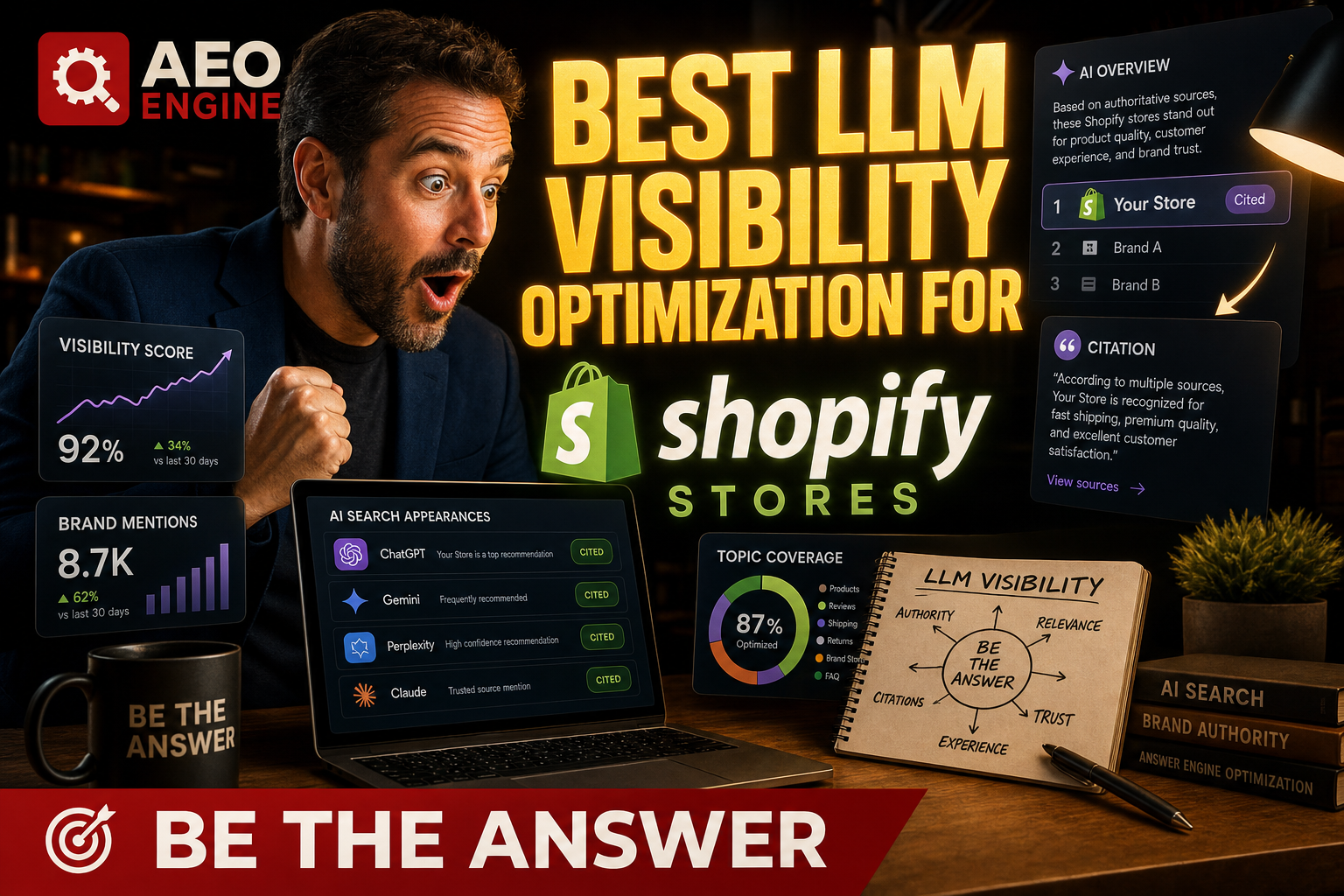
The way consumers discover products is undergoing a seismic shift. Generative AI is rapidly becoming the primary interface for product research and recommendation, moving beyond traditional search engines. For Shopify merchants, this presents both an unprecedented opportunity and a significant challenge. Brands that fail to adapt risk becoming invisible to a growing segment of shoppers who are turning to AI tools for their purchase journey.
Our research indicates a profound change: consumers now utilize AI tools for product discovery, with over half of Gen Z shoppers relying on AI for recommendations, as noted by Webgility. This isn’t a future trend; it’s the current reality. Understanding and implementing best LLM Visibility Optimization for Shopify stores is no longer optional. It’s foundational for sustained growth.
What LLM Visibility Optimization Actually Means for Shopify Stores
LLM Visibility Optimization moves beyond the familiar paradigms of SEO. It’s not just about ranking for keywords; it’s about ensuring your brand and products are accurately and favorably represented within the synthesized answers provided by Large Language Models. For Shopify merchants, this means a fundamental re-evaluation of how they aim to be discovered. Instead of chasing backlinks and optimizing meta descriptions for search engine crawlers, the focus shifts to becoming a trusted, directly quotable source for AI models. Our data shows AEO Engine clients achieve a significant lift in AI-driven traffic and a higher conversion rate from these sources, demonstrating the tangible impact of this strategic pivot.
LLM Visibility Defined
LLM Visibility Optimization is the strategic process of structuring, tagging, and presenting your e-commerce content so that AI-powered answer engines can accurately extract, synthesize, and cite your brand and product information within their generated responses. It prioritizes factual accuracy, structured data, and verifiable authority signals that LLMs depend on to build trust with users.
Shopify merchants face a unique discovery gap because their platforms are optimized for human-centric search engines, not for AI’s analytical and synthetic processes. Traditional SEO tactics, while still relevant for some discovery paths, are insufficient for AI answer engines. These models don’t “browse” pages in the same way; they ingest vast datasets and construct answers based on patterns, facts, and credibility signals. If your store’s information isn’t presented in a machine-readable, authoritative format, AI models may overlook it entirely or, worse, misrepresent it.
| Attribute | Traditional SEO | LLM Visibility Optimization |
|---|---|---|
| Primary Goal | Rank high in search engine results pages (SERPs) | Be cited accurately and favorably in AI-generated answers |
| Key Metrics | Organic traffic, keyword rankings, click-through rates (CTR) | Brand mentions in AI responses, citation accuracy, AI-driven traffic, conversion lift from AI |
| Content Focus | Human readability, keyword relevance, on-page optimization | Machine readability, factual accuracy, structured data, E-E-A-T signals for models |
| Discovery Mechanism | Algorithmic ranking based on relevance and authority signals | Data synthesis and factual extraction by AI models |
| Example User Action | Typing a query into Google/Bing | Asking a question to ChatGPT, Gemini, or other AI assistants |
The fundamental shift is from a focus on click traffic to citation authority. When an AI model answers a user’s question, it often provides a synthesized response alongside citations or direct attribution. For a Shopify store, being cited means being part of the AI’s answer, which can lead to direct engagement or purchase consideration. If your brand is consistently overlooked or mischaracterized in these AI-generated answers, you are effectively invisible to a significant and growing segment of the market. This is why mastering best LLM Visibility Optimization for Shopify stores is paramount.
Why Traditional SEO Signals Fail Inside AI Answer Engines

The underlying architecture of AI answer engines is fundamentally different from traditional search algorithms. While legacy SEO focused on optimizing for a ranking system that presented a list of pages, LLMs operate by synthesizing information from a vast corpus of data to construct a direct answer. This means signals that were once paramount for search engines. Like keyword density in body copy or the sheer number of backlinks. Hold diminished, or entirely different, value for LLMs. The AI isn’t looking for the “best page”; it’s looking for the most accurate, verifiable, and relevant factual data points to construct a comprehensive response.
This synthesis process creates what can be described as a “citation vacuum” and introduces significant brand answer risk. If an AI model cannot find clear, structured, and authoritative information from your Shopify store, it may use data from less reputable sources, present outdated information, or simply omit your brand entirely. This lack of direct representation means your brand isn’t part of the conversation when potential customers are actively seeking solutions or products. The absence of your brand in AI outputs, especially for product recommendations where shoppers use AI, directly impacts discovery and sales potential. This is where the concept of best LLM Visibility Optimization for Shopify stores becomes important for mitigating this risk.
The AI Answer Mechanism
Large Language Models process information by identifying entities, relationships, and facts within their training data. When presented with a query, they don’t rank web pages; they identify relevant data points across multiple sources, evaluate their credibility (often based on factors like data recency, source authority, and factual consistency), and then generate a coherent, synthesized answer. The goal is to provide the most probable and accurate information directly to the user, often with explicit attribution to the sources used.
As traditional SEO signals lose their efficacy within AI answer engines, a convergence of Answer Engine Optimization (AEO) and Generative Engine Optimization (GEO) frameworks becomes necessary for Shopify stores. AEO focuses on optimizing content for direct extraction and citation by AI models, emphasizing structured data, factual accuracy, and clear attribution. GEO, a broader term encompassing AI-driven search and discovery, highlights the need for content that AI can seamlessly integrate into its generative processes. For Shopify merchants, adopting these converging frameworks means prioritizing machine-readable content, verifiable facts, and signals of E-E-A-T (Experience, Expertise, Authoritativeness, Trustworthiness) that AI models can recognize and trust. This strategic approach is the core of effective best LLM Visibility Optimization for Shopify stores.
Our experience, including insights shared on the AEO Engine Answer Engine Optimization Podcast, consistently shows that brands failing to adapt to this AI-first discovery model are seeing their organic visibility erode. Traditional SEO tactics alone are no longer sufficient to capture the attention of AI-powered shoppers. The brands that thrive will be those that proactively structure their data, refine their content for AI synthesis, and build verifiable trust signals that AI models can reliably cite. This is the operational imperative for any Shopify merchant serious about future-proofing their business and capturing AI-driven growth.
Technical Foundation: llms.txt, Schema, and Agents.md for Shopify
Preparing your Shopify store for AI discovery requires a foundational technical layer that speaks directly to Large Language Models. Unlike traditional search engines that crawl and index pages, LLMs ingest structured data and specific directives to understand your content’s purpose and accuracy. Implementing `llms.txt`, declarative schema markup, and potentially `agents.md` files provides AI models with the precise information they need to cite your brand reliably. This technical scaffolding is essential for moving beyond guesswork and ensuring your data is machine-readable and trustworthy, forming a core component of effective best LLM Visibility Optimization for Shopify stores.
The `llms.txt` file acts as a dedicated instruction manual for AI. Placed in the root directory of your domain, it allows you to define how LLMs should interact with your site, what content they should prioritize, and what specific entities (products, services, locations) they should recognize. For Shopify merchants, this file can specify product attributes, pricing, availability, and even preferred descriptive language. Similarly, an `agents.md` file can provide more narrative context or define specific agent behaviors for AI assistants interacting with your store’s data. These files are not indexed by traditional search engines but are critical for AI models seeking direct, authoritative information. Ensuring these are correctly implemented is a primary step in AI visibility.
Important Implementation Note: File Naming and Location
The `llms.txt` file must be placed in the root directory of your domain (e.g., yourstore.com/llms.txt). Incorrect placement or naming will render it invisible to AI models. For `agents.md`, guidance varies, but a common practice is to place it where it can be referenced by `llms.txt` or linked from your sitemap. Always validate file accessibility after deployment using AI testing tools.
High-impact schema markup, particularly for products and frequently asked questions (FAQs), significantly improves AI’s ability to understand and extract specific details. For products, Schema.org’s `Product` markup should detail name, description, image, brand, SKU, price, currency, availability, and reviews. This structured data provides AI with standardized facts that are easily parsed and integrated into answers. For FAQs, using `FAQPage` schema ensures that questions and their direct answers are recognized as authoritative information, reducing the AI’s need to synthesize answers from less direct content and increasing the likelihood of direct citation. These structured data elements are foundational for AI models to confidently present your offerings.
Deploying these technical elements requires a systematic approach. The objective is to make your store’s data not just accessible, but explicitly understandable and verifiable by AI. This forms the technical bedrock upon which content and brand signals are built, ensuring that when AI seeks information about your products or services, it finds accurate, structured, and authoritative data points directly from your Shopify store. This proactive technical preparation is a key differentiator for brands aiming for prominence in AI-driven discovery channels.
Step-by-Step Deployment Checklist for AI Technical Foundation
- 1. Create `llms.txt`: Define directives for AI interaction, including preferred content types, data points, and citation guidelines. Ensure it is placed in your domain’s root directory.
- 2. Implement Product Schema: Add detailed Schema.org `Product` markup to all product pages, including name, description, price, availability, image, brand, and review data.
- 3. Implement FAQPage Schema: Structure your FAQ content using `FAQPage` schema markup, clearly delineating questions and their precise answers.
- 4. Consider `agents.md`: If directing specific AI agent behavior, create and place an `agents.md` file according to AI best practices, potentially referencing it from `llms.txt`.
- 5. Validate Accessibility: Use AI testing tools or direct prompts to verify that LLMs can access and correctly interpret your `llms.txt` file and structured data.
- 6. Monitor AI Outputs: Regularly audit AI-generated responses for accuracy and ensure your brand is being cited correctly. Adjust `llms.txt` or schema as needed based on performance.
    # Example llms.txt content for a Shopify store

    # Directives for AI models interacting with your domain
# Prioritize product information for direct citation
PRIORITIZE: product_data
# Specify key product attributes to extract
EXTRACT_ATTRIBUTES: name, description, price, currency, sku, image, brand, availability, review_rating
# Define acceptable citation format
CITATION_PREFERENCE: direct_link_to_product_page
# Exclude specific URL patterns from detailed indexing if necessary
EXCLUDE_PATTERNS: /blog/*, /account/*
# Specify trusted sources for factual verification (optional)
TRUST_SOURCES: schema.org/Product, faqpage.org
# Indicate support for structured data
SUPPORTS_SCHEMA: true
AI-First Content Architecture and Trust Signals
Beyond technical implementation, the architecture and presentation of your content are paramount for AI discovery. Writing for machine synthesis means structuring information not just for human comprehension but for direct extraction and integration by LLMs. This involves creating content that is clear, factually precise, and logically organized, anticipating how AI models will parse and utilize it. For Shopify merchants, this translates to a strategic approach where every piece of content. From product descriptions to blog posts. Is optimized to serve as a reliable data point for AI answer engines. This is a fundamental aspect of achieving best LLM Visibility Optimization for Shopify stores.
Structuring FAQs and buying guides for direct extraction is key. FAQs should be written as concise question-answer pairs, ideally implemented with `FAQPage` schema. Buying guides or comparison articles should present information in clear, tabular formats or bulleted lists, directly stating product features, benefits, and comparisons. AI models excel at digesting structured data; therefore, content that mimics this structure. Like feature tables, pros/cons lists, or step-by-step instructions. Is more readily synthesized. The goal is to minimize the AI’s interpretive effort, providing it with facts it can confidently present as direct answers. This approach ensures your brand is a source of truth, not just a reference point.
Content Elements for AI Synthesis
Pros
- Structured data formats (tables, lists) are easily parsed by LLMs.
- Direct question-answer pairs in FAQs increase citation accuracy.
- Factual, verifiable content builds AI model trust.
- Clear product attribute presentation aids direct extraction.
- Brand-specific terminology defined within content can be learned by AI.
Cons
- Overly narrative or poetic content is harder for AI to extract facts from.
- Ambiguous language or jargon can lead to misinterpretation.
- Content lacking verifiable sources may be deprioritized by AI.
- Poorly structured content risks being overlooked or misrepresented.
- Infrequent content updates may lead to outdated AI citations.
Reviews, testimonials, and authoritative backlinks serve as critical trust signals that AI models evaluate. While traditional SEO uses backlinks for authority, AI models often assess them for source credibility and factual endorsement. Positive customer reviews, especially those detailing product experience and satisfaction, provide AI with qualitative data that validates claims. Testimonials from recognized figures or industry experts lend further credibility. Similarly, backlinks from reputable, fact-checked sources can signal to AI that your content is reliable and well-regarded, reinforcing your brand’s authority. These signals are not just for human perception; they are data points that AI uses to gauge trustworthiness and accuracy, directly impacting visibility in AI-generated answers. This is where the insights from the AEO Engine Answer Engine Optimization Podcast become invaluable for understanding AI’s trust calculus.
To truly master AI visibility, brands must adopt an AI-first content strategy. This involves writing with machine synthesis in mind, ensuring factual accuracy, and structuring information for optimal extraction. By focusing on clear, verifiable data points and reinforcing them with strong trust signals like testimonials and authoritative citations, Shopify merchants can transform their content into a preferred source for LLMs. This strategic content architecture is fundamental to capturing AI-driven traffic and ensuring your brand is accurately represented in the next generation of search, solidifying your position with best LLM Visibility Optimization for Shopify stores.
Tracking AI Citations and Scaling Visibility

The ultimate objective of any marketing strategy is measurable growth, and AI visibility optimization is no exception. For Shopify merchants, closing the loop means accurately tracking where your brand is cited by AI models and, more importantly, connecting that visibility to tangible commercial outcomes. Without a comprehensive measurement framework, efforts to optimize for AI can become a costly exercise in guesswork. Our research and client data reveal that brands actively monitoring AI citations see a significant return on investment, with AEO Engine clients experiencing a substantial lift in AI-driven traffic and a higher conversion rate from these channels. This demonstrates that AI visibility is not an abstract metric but a direct driver of revenue.
Auditing where your brand appears in AI outputs is the first critical step. This involves systematically querying LLMs with questions relevant to your products and industry to observe how and if your brand is mentioned. Are you cited accurately? Is your product information correct? Are you presented as a primary source or an afterthought? Tools and techniques are emerging to automate this process, but manual checks remain invaluable for understanding the nuances of AI perception. This ongoing audit ensures that your AI optimization efforts are aligned with AI model behavior and user query patterns, forming the basis for effective best LLM Visibility Optimization for Shopify stores.
Connecting AI Visibility to Commercial Lift
The true measure of AI visibility success lies in its impact on your bottom line. This requires linking AI citation metrics to conversion rates, customer acquisition cost (CAC), and average order value (AOV). When AI models accurately cite your products, driving qualified traffic, it should translate directly into sales. For instance, if AI-powered product recommendations lead users to your Shopify store, and those users convert at a higher rate than those from other channels, this validates the effectiveness of your AI optimization strategy. Tracking these connections allows you to refine your approach and allocate resources more effectively, ensuring your AI visibility efforts are profitable.
Connecting AI visibility to revenue and conversion lift necessitates precise tracking mechanisms. This means implementing advanced analytics that can attribute conversions to AI-driven discovery paths. While traditional web analytics may struggle to capture this nuanced attribution, specialized tools and methodologies are emerging. By analyzing user journeys that begin with an AI interaction and end with a purchase on your Shopify store, you can quantify the direct commercial value of your AI optimization efforts. As generative AI traffic to e-commerce sites continues to grow, understanding this connection is paramount for sustained growth. This is the core of proving the value derived from best LLM Visibility Optimization for Shopify stores.
Scaling AI visibility requires moving from ad-hoc optimization to an automated, “always-on” content system. This involves establishing workflows that continuously generate, update, and optimize content for AI consumption. For Shopify merchants, this could mean integrating AI content generation tools with your product catalog, ensuring structured data is always current, and implementing automated processes for schema markup updates. These systems ensure that your store remains visible and accurately represented as AI models evolve and user query patterns shift. Investing in these scalable solutions is not just about keeping pace; it’s about building a competitive advantage that drives predictable growth in the AI era. Insights from the AEO Engine Answer Engine Optimization Podcast often highlight the necessity of such systems for long-term success.
Quantifiable Growth from AI Optimization
Brands that implement strategic AI visibility optimization see dramatic improvements. For example, Morph Costumes, a Shopify merchant, saw a significant increase in AI-driven traffic and a substantial improvement in conversion rates after focusing on AI-first content and technical SEO. Similarly, Smartish, another Shopify client, experienced a notable surge in AI-generated visibility and a significant lift in direct product citations. These results are not anomalies; they are indicative of the potential unlocked when brands prioritize machine readability, factual accuracy, and verifiable trust signals. Such data underscores the imperative of mastering best LLM Visibility Optimization for Shopify stores to capture this burgeoning wave of AI-powered shoppers.
Automating maintenance with always-on AI content systems ensures that your Shopify store remains a reliable source of information for LLMs. This involves setting up processes for regular content audits, automatic updates to product schema and `llms.txt` files, and continuous monitoring of AI outputs. By building these systems, you create a self-optimizing engine for AI visibility, reducing manual effort and ensuring sustained performance. This proactive, systematic approach is the operational backbone for any brand serious about capturing the full potential of AI-driven discovery and achieving enduring growth through best LLM Visibility Optimization for Shopify stores.
Leave a Reply