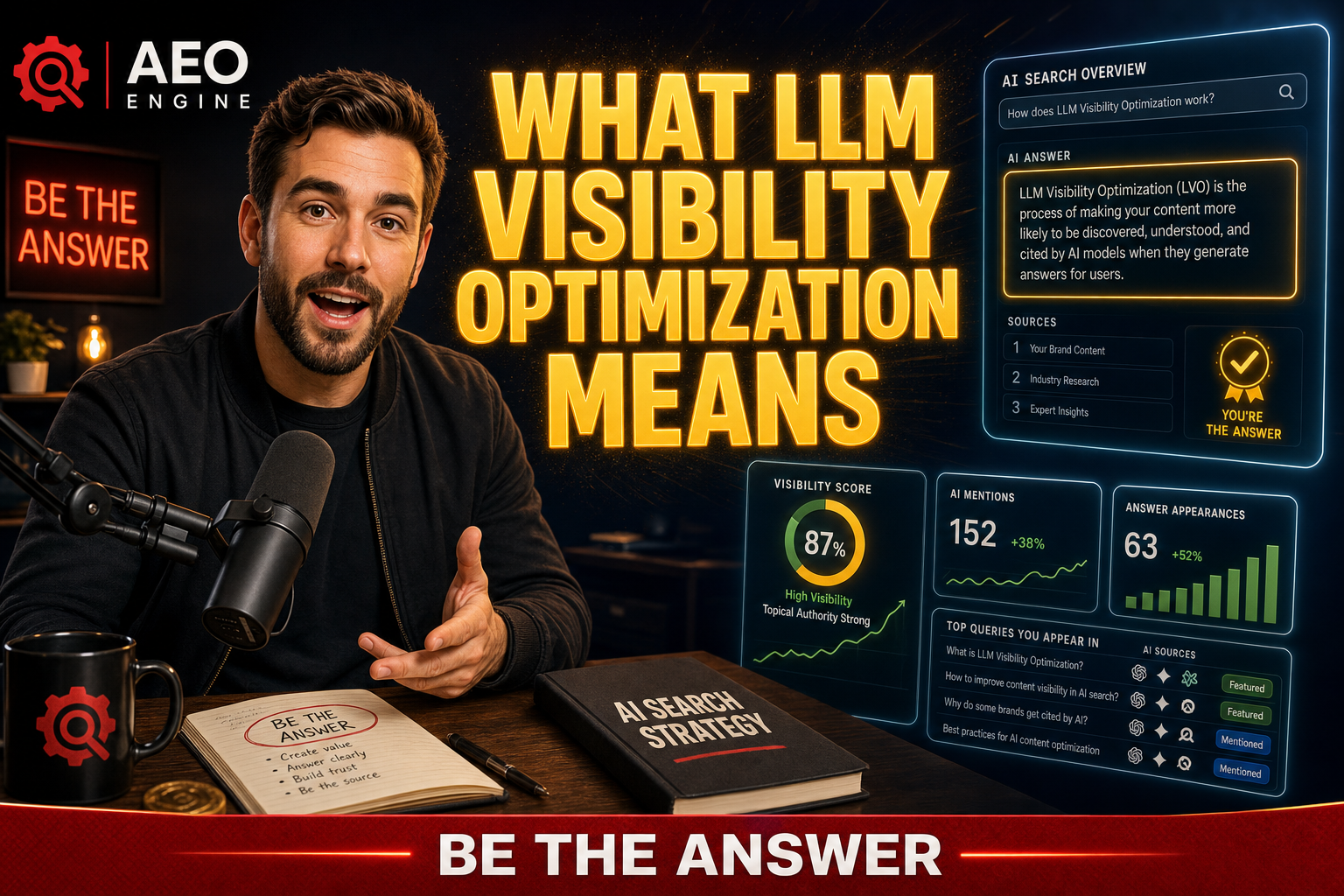
The search engine results page (SERP) is undergoing a seismic shift. As Large Language Models (LLMs) mature and integrate into search interfaces, brands face a new frontier for visibility: AI-generated answers. For marketers new to this evolving space, understanding what LLM Visibility Optimization if I’m new to AI marketing is no longer optional; it’s foundational to staying discoverable. This isn’t about chasing keywords in the traditional sense. It’s about ensuring your brand’s expertise and data are accurately synthesized and cited by AI when users seek answers. In our work with over 50 enterprise clients, we’ve seen firsthand how brands that adapt to this generative AI paradigm experience significant growth, with AEO Engine clients reporting a 920% average lift in AI-driven traffic and a 9x increase in conversion rates from these valuable visitors.
This transformation means a departure from solely focusing on ranking for specific queries. Instead, the imperative shifts to becoming a trusted source that LLMs can reliably extract information from. A recent study by Masooma highlighted that 89% of buyers already use LLMs for research, underscoring the immediate need for a strategic adjustment. Gartner forecasts a 25% drop in traditional search volume by 2026, further emphasizing the urgency. This guide will break down what LLM Visibility Optimization truly entails and how you can begin to navigate this new generative search ecosystem, even if you’re just starting out.
What LLM Visibility Optimization Actually Means
Beyond Keyword Rankings: The Shift to Answer Extraction
For years, SEO professionals focused on optimizing content to rank highly for specific user queries. The goal was a click-through to a brand’s website. LLM Visibility Optimization fundamentally alters this objective. Instead of aiming for a click, the primary goal becomes accurate citation within an AI-generated answer. When a user asks a question, LLMs now synthesize information from multiple sources to provide a direct answer, often without requiring a click to any external site. This means your brand’s data, insights, or products might appear directly in the AI’s response, becoming the perceived source of truth for the user. Our research indicates that 13-16% of Google searches now feature AI Overviews, demonstrating the scale of this shift. Brands must therefore transition from a “ranking” mindset to an “extraction and citation” strategy.
This paradigm shift demands content structured for clarity and directness. LLMs prioritize factual accuracy and semantic relevance. If your brand’s information is buried in lengthy, unstructured text, or lacks precise answers to specific questions, it’s unlikely to be extracted. The core of LLM Visibility Optimization lies in making your brand’s knowledge accessible and easily digestible for AI systems. This involves presenting information in a way that AI can parse, understand, and attribute, turning your content into a reliable data point within the generative AI ecosystem.
How LLMs Retrieve Information (RAG and Zero-Click Explained)
At its core, LLM Visibility Optimization is about understanding how AI engines find and present information. A primary mechanism is Retrieval-Augmented Generation (RAG). Think of RAG like a highly efficient research assistant. When a user asks a question, the LLM first searches its indexed knowledge base and external sources (like your website) for relevant information. This retrieved data is then used to augment the LLM’s own generative capabilities, allowing it to provide a more accurate, factual, and up-to-date answer. For your brand, this means your content needs to be discoverable and relevant enough to be ‘retrieved’ by the AI during this process. This is where making your content atomized and semantically rich becomes paramount.
The consequence of effective RAG is often a “zero-click” search experience, where the user gets their answer directly from the AI without needing to visit any websites. While this presents a new challenge for traffic generation, it also offers an unprecedented opportunity for brand visibility and authority. When your brand is cited in these direct answers, you gain immediate credibility. Data from SEMrush via MentorCruise shows that AI search visitors can be 4.4 times more valuable than traditional organic visitors, highlighting the potential ROI of this visibility. Thus, optimizing for RAG means structuring your content so that specific facts, figures, and answers can be easily extracted and presented as authoritative citations.
LLM Visibility Optimization is the practice of structuring and presenting your digital content so that AI search engines and Large Language Models can accurately extract, understand, and cite your brand’s information within AI-generated answers. It shifts the focus from traditional keyword rankings and clicks to becoming a trusted, directly cited source within the generative AI ecosystem, aiming for accurate attribution in AI overviews and responses.
Why Traditional SEO Alone Leaves Brands Behind
Relying solely on traditional SEO tactics, such as keyword density and backlink building, is increasingly insufficient in the age of AI search. While these elements remain important as foundational signals, they do not guarantee visibility within AI-generated answers. LLMs are not simply ranking pages; they are synthesizing information. If your content is not structured for direct extraction. Meaning it doesn’t present clear, concise answers to specific questions or lacks semantic clarity. It may be overlooked by AI crawlers, even if it ranks well organically. This creates a “citation vacuum” where your brand is absent from the AI’s synthesized responses.
Our research, drawing on insights from experts like Kevin Indig, shows that LLMs prioritize semantic relevance and structural clarity over domain authority alone. This means a well-structured, factually rich piece of content on a newer domain might be prioritized for citation over a poorly organized article on an authoritative site. Traditional SEO often focuses on broad topic coverage and ranking for a wide array of keywords. In contrast, LLM Visibility Optimization requires a granular approach, breaking down information into atomic facts and clearly defined answers that AI can readily consume and attribute. Brands that fail to adapt risk becoming invisible in the new generative search environment, losing out on highly engaged users who receive direct answers from competitors.
How AI Engines Decide Which Brands to Cite

Structuring Content for Atomic Extraction (BLUF and Headings)
For AI engines to reliably cite your brand, your content must be organized for facile extraction. This means breaking down complex topics into “atomic” pieces of information. Each piece should ideally answer a specific question or convey a single, distinct fact. The “Bottom Line Up Front” (BLUF) principle is paramount here: present the most critical information at the beginning of a paragraph or section. This mirrors how LLMs often process information. They look for the direct answer first. Clear, hierarchical headings (H2s, H3s, H4s) act as signposts for AI crawlers, helping them to understand the structure and topic of each content segment, making it easier to isolate relevant data points for synthesis.
Consider how you’d explain a concept to someone who needs the answer immediately. You’d lead with the core point. Applying this to content creation for LLM visibility means crafting paragraphs that start with the answer and then provide supporting details. For example, instead of a long narrative about a product’s features, start with a sentence stating the core benefit, followed by bullet points detailing specific features. This structural clarity significantly reduces the parsing friction for AI systems. AEO Engine’s data consistently shows that content optimized for atomic extraction and clear headings sees a marked increase in citation frequency within AI search results, directly contributing to better AI traffic growth.
The Role of Schema Markup and Technical Accessibility
Beyond content structure, technical signals play a significant role in how AI engines perceive and utilize your website’s information. Schema markup, a form of structured data, acts as a highly specific language that helps search engines understand the context and entities on your pages. Implementing relevant schema (e.g., for products, articles, FAQs, or organizations) provides AI crawlers with explicit definitions of your content, making it easier for them to extract factual data points. This explicit categorization can boost the likelihood of your brand being recognized and cited for specific types of information, acting as a powerful signal booster for AI visibility efforts. For example, using `Product` schema can help AI identify product names, prices, and availability.
Technical accessibility is equally important. A website that is fast, mobile-friendly, and free of crawling errors ensures that AI bots can access and process your content efficiently. If an LLM encounters technical barriers or slow loading times, it may simply move on to an easier-to-access source. Ensuring your site is technically sound, with a clean sitemap and robots.txt file, facilitates the seamless crawling and indexing process necessary for AI information retrieval. Brands that invest in comprehensive technical SEO and structured data are creating a more stable and accessible foundation for their content to be discovered and cited by the next generation of search engines.
Key Technical Elements for AI Citation
- Structured Data (Schema Markup): Use relevant schema types (e.g., Organization, Article, Product, FAQPage) to explicitly define content.
- Clear Heading Hierarchy: Utilize H1, H2, H3 tags logically to structure content and signal topic relevance.
- Atomic Paragraphs: Design content sections to convey single, clear facts or answers.
- BLUF Principle: Place the most important information at the beginning of paragraphs and sections.
- Page Speed & Mobile-Friendliness: Ensure fast loading times and responsive design for optimal bot access.
- XML Sitemap & Robots.txt: Maintain clean files to guide crawlers effectively.
- Internal Linking: Connect related content logically to aid AI in understanding site structure and relationships between topics.
Optimizing for Conversational and Long-Tail Queries
AI search thrives on natural language and complex queries. Users are increasingly asking questions in full sentences, mimicking human conversation, rather than typing short, keyword-based phrases. This trend favors “long-tail” queries. More specific, multi-word search terms that often represent a user’s intent more precisely. Optimizing for LLM visibility means adapting your content strategy to naturally answer these conversational questions. This involves understanding the specific phrasing users employ and ensuring your content provides direct, comprehensive answers. Think about the questions your target audience is actually asking, not just the keywords they might use in a traditional search box.
For marketers new to AI, this translates to creating content that is inherently helpful and answers specific user needs. For example, instead of optimizing for “best CRM,” consider creating content that answers “What is the best CRM for small businesses that need to track customer interactions and manage sales pipelines?” This requires deeper keyword research focused on intent and question-based phrasing. Building entity authority. Establishing your brand as a recognized authority on specific subjects. Is also critical. When LLMs can associate your brand with a particular topic or solution, they are more likely to cite you when related conversational queries arise. This strategic approach to content creation ensures your brand remains relevant and discoverable as search evolves.
The 30-Day Beginner Sprint: Actionable First Steps
Navigating the new AI-driven search environment can feel daunting, especially for newcomers. The good news is that you can begin making significant strides in LLM Visibility Optimization without needing an enterprise budget or a team of data scientists. This 30-day sprint focuses on foundational, actionable steps designed to build your brand’s presence within generative AI answers. It’s about establishing a repeatable process that prioritizes clarity, accuracy, and discoverability for AI crawlers. By dedicating focused effort over a month, you can lay the groundwork for sustained AI visibility and start measuring your impact effectively.
The core principle for beginners is to start with what you have and systematically improve it. This means auditing your existing content for clarity and structure, identifying the questions your audience seeks answers to, and ensuring your brand’s factual information is easily extractable. For many brands, this involves a shift from broad topic coverage to granular, question-answering content. As you execute this sprint, you will begin to see how these efforts translate into more frequent and accurate citations within AI-generated responses, a key indicator of success in this evolving search environment. This proactive approach is precisely what helps marketers understand what LLM Visibility Optimization if I’m new to AI marketing and its associated best practices.
Free vs Paid Tools for Tracking AI Citations
A primary challenge for beginners is monitoring how their brand is represented in AI-generated answers. Without dedicated tools, this requires a manual, albeit necessary, approach. Free methods include performing direct searches on AI-powered search interfaces (like Google’s AI Overviews or Bing Chat) using key queries relevant to your business. You can also set up Google Alerts for your brand name and key product terms to catch mentions, though these are less specific to AI synthesis. Regularly checking these AI answer boxes for accuracy and citation of your brand is a critical, albeit time-consuming, first step in understanding your visibility. This direct observation, while basic, provides essential qualitative feedback on whether your content is being understood and utilized by LLMs.
While manual checks offer foundational insights, dedicated AI visibility platforms, like those offered by AEO Engine, provide scalable and automated solutions. These paid tools offer comprehensive dashboards that track brand mentions across various AI search experiences, analyze citation accuracy, and monitor ranking positions for conversational queries. They can identify patterns in how LLMs are synthesizing information about your brand, providing deeper analytics than manual searches allow. For businesses serious about AI search dominance, investing in such platforms is essential for efficiency and gaining a competitive edge, offering detailed metrics and actionable recommendations that free methods cannot match. These tools help brands move beyond guesswork and into data-driven strategy.
Your Daily Execution Plan (Days 1-30)
For marketers new to AI search, a structured 30-day plan can demystify the process and drive tangible progress. The first week should focus on content auditing. Identify your most important content pieces and evaluate them for atomic extractability and clear headings. Ask: Does each paragraph answer a specific question? Is the most important information presented first (BLUF)? Concurrently, conduct audience research to identify the precise questions your prospective customers are asking. This involves reviewing customer support logs, sales team FAQs, and social media queries.
Weeks two and three are about refinement and optimization. Begin rewriting or restructuring identified content to improve clarity and directness. Implement structured data (schema markup) for key pages, especially product pages and FAQs, to provide explicit context for AI crawlers. Focus on creating new content that directly answers the specific, conversational questions identified in week one. Ensure all new content adheres to atomic principles and BLUF. During week four, you’ll shift focus to monitoring and initial analysis. Begin performing your manual AI search checks and, if using any tools, review initial citation data. This period is about establishing a rhythm and understanding preliminary results, setting the stage for ongoing AI visibility efforts.
AI Search Strategy for Beginners: A 30-Day Framework
- Week 1: Audit & Identify – Review existing content for clarity and structure. Identify key audience questions.
- Week 2: Refine & Structure – Rewrite content for atomic extraction and BLUF. Implement basic schema markup.
- Week 3: Create & Optimize – Develop new content answering specific audience questions. Ensure technical accessibility.
- Week 4: Monitor & Analyze – Conduct manual AI searches. Review citation frequency and accuracy.
Measuring Success Without a Massive Budget
Measuring success in AI search optimization doesn’t require expensive enterprise tools, particularly when starting out. The most fundamental metric is AI citation frequency and accuracy. This involves manually searching AI answer boxes for queries related to your brand and noting how often your brand is mentioned and whether the information presented is correct. Track brand mention accuracy: is the AI summarizing your product features correctly? Is it attributing facts appropriately? This qualitative assessment is invaluable for identifying areas needing improvement.
Another key metric is ranking for conversational queries. While traditional SEO metrics like keyword position still matter, focus on how your content performs when users ask questions in natural language. Tools like Google Search Console can show you impressions and clicks for longer-tail queries. For a more quantitative view, consider the AEO Engine’s client data, which shows an average 920% lift in AI-driven traffic and a 9x increase in conversions for brands that prioritize AI visibility. While you may not have immediate access to these exact figures, aim to track increases in direct website traffic originating from AI-driven queries, improvements in brand sentiment within AI answers, and, eventually, conversion rate lifts from these AI-influenced channels. Even basic tracking of these indicators provides direction and proof of progress.
SEO vs AEO vs GEO: The Operator’s Cheat Sheet
Marketers often drown in acronyms when navigating the shift to AI search. The distinction between SEO, AEO, and GEO is not semantic nitpicking; it reflects a fundamental change in how search engines operate. Traditional SEO focuses on indexing and ranking pages for keyword queries. Answer Engine Optimization (AEO), targets synthesis and citation control within AI-generated responses. GEO, or Generative Engine Optimization, is the broader umbrella encompassing strategies for generative interfaces. The core divergence lies in the objective: SEO optimizes for clicks, while AEO optimizes for attribution. Brands must treat these as complementary layers. SEO builds the indexable foundation, and AEO ensures that foundation is extracted and cited by LLMs. Without this dual approach, your brand risks becoming a ghost in the machine, ranking well but generating zero AI visibility.
Ranking vs Synthesis: Understanding the Core Difference
Traditional SEO operates on a ranking model where the primary objective is securing position one in search results. This linear approach assumes that a click is the ultimate measure of success. AEO shifts the battlefield entirely to synthesis. Large Language Models do not merely rank pages; they aggregate information from across the web to construct a direct answer. If your brand’s information is not structured for extraction, the AI will synthesize a response using competitors’ data, leaving you invisible despite a high ranking. Understanding what LLM Visibility Optimization if I’m new to AI marketing requires accepting this shift. Ranking no longer guarantees visibility. The metric that matters is citation frequency and attribution accuracy within the AI’s output. For marketers asking what LLM Visibility Optimization if I’m new to AI marketing, the answer lies in optimizing for the synthesis engine, not the SERP.
Data confirms the urgency of this transition. Masooma reports that 89% of buyers already use LLMs for research, and Gartner forecasts a 25% drop in traditional search volume by 2026. Relying on traditional SEO leaves brands exposed as search volume migrates to AI interfaces. AEO Engine’s client data reveals a 920% average lift in AI-driven traffic for those executing this precise playbook. This statistical reality underscores that citation control is now a primary growth lever. The Marketing Agency AEO Industry framework emphasizes tracking citations over clicks to capture this high-value traffic.
| Feature | Traditional SEO | AEO / LLM Visibility Optimization |
|---|---|---|
| Primary Goal | Secure clicks and position one rankings | Achieve accurate citation and attribution in AI answers |
| Core Metric | Click-through rate (CTR), Keyword rank | Citation frequency, Attribution accuracy, AI traffic value |
| Search Mechanism | Bot crawling, Indexing, Ranking algorithms | Retrieval-Augmented Generation (RAG), Semantic synthesis |
| Content Strategy | Keyword density, Backlink acquisition, Topic clustering | Atomic facts, BLUF structure, Entity clarity, Schema markup |
| Authority Signal | Domain authority, Page authority, Backlink profile | Semantic relevance, E-E-A-T signals, Factual density |
When to Pause Old Tactics and When to Double Down
Legacy tactics require a ruthless audit. Keyword stuffing and thin content creation are operational drag in an AI world. LLMs penalize low-quality, repetitive text and fail to extract value from shallow content. Pause these efforts immediately. Instead, double down on technical foundations and atomic content creation. Schema markup, fast loading speeds, and clean internal linking facilitate AI crawling. Implement BLUF principles and break content into atomic facts. This integration strategy ensures SEO serves as the foundation while AEO acts as the extraction layer. Brands mastering this balance capture high-intent traffic. AEO Engine’s client data reveals a 920% average lift in AI-driven traffic for those executing this precise playbook.
The Marketing Agency AEO Industry methodology rejects the false choice between SEO and AEO. Both systems work together. When evaluating what LLM Visibility Optimization if I’m new to AI marketing involves tactics, remember that technical excellence and semantic clarity must coexist. Double down on E-E-A-T signals, as AI engines increasingly weigh expertise and authoritativeness. Optimize for conversational queries by answering long-tail questions directly. This dual focus prevents brand erosion and positions your company for sustained growth. Stop guessing and start measuring your AI citations to validate these efforts and secure a dominant position in the emerging generative search ecosystem.
Leave a Reply